
collection1b

August 23, 2015
Vintage Pen Shows Again
[Posted on L&P on Oct 2-8, 2008, and Jan 26, 2014.]
Perhaps it might be time to have exclusively vintage pen shows again, you know, pen shows that are more like the pen shows of yore. They could be more like conventions of PCA-Pennant, WES, Pentrace, Zoss, Stylophiles, acp-p, FPN, and L&P users and members and subscribers. All modern pen dealers would be excluded, except as vintage pen collectors and dealers. These shows would be more like conferences of pen historians and scholars, and serious collectors with well-advanced collections, and places for new collectors to meet with these people and pick their brains. They could even be organized around visits to a pen company archive, like the visit that John Mottishaw put together for the PCA at the Parker archives in May 29-30, 1992 in Janesville, but with at least one day set aside for pen trading and selling. I have fond memories of that visit.
In the past, some of the best pen shows I have attended were held in conjunction with the Inkwell Collectors. At one of these double shows, the one in Houston, I had an opportunity to visit with two local collectors and view two world-class collections, one of pens and another of inkwells. We even started a tradition of a good old Texas barbeque at one of these meetings. These new shows could either have two separate display areas and auctions, or one large common display area and auction. Something like this already goes on at pen shows when all the Zossers, or Pentracers get together and wear identifying badges, so that they can find one another.
David Nishimura wrote, “Yes, indeed. As I wrote back in 1999 in “Rethinking the Pen Show”, a vintage-only show could be much cheaper to run and to participate in. And the idea of joint shows with similarly-minded collectors in sibling fields is excellent. One of the great pitfalls of collecting in the online world is the tendency towards tunnel vision: one searches by keywords and bookmarks, largely eliminating the serendipitous discoveries of real-world antiquing, just as browsing online is so different from a visit to a real bookstore. Combined shows would facilitate that sort of lateral expansion of collecting interests that used to occur regularly, often as a result of conversations struck up with dealers and collectors over intriguing but unfamiliar objects spotted at general antiques shows.
“And as I’ve said again and again, pen collectors really need to spend more time looking at how other fields of collecting run their events. Field trips to major collections, factory tours, and historical site visits are routine features of other shows that we just don’t get at pen shows. Ditto for space set aside at no or reduced cost for collections to be exhibited—or even contests for the best collection displayed.”
And I wrote, “Yes, and the exhibitors should be the only ones to vote for the best-of-show, deciding amongst themselves who would be their choice for master pensmith at that show. And the prize or award could be a copy of the P. F. C. Honor Roll medal.
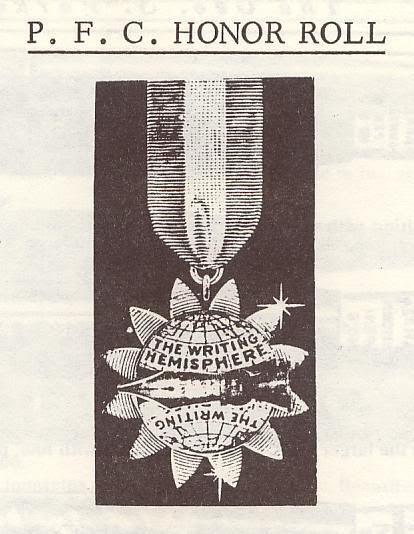
“If someone wants to arrange a vintage pen show in his or her home town—and the duties of holding such shows could rotate between several people and different cities—just let me know the time and the place, and I’ll be there. I wouldn’t miss it. I remember the first pen show I attended. When I entered the show room, I levitated a foot off the floor, and just floated around the show for the rest of the weekend singing “I’m in heaven”. I didn’t come back down until the plane landed back at home, and then reality started to set in again.
“I even tinkered with and repaired pens in the airport layovers. At other shows I bumped into Susan Wirth, and Doug Berg, and the Lotts, and Jim Nahrwold, and many of the Minneapolis collectors, and we went to the North West Airlines lounges and drank, and had mini pen shows, and talked more pens. David, you probably shared many a trip back home with Frank Dubiel. Now, that would be quite a seminar to sit in on as an observer, watching two pensmiths having a dialogue about pen repairs, or whatever else would come up. I remember a dinner at an LA Pen Show that I sat in on with a few lathemen including Paul Rossi, Chris Thompson, David Broadwell, and the guy who made pens from Ivory, and all they talked about was pen whirling. They told nothing but machine shop stories, and I, their willing audience, treated it as if they were telling the stories for my own personal pleasure and entertainment. It was great fun.”
John Chapman wrote, “I believe the Portland Pen show, in practice, comes close to being vintage-only. When I went two years ago, there were maybe 2 new-pen vendors, and they seemed very lonely. Mostly it was tables of vintage pens. I think I spent most of my time there digging through parts bins, and finding a few parts that I really needed, but I also put together a lovely two-banded Waterman #0614 from what I found. I even ran into a few reviews from the new-pen aficionados who were rather disappointed. Maybe it’s a place to start?”
And I wrote, “And last year, if I recall correctly, the Portland Pen Show was held, if not in conjunction with, and in the same facility as, then at least on the same weekend as the Inkwell Collectors’ show. You’re right, John, it’s a start. They’ve got the right idea there. And Columbus is also strong on vintage pens, and, to a lesser extent, so is Chicago, or at least they used to be. But these shows, along with LA and DC, are still heavily weighted to the modern pen, and they are still half-a-week-long affairs. And the NY show is no longer in NY. The people who attended the first pen shows started the hobby, and the people who continued to attend through the 80s and 90s made the hobby. But what we need now are shows like the first ones, something more like what David wrote about in his “Rethinking the Pen Show”, shows like the ones in London, and France, and Italy, and Germany, smaller shows held in smaller venues that are not necessarily tied in with the show hotel, but they should be held in major cities like NY, LA, and DC. The hotels can be used for the meetings and presentations over a weekend. All you need are 1-2 days, possibly 3, just enough for a show day, and for a day or two of seminars and colloquiums, and a couple of evenings for relaxed meals, perhaps catered dinners, and socializing at the hotel bar. That’s where all the networking happens anyway, and also where all the good stories are told!
“And some consideration should be given to those who bring portions of their collections for display, possibly with reduced table cost. Right now, most pen shows are not so much shows, but sales. The Wild Rose Antique Collectors Club in Edmonton holds an annual “Show & Sale” every spring, and they always reserve a certain numbers of booths for exhibitions and displays. There are a few laudable exceptions to the rule of sales-only tables in the history of pen shows. The Wash DC pen show used to have a vintage pen theme in its early days when Boris Rice and Bob Johnson were the co-promoters. In 1992, the show had the theme of the Parker Duofold, and Boris used the occasion of bringing out some Parker Duofold store-display show cases full of pens and pencils and desk sets and other ephemera. I always looked forward to and enjoyed the displays that Dr. Richard Barbee put on at the Chicago Pen Show. One year he had a display of a few hundred different pencil sharpeners from his collection, and another year it was nothing but Duofolds in vintage show cases. But one time when I was at his table getting the personal treatment, with a hands-on guided tour of the pens, some guy came along and asked the price for a pen. When he was told that the pens were on display only and not for sale, the guy rudely left in a great big “showy” huff. He wouldn’t even stop to look.
“And one of the nicest parts of the now-defunct Houston Pen Show was seeing the early Parker show cases full of early Parker filigree and overlay pens that Stan Pfeiffer would bring to the show for display. The other nice part of the show was staying over an extra day for a great beef barbeque that Stan held at his place, every year since 1995, on the Monday following the show. Not only did we get to see the rest of his collection at his home, but other people also started to bring substantive portions of their own collections for show-and-tell. On one occasion I recall that Michael Fultz brought several trays of rare, early hard rubber pens from his collection, now in the Sachs-Fultz Museum, that we handed around and looked at while Fultz gave an informal talk about the pens. Some of the autographs I collected on the occasion of that show weekend are in the above link. I also got the recipe for a great chicken salad sandwich from Pete Kirby’s 94-year-old grandmother, who was absolutely delighted that someone noticed the diced Granny Smith apple that gave a nice sour crispy crunch to her recipe, so she came down to the show to meet the guy who noticed it. Mmmm, yum, yum! both the pens and the salad.
“These are the kinds of things that stand out in my memory, not what’s new in new pens, and the newest shade of pink, or burgundy, or brown ink, and what pen you are carrying in your pocket and not using today.”
David Nishimura wrote, “And while we’re at it, don’t forget the displays at the Columbus show of selections from Dick Johnson’s collection, and Paul Sameth’s desk sets at DC. Credit where credit is due!
“For a while I was trying to organize a floating pen-scholars’ round table, where members would arrange to get together at a show and bring show-and-tell pieces relating to a given topic. or topics. I confess I didn’t keep up with the effort as much as was required, but the idea was sound and just takes a little more persistence than someone with three young children can muster.”
And I wrote, “I missed those displays of selections from Dick Johnson’s collection at the Columbus show because I didn’t get to that show, and my one big pen-collecting regret is that I didn’t attend that show more often. The one time that I did attend a Columbus show, I had to get to the airport at 4:30 AM for a flight at 5:30 AM that arrived at the Minneapolis hub just in time to miss the connection with the only early morning flight to Columbus, so I grudgingly booked my flight inspire of the long layover. I had to sit in that sterile airport the whole day waiting for the only late-afternoon flight that got me into Columbus about 8:PM, and into the hotel about 9:PM. So you can understand why I didn’t attend more often. To that particular show’s credit, however, I did find someone from Canada at the show who had two RHR Waterman’s #55 bandless caps without the groove machined into the lip, both from a large pen repairman’s stock of parts, and I talked him out of one of them. And as for Paul Sameth’s desk sets in DC, it was my understanding that all his desk sets were for sale, and not just on display, but I might be wrong. He kept complaining that his wife wanted him to downsize his desk set collection.
“By the time you were organizing those floating pen-scholars’ round tables, I had stopped attending pen shows, mostly to finish my pen patent book, but also because the shows had by then lost their luster for me. And travel across the border had also by then become more and more unpleasant and uneasy. Perhaps it’s time once again to consider organizing those round tables. By the way, when I show my book to anyone I call it “my baby”, and like you, I have a second and third one on the way.”
David Nishimura wrote, “Yes, the flight connections are not very convenient for Columbus. This year I managed to get a very cheap ticket from Providence, but it still takes nearly as long to get there as to go all the way to California, once layovers are factored in.
“Paul Sameth’s desk set displays at DC were usually in the entrance area, in glass display cases, and were clearly there as exhibits, not as sale items. Don’t confuse those displays with the sets he was selling, which were inside the room on tables with price tags.
“The idea for the round tables was very much rooted in the desire to remedy not only the loss of a central meeting point with the shift from shows to online forums, but also that very discontinuity between experienced and new collectors that has been discussed so extensively in this thread. At a typical show, there are always spontaneous conversations between serious collector-scholars—usually sitting behind a table, at the bar, or at a restaurant—which are fascinating and productive and completely invisible to those drawn instead to their favorite online celebrities, or fellow habitués of online forums. It seemed absurd that these conversations were taking place without anyone being able to listen in and benefit from them, and it seemed that they would be all the more beneficial if we arranged some topics ahead of time, so that relevant show-and-tell material could be brought along.
“As originally conceived, those specimens were brought by participants and put out in a display case prior to the session. If we were to start up these talks once again, however, I’d suggest that good digital photos be submitted instead, and presented using a projector. No reason not to bring the actual items as well, of course, but photos are really essential for a successful presentation with any sort of audience.”
Larry Allin wrote, “I would return to attending pen shows, if there were such a round table, especially if there were displays of ephemera. After a number of years trying many of the shows, I have pretty much given up on shows as a source of information about my interests. The esoteric nature of much of my collection—Inkograph Co. pens, Rexall house brands, and vintage Conway Stewart—makes for big expense for little payback, now that I have attended all the seminars and been exposed to most of the general info on pens and repair.
“For the past year, I have been researching Inkograph Co and its principal officers, but it is very slow going. I have never done any historical research, and my 30-years experience researching and implementing new IT technology doesn’t translate well to researching 50-100 year old products, people, and companies. I have been using libraries here in St. Louis, a national patent repository site, Chicago, both electronically and in-person, and NYC, electronically only, thus far.
“Pen shows offer little in the way of ephemera, except for the top-tier brands. I’ve decided to spend my travel money on Paper and Advertising Collector shows, rather than pen shows, in the hope that I might find ephemera to support my research. If there were a pen scholar’s gathering in North America, stand-alone, or show-within-a-show, I’d be there hoping to learn from those who have gone before, and thrilled to share my meager offerings.
“If enough pen scholar’s were interested in attending the one or two large paper ephemera shows, perhaps a special-interest-group could meet around those shows.”
David Nishimura wrote, “The Inkograph Co. suggests a seminar topic, more than one for a round table discussion, devoted to pen history research essentials. Alas, I am far from qualified to teach in this area, but there are others who certainly have the knowledge and experience—not all of them necessarily pen collectors. Many of the tools are those of the genealogist, and others pertain more to commercial and labor history, while yet others have to do with legal research.
“One further note as regards seminars and round tables. The usual pen show seminars are targeted at new collectors, so it really doesn’t matter much when they are held. Those of us who are active buyers, however, whether for ourselves, or for resale, or both, will not take time out from the hunt while the chase is still on. Scheduling of the sort of educational get-togethers that we need will have to take this into account. Although many show participants complain whenever there is the slightest curtailment of trading—some would go 24/7, it seems—I strongly believe that a successful vintage-focused show should have strict limits on trading hours. There must be enough time allocated for everyone to see everything, of course, but it is counterproductive to have each day’s trading session a needlessly gruelling marathon. Open the trading room up late enough to allow everyone to get breakfast, and close it up early enough to allow everyone to get a proper dinner. Quality trading time is what we need, but what we often get, especially in the evenings, is lots of dazed collectors aimlessly picking up and putting down the same pens over and over again, waiting, often as not, in vain, for someone to show up and throw some fresh bargains out on a table. Unless trading hours are restricted, it will be very difficult to get the sort of participation required for other activities, whether they be lectures, seminars, round-table sessions, or field trips.
“In this, other fields of collecting once again offer us a model. It would also be desirable to explain at length beforehand the hows and whys of this “new” arrangement, since there is sure to be some grumbling and resentment from those accustomed to the fundamentally laissez-faire approach taken by most show organizers to date.”
And I wrote, “Perhaps that should be the topic of the first seminar, or colloquium, that is, how we should set up these kinds of shows, and what kinds of “limits” to set up, and how we can “police” ourselves, in order to curtail all the diverse expectations that everyone will bring along with them to such an event.
“The first seminar could be a get-together planned to take place at another existing pen show, preferably a vintage-friendly pen show. And the next few seminars and colloquiums could be piggy-backed on other pen shows, until someone takes that bold leap into the past and arranges a pen show that recreates the old vintage-pen-show atmosphere, a pen show that comes back to being what they used to be like. That will be the eureka moment, when a group of like-minded people will come together in the realization that that is what a pen show should be like.
“And then maybe some people, including me, will come back to attending pen shows again.”
David Nishimura wrote, “I do think it is essential to keep in mind that while we may be seeking to recapture the best of the old atmosphere, we cannot get it by retaining the old structure. I also think that one should not assume that a new, vintage-only show would be an immediate success. I’d think that there would be two potential paths to take. The first would be to start very small indeed, something more along the scale of a club meeting, but coupled with other events—think of past visits to the Parker archives, the Hamburg hard rubber factory tour, etc. The other would be to shoot for something a bit larger, should the opportunity for a tie-in to take place—most likely, the dispersal of a major collection at auction, such as what happened with the Bouras sale.”
And I added on Jan 26, 2014, long after the fact, “I think we were having a roundtable right there on L&P, and we didn’t realize it”.
George Kovalenko.
.

August 20, 2015
Pen World early issues

[Posted on L&P on Sept 8, 30, Oct 1, 2008.]
A while ago I also “treated myself to a Pen World retrospective”, Vol.4, No.1, p.2, and looked through all the early issues, so here’s an appreciation of the magazine in its early, vintage-pen era.
What we’re dealing with here is the first four or five years, or volumes. The earliest issues looked like they were typeset and composed by the good, old-fashioned, analogue, scissors-and-glue-and-tape, cut-and-paste method, that is, they were composed by a typesetter on a typesetting machine rather than a computer operator using a desk-top publishing program. They were also full of typos.
The early issues were almost 95% about vintage pens, except for the new pen ads, and they actually mentioned the prices of pens. It’s almost unheard of today, but some of the articles were all words and no photos. They used words like “stylophile”, Vol.1, No.4, p.14, and precursors to the word “someguy”, same issue, p.30, in such phrasing as, “I sold it to some kid”, and “The big collector was here, you know, the doctor from Utah”. Various collectors wrote little cautionary fables about the abuses in pen collecting, Vol.3, No.1, p.27. There were lots of pictures of vintage pens in men’s shirt pockets, Vol.3, No.2, p.27. They published many pictures of their contributing writers and editors and fellow pen-show attendees who all looked so young. All the big pen collectors of today were still young whipper-snappers then who, either still had hair, or still had dark hair. There was Jonathan Steinberg, who styled himself as ‘Licensed To Quill’, looking much like Peter Sellars as the character Quilty in the film Lolita, Vol.1, No.3, p.19, and Ed Fingerman with a bushy mustache looking much like Groucho Marx in any Marx Brothers movie, Vol.4, No.4, p.18, and Glen Bowen looking very much like he still had “hair”, that is, he still wore a rug in those days, Vol.1, No.3, p.2. The magazine was like Zoss, alt.collecting.pens-pencils, The Ink Spot, Penlovers, Stylophiles, Pentrace, and Lion & Pen all rolled up into one.
And what an eye-opener! The only pens on the covers of the first three volumes were vintage pens, almost exclusively, except for Vol.2, No.4. After Vol.4, No.1 the magazine started the long slippery slide down the slope to new pens, and the long slouch towards bedlam. Modern pens crept in through the “Trends ‘N’ Pens” section, Vol.2, No.1, sort of as an aside to the main articles, but they slowly out-flanked the vintage pens and took over the articles in the main body. Vol.2, No.2 is the first issue with a non-pen-related article, an article on, you guessed it, watches! The first modern pen article appeared in Vol.3, No.1, p.14, and the first ballpoint article was in Vol.3, No.2, p.9. And how about the word “stylophile”? When was it first used? One of the earliest uses I was able to find was in Pen World, Vol.1, No. 4, the Summer 1988 issue, page 14. It was used by Art Maier to describe himself as a “Teacher, calligrapher, researcher, writer, stylophile”. The word simply jumps off the page!
The downfall coincided with the change over of the “editorial slant”, or “personality” from that of Glen Bowen to that of Nancy Olson between issues Vol.3, No.4 and Vol.4, No.1. They still continued publishing vintage pen company histories, and articles about vintage pen collectors. The best RHR issue is the one with the profile of Boris Rice as a collector, Vol.4, No.5. The 1990 profile of Dick Johnson states that he had been collecting pens for almost 30 years, that is, since 1961. One overlooked treasure trove of information in the magazine is the series of articles by Bob Tefft on various pen companies. And the two articles about the rarest and most-sought-after Parker pens in Vol.4, No.6 and Vol.5, No.1 made those two issues the most-sought-after and hard-to-find issues for quite a few years thereafter. But the fall from grace came about with the passing of the reigns of editorship, and an editor with a computer, Vol.4, No.4, p.46. She actually wrote in the editorial in Vol.3, No.4, p.2, “Pen World has never been known to bow to current trends”.
So can you blame them for crossing over to the dark side? I know, I know, they went where the money was, but I also know how I would answer. That way lies madness. Eventually Pen World became exclusively a modern pen magazine, ironically just after Nancy Olson left the editorship to switch over to Stylus magazine.
David Nishimura wrote, “It’s been long enough that I no longer can recall the exact sequence, but in my discovery of pen collecting, one important event was spotting an announcement of Pen World’s inception—and then searching in vain for some months for further information. There was no Google back then, and PW was invisible to all reference librarian resources at the time. I think the article was actually just a brief note in the Wall Street Journal, amid other miscellany.
“Perhaps others with more inside knowledge can clarify, but as far as Pen World’s change of direction and who was responsible for it, we seem to have a case of correlation without proof of cause. That is to say, I’d not jump to blame Nancy Olson. Her appointment was as likely a result of that change of direction as a cause of it. Indeed, Glen Bowen remained very much in charge of the magazine—it wasn’t as if he went off to pursue other interests, leaving Nancy in sole command.”
Rob Astyk wrote, “I think that David is withholding judgment while George is judging, but on incomplete information. Not that my information is any more complete, or authoritative than anyone else’s. It is quite possible to see the morphing of Pen World as the natural and pragmatic evolution of a magazine that wanted to continue to exist. That morph is, I believe, survival of the fittest via advertising.
“I’ve had a little, admittedly very little, experience with a pen hobby magazine. I can assure you that Frank D. Waterman, George S. Parker, Walter A. Sheaffer and John C. Wahl are not buying advertising for their classic pens any longer. Rubbermaid and Bic and Cross, Pilot and Sailor, Mont Blanc and Pelikan, Montegrappa and Visconti are the companies buying advertising. Because the lifeblood of the magazine is advertising, and that advertising comes from the makers of contemporary pens, contemporary pens rule the magazine. The advertising agencies that handle those accounts can see that the odd article about a pen made a century ago is quaint, charming, and piques the interest of some people in pens generally. However, the service that advertisers expect for their money is hype about their latest absurdly expensive limited edition, and glowing articles about their regular line of pens.
“Nancy Olson may coincidentally have appeared about the time of the shift. She may even have been a major proponent of the shift in Pen World, but the ultimate “villain” in this, as in all cases, is money. The only way that one gets money is by being a whore in some way. The only thing that differs is the service you perform for your cash.
And I wrote, “You’re both right. I can’t really prove it, and it’s probably just coincidence that Nancy appeared at that time, and she was just implementing Glen’s new policies, in any case. I never meant to imply that he went off to pursue other things. All I can say is that they lost me as a subscriber, and then as a buyer of the magazine at the book store, when they went to modern pens as opposed to vintage.
“When I started to subscribe to the magazine, it arrived on time, but then slowly, over time, it arrived later and later until finally it was 7 weeks late. The next issue was almost on the newsstands, but my previous issue was still in the mail. The last straw was when an issue arrived in such beat-up condition that I promptly canceled my subscription and asked for my money back. It literally looked like it had been dragged behind a dogsled for a 1000 miles. Thereafter I purchased my copies at the book store, and only if a particular issue had something of interest to me. And when it went completely modern a few years ago, I stopped altogether. At the beginning of this year, the magazine lost its local supplier up here in my city, so now it isn’t even available here anymore, not even for browsing. I haven’t even seen a new issue in almost a year. I never subscribed to Stylus either, and after seeing a few issues on the newsstand, I didn’t bother with that magazine either.
“Rubbermaid, Bic, Cross, Pilot, Sailor, Mont Blanc, Pelikan, Montegrappa, and Visconti can buy and control all the advertising that they want in those magazines, but those magazines have lost a lot of the first and second wavers as subscribers a long time ago, not just me.
“Has anyone heard anything lately about Glen selling his interest in Pen World to someone else? Apparently he no longer owns the magazine.”
John Danza wrote, “On a related note, I spoke with Nancy Olsen and Jon Messer at the 2007 Chicago Pen Show, as they were manning their table giving away copies of Stylus. Jon asked me whether I was a subscriber. When I said “no, because I’m only interested in vintage pens” he was a bit taken aback, and shot back at me fairly forcefully that they deal with vintage pens also in every issue. I pointed out to him that their coverage of vintage pens was a single token article in each magazine, but the rest was basically the same as Pen World. He had no response, and I moved on. While I loved Stylophiles during its short run, I understand the difficulty it had as a start-up. That leaves The Pennant as the only option for me.”
David Nishimura wrote, “As George notes, Pen World played an important role in pen collecting history, albeit a relatively short one. I certainly had my issues with how PW was run, but at this juncture, the more interesting question is whether a magazine with a vintage focus would have any chance of being financially viable. Frankly, I’m doubtful—online publishing seems the way to go for any similar special-interest topic nowadays. And I think it’s worth considering that all along, old pens and new were odd bedfellows, and it was virtually inevitable that the new would crowd out the old, just as the laundromats and shoe repair shops disappeared from a gentrified neighborhood.
“This conflict has also played itself out at pen shows. Had show organizers decided to keep them, or at least some of them, vintage-only, I do think the discontinuity between pre- and post-Ebay collectors might not have been so pronounced. As it happened, shows became markedly more expensive to attend just as the Internet was emerging as a low-to-no-cost alternative venue. Meanwhile, show organizers put their money into hiring publicists to bring in members of the general public to keep the new-pen sellers happy—with no parallel efforts made to persuade actual, or potential collectors of vintage pens to attend. Call me Cassandra, but I published an online essay about this back in 1999.”
George Kovalenko.
.
August 17, 2015
PFC statistics
, and numbers of pen collectors.
[Posted on L&P on Sept 23-25, 2008.]
Here are some PFC statistics gleaned from reading the magazine.
I have a partially reconstructed PFC membership list, but it’s not anywhere near to being complete. The names were collected from any mention of the members within the editorials, and articles, and letters, and lists. The membership total may have risen well over 2500 at some point, but my list contains only 761 names. In my short list, there are 69 doctors, and 9 reverends and fathers and rabbis, and many others with professional degrees. The early members all received membership cards with chronologically assigned membership numbers, and the highest number I could find in the letters was #463, but Cliff stopped issuing and citing these numbers around March 1980, right about the time when the lifetime members first appeared. You can see an example of a card reproduced in a letter in the April 1992 issue, p.5. Of the 761 members I found, there were only 88 whose membership numbers were given. I also have a shorter list of 108 early members, if you count a few extras who are definitely from that early numbered-members period, but for whom I don’t have membership numbers.
Here are the membership totals over the years, by Cliff Lawrence’s own admission. From a start of only 3 members in early 1976, probably Cliff, Judy, and a close pen-collecting friend, the list jumped to 70-80 members by the end of 1976. There were about 200 members in the middle of 1977, and a high of about 300 members sometime in 1978-79. It went down to 225 members by June 1980, and then rose up to 638 members by November 1980. There were nearly a 1000 members in January 1981, but it dipped down to 536 members by January 1983. It was back up to around 950 members sometime in 1984, and then he states that a high mark of 2500 was within reach in 1989. Whether he actually surpassed that mark is passed over in silence, and there are no more mentions of membership totals, that I could find, for the rest of the life of the magazine.
During the time when the number of members fell, the magazine was physically reduced in size as a cost-cutting measure two times. Hence the two gaps in the row of magazines as they sit on the shelf, one between March 1983 and December 1984, and another between May 1985 and July 1986, like buck teeth where the magazines dip down from 8.5 x 11 inches to roughly 7 x 9. The magazine size returned to letter size in August 1986, and with the October issue it took on the two-color scheme on the inside and outside covers, a carmine red frame around a central block of black type and images. The two-color scheme also crept into portions of the main body of the magazine in the 1990s.
There were, however, a few telling signs of the increased popularity of the magazine. A good measure of that popularity, and also of the financial backing for the magazine, as Cliff himself admitted, came from the sales of his various books. Another telling sign was the appearance of the color covers on the magazines from November 1987 till Mar-Apr 1993, and also the color back covers that appeared sporadically from July 1990 till Mar-Apr 1993. There was also the single instance of a color centerfold in the December 1990 issue, and the sporadic appearance of black & white “Ad of the Month” centerfolds throughout the early 1990s. The number of pages in the magazine stayed at a constant 36, or 40 pages until 1992, when it went up to 44 pages in January, and then jumped up to 56 pages in May-June, and then up to a new high of 64 pages in its last two issues, Mar-Apr and May-June 1993. The last issue, however, does not have color covers, and returns to the two-color scheme. The magazine went out in a blaze of glory in those last 2 issues.
Thereafter it was renamed the Pen Trading Post, and was strictly a pen sales catalogue of a slight 24 pages, until the membership fell off, and Cliff started to include some old reprints of previously published pen information and history to try to get his readership back. The last issue I have been able to find is a simple black & white issue, no. 220 from October 1998, but there may have been others after that one.
Pavlo Shevelo wrote, “George, that’s some research! I’m just knocked out by both the volume of work done and the profound results achieved.
“But [as you well know], in research, all and every result generates more new questions than were answered. I’m pretty much curious whether it’s possible to answer the following questions, at least by some rough estimation.
1. What percentage of all (‘serious’) collectors was covered by PFC membership? Are any estimations of total quantity of collectors available, or possible for that period of time?
2. Could it be possible that the amount of PFC readers was significantly larger than the amount of PFC members, or subscribers? I mean things like the distribution of articles by photo copies, and lending and borrowing of original magazines.
3. In opposite, what about the percentage of non-collectors, so just pen users, or consumers within and among the PFC membership?
4. What is the percentage of PFC members who were silent, meaning never submitting either an article, or even a letter to be published, or broadcasted? How many articles by other authors can be encountered during all the years of the PFC’s existence?
5. What is the percentage of PFC members who remain to be integrated with the collectoring community up to the end of the 3rd wave as holdovers from and participants in the previous two generations?
“Apparently the bottom line of my questions is an attempt to comprehend the role of the PFC as a means of communication and interconnection for the collector community, hence as an infrastructure element of this community, during those years.”
And I wrote, “I’ll take a stab at answering your questions, but they’re just guesses. I hope others will take a stab as well.
1. If I recall correctly, Fultz came up with an estimated number of about 100,000? worldwide. That would make the PFC membership a mere 2.5%. I would guess that they were more like 5-10% of all collectors at the time, “serious” or otherwise, which makes my estimate of the total number smaller. You also have to think of the WES and other clubs like that around the world.
2. Certainly the readership was significantly larger than the membership. Some of the members listed were husband and wife, father and son, and even two women who appeared to be lesbian partners. But these were just the tip of the iceberg of copy sharing, which probably at least doubled, or even tripled the number of readers.
3. I can’t guess at the percentage of non-collectors within the PFC membership, but there were definitely some dealers, and pen users in there. But most of the members were there for the information and the pen history, and they left when the information stopped in the mid-1990s. By then, they could buy the pens in any of a number of other venues.
4. About 80% of the members were silent lurkers, meaning they never wrote letters, but over 99% never submitted an article. In other words, not too many articles were submitted, and most of those submitted were in the early years. They did, however, submit a lot of the advertisements, and catalogues, and images. At one point Cliff refers to a file of over 5,000 such items, either purchased, or found, or submitted, whether in original, or photocopy.
5. A good 15-25%, possibly a lot more, of the oldies are still around and well-integrated within the collecting community, right through the subsequent two generations and up to the end of 3rd wave. Some of them are not very computer literate, though. I think the problem is in the reverse direction. The newbies are not very aware of their history, and not very hardcopy literate, that is, they don’t read the old books and magazines. The role of the PFC and WES in those early years is incalculable. They were some of the first means of communication in those early years, until the pen shows and other magazines came along, and the other local clubs and groups were formed. And then the Web came along, and, depending upon your perspective, either spread it worldwide, or blew everything apart while everyone stayed home and watched it all on the computer, typing instead of writing with a pen.
David Nishimura wrote, “Once again, good work, George.
“I was just talking to someone the other day about the number of pen collectors active now. I told her that there are no reliable figures—no one has made a systematic effort to date. One could try extrapolating from magazine circulation figures, club memberships, pen show attendance, Ebay bidders, and pen website traffic, but even if you could gather all those numbers, the degree of overlap simply cannot be determined with any accuracy. Still, even if absolute numbers cannot be established, at least we could get some idea of relative numbers—and I do think it is clear that there are more pen collectors worldwide now than ever before.
“I must also voice my agreement with your point 5. Though some PFC-era collectors are not so computer-savvy, the bigger factor is that most are disinclined to participate in online forums—which may have less to do with what “wave” of collecting they belong to, and more to do with their stage of collecting. The fact is, few advanced collectors, no matter what era they began in, spend much time posting online. Those that are pure collectors, as opposed to dealer-collectors, are even less likely to have any visible online presence. I know quite a few advanced collectors who began in the post-Ebay era who don’t even spend time on Ebay with any regularity. They are looking for very specific, very rare items, and don’t have the time, or inclination to do the online, needle-in-a-haystack thing any more.
“As far as restoring awareness of their history to present-day pen collectors, perhaps we should try to publish an ongoing series of profiles of influential, but Internet-invisible collectors in The Pennant, or Stylus. Rather than focusing on the highlights of their personal collections, as the Pen World collector profiles always did, these might emphasize the subjects’ place in the history of pen collecting, when and how they began, who taught them, whom they taught, what other collectors they particularly like and respect, as collectors, and their views on collecting, past, present, and future, etc. It’s ridiculous that Internet-era collectors routinely post so excitedly about seeing this minor collector and that minor dealer at a show, while taking no notice of the field’s giants standing across the aisle.
“The notion that these collectors are somehow stuck in the pre-Internet age is mistaken. The collectors I’m talking about are still active, still attend shows, and all use email, mobile phones, iPods, etc. You interview them just like anyone else: at a show, or by phone, perhaps with some email followup, as necessary.
“Just because you are a collector doesn’t mean you want to be a researcher, let alone a teacher. And not all teachers are inclined to teach introductory courses. Look how many senior scholars in academia teach only graduate seminars, if given a choice. Many researchers would be just as happy not teaching at all.
“This is not peculiar to any particular era of pen collecting. Nowadays we see a lot of collectors who often post online, but most of this is chatter, plus asking and responding to extremely basic questions that could easily be answered by a cursory Internet search. That 99% who do not publish any original research hasn’t changed a bit.”
And I wrote, “David, publishing an “ongoing series of profiles of influential, but Internet-invisible collectors” is a great idea. But The Pennant is probably a better venue for the series than Stylus, which seems to be going the way of Pen World lately, with its greater emphasis on modern pens. And after a great start in the late 1980s and 90s, Pen World magazine is now almost a total loss to vintage pen collecting. Also, you’re right to say “we”. It should be a group effort, with different interviewers taking on various subjects, or even collaborating in small panel discussions and informal conversations. For instance, Ron Dutcher, or Russ Stutler could interview Masa Sunami.”
John Chapman wrote, “There are different types of researchers. I suspect most advanced collectors are researchers in the sense of knowing what pens are rare and what are needed to complete collections. That does not mean that they are spending a lot of time digging through the patent files, or researching old newspapers and magazines. Some care more about the pens themselves than, say, the story behind the owners. I suspect that some of the ones that have not published have a ton of knowledge gained from seeing and handling thousands and thousands of pens, rather than from more academic knowledge. This hands-on knowledge is incredibly valuable to understanding pens and pen history, yet sometimes gets neglected by a more academic approach to pen research.
“But I think that David’s point is more that many advanced collectors have little interest in easily sharing their knowledge with masses of new collectors, particularly internet-focused collectors who ask lots of basic intro questions. These advanced collectors are more interested in discussing advanced questions with equally advanced collectors, not constantly educating the new folks. Or they would be happy to answer questions from new folks, if approached—they just don’t put their knowledge forward for free as graciously as people like David do.”
Rob Astyk wrote, “John, I understand your point about advanced collectors wanting to discuss pens with their peers. I see nothing wrong with that at all. Yet if the information those folks have never gets out, how can others rise to a level that allows them into their discussion group? Worse yet, perhaps some lucky newbie has a model that is the missing link in some chain of developments of that particular pen. The newbie may not be able to discuss detail like an advanced collector-specialist, but his information could benefit the advanced collector, while the advanced collector’s knowledge and experience could advance us all, if shared more broadly.
“Collecting is inherently an avaricious hobby. We all want to have certain pens in our collections[, or leave certain pens in our collections when we die]. But there comes a point where the private grasping becomes poisonous, if never shared with others. I know that I often look at photos posted in the Pentrace “Sunday Topics” and say, “That ought to be in my collection”. It isn’t, and I’m happy for the person who owns the great set, or perfect example, but ultimately I am very grateful that he shared, so that I know something new, and can indulge in momentary jealousy. There’s something pathological, I think, in never sharing.”
David Nishimura wrote, “A good and perceptive response, John. The advanced collectors we are discussing are hardly avaricious, or secretive. By and large, they are very open to intelligent and informed questions, and will often graciously field the really basic queries as well. What most are not interested in doing, however, is going out of their way to set themselves up as question-answerers to the world. To find this blameworthy is absurd. Many live very busy lives; many are reticent by nature. Answering questions takes time, and most questions end up being repetitious. Many questions are asked by those strictly interested in making money off the information, while many questioners are demanding and ungrateful. I received a nasty and obscene reply just the other day from a woman who was asking me to identify and value some pens she was going to list on Ebay; my offense was chiding her for not cropping or resizing her multiple, multi-megabyte photo attachments.
“What we appear to be seeing here is a disconnect between those who think everything should be continuously broadcast to everybody and those who are content to have the information accessible to anyone who is willing to make a modicum of effort to seek it out. Fact is, just as most people don’t want to read academic journals, most collectors aren’t interested in the most involved and esoteric details of pen history. The real barriers to access are internal and psychological.”
And I wrote, “We all remember how much Frank Dubiel loved to field questions about pens, but even with him there was a limit. When he got sick and tired of answering the same questions over and over, he would brusquely tell the person to “Read Da Book!”. And when someone persistently asked questions that were answered in his book, another of his famous responses was to tell the person, “Da Book is not a correspondence course”. But if you asked him a question about some esoteric pen issue, he would just shine. And most other advanced collectors are the same. They are, as John said, “more interested in discussing advanced questions” with their peers, rather than acting as “question-answerers to the world”, as David said.”
John Chapman wrote, “Well, there are also tiers of new-ness to the field. I would argue that many Newbie’s don’t bother to try to build something like Penpedia, but just ask their questions on the pen boards, even though a quick word-search might give them some of the information.
“Fortunately there is a second tier of newbie, in which I think I can include myself, who is learned enough to answer some of the basic questions, and defers the more advanced questions to the more knowledgeable. They need to be corrected, from time to time, by more knowledgeable collectors, like some of the good folks here. I would suspect that this is the type of newbie working on Penpedia.
“The question that something like Penpedia, or Lion and Pen, or any other source needs to ask is what its particular format has to offer the collector with advanced knowledge of the field. Why put their information on a new website, of unknown longevity and management, as opposed to writing an article for The Pennant, or another source? Why is someone like Fultz writing articles for Pen World and Penbid, and not posting in online message boards? There are established venues for information, and new venues need to demonstrate their value. Plus, there are questions of ownership that are different online versus elsewhere.
“I also suspect there are a great number of collectors out there with great plans to compile their pen collecting knowledge into a book, or some such, but never quite get to it, as is true in so much in life.”
[That’s sort of what I’m doing, in my small way, here in this blog.]
George Kovalenko.
.
August 14, 2015
Dick Johnson
[Posted on L&P on Sept 15-16, 2008.]
To get back to pen research, Cliff Lawrence published a 17-page article about Conklin in the August 1981 issue of Pen Fancier’s Newsletter, and in response to it Dick Johnson, one of the major pre-1977 Conklin collectors, wrote a page-and-a-half letter correcting some mistakes and deficiencies in the article. This letter appears in the April 1982 issue of the Pen Fancier’s Magazine. Dick lives in Ohio, and has collected Conklins so long that he could give probabilities of finding certain rare models in numbers of examples out of 100 Conklin pens found in the wild. Already at the time of the letter, he had hundreds of examples and variants to work from. One time, at a pen show, he told me that he literally had barrels, plural, of broken pens and pen parts [and whole pens]. He gives the correct number-and-letter model codes, and the percentages of their rarity.
Concerning red hard rubber Conklins he writes on p.5, “Crescent fillers were made in orange, but only one or two of every hundred found are in this color. They must have been made over a period of several years, and one is identical to the small Endura, except of course for its Crescent filler. One of these pens has a round cap top like the older Conklins, but has a black section and donut [retaining ring]. Another has a flat cap top and a red and black MBL [marbled=mottled] section. None of the orange pens have model numbers, but the patent dates and markings are the same as older pens”. Cliff adds this editorial note, “We’ve seen several orange hard rubber Conklins with red-black sections and believe they came this way”.
At another pen show in the 1990s, or early 2000s, because he knew that I liked rhr, Dick told me another pen-finding story. In an instance of what we would now call “a someguy find”, he told me that he found a box of about 50-75, I can’t remember the exact number, rhr Conklin sections at a pen repairman’s shop. He almost died with excitement. They were all dirty with ink, so he took them home and cleaned them, and one after the other his heart sank when he found that every single one of those sections was cracked or broken. But he said it proved one thing, that Conklin probably originally released its rhr pens with rhr sections, to start off with at least, and all those rhr pens with bhr and rmhr sections are replacements, either by repairmen, or in later production runs once Conklin became aware of this vulnerability in the part.
By the way, donut is a quaint, early name for the retaining ring, but mathematically speaking, a retaining ring is not a true torus. It’s actually a split ring, or a bagel that has come apart at the seam, or maybe a donut or bagel with a bite taken out of it.
David Nishimura wrote, “This is another worthy addition to our efforts to see the torch passed. Dick Johnson has an accumulated wealth of knowledge that is truly peerless, yet he has published next to nothing of it, and few Internet-era collectors even recognize his name. To update the post, it should also be added that Dick is still active, and though his 1982 response is worth citing, it’s not as if he has been holding still. He would surely be able to add a lot more info and a lot more detail, were he to rewrite that response now, with over 25 years MORE experience than then!
“As for the barrels, they were 55-gallon drums, and they were used not just for broken bits, but also for whole pens. That’s how many pens Dick had, at one time.
“And a brief comment about nomenclature: “convergence” is a rather trendy word, but I don’t think it should be used where what is meant is continuity, or making a connection. When you have a generation of older collectors retiring and a new generation coming in without getting to know them, you can call it a break, or a disconnect, or something similar, but please, leave convergence out of it. If my flight to Chicago arrives too late for me to catch my flight onwards to San Francisco, the problem isn’t lack of convergence. Let us use “convergence” properly, to indicate a coming-together of various trends—such as the connections that the Internet makes possible, between collectors, between collectors and research tools, and in the ability to track markets and the objects passing through them.”
And I wrote, “Thanks, David. We’re lucky that Dick is still alive and active in pen collecting, and collecting pen history, and collecting the history of pen collecting.
“You also wrote, “He would surely be able to add a lot more info and a lot more detail, were he to rewrite that response now, with over 25 years MORE experience than then”. That was the whole point of my updated story from a pen show in the 1990s, or early 2000s.
“I still think that some convergence is necessary, trendy word, or not, since there is some disconnection between the three generations or waves. But you’re right, continuity needs to be re-established. I’m good with both words, and I don’t have a lot invested in either word, so I’ll go with the consensus of the opinion. The break, or disconnect, or discontinuity between the waves has to be repaired, and that will require a lot of reading on the part of all participants. To that end, the convergence of the old-fashioned print technologies and word-of-mouth stories of the old-time collectors and the research tools on the Web of the new-time collectors is our objective here. The stories of those living resources like Dick, with over 45 years of experience in collecting pen history, have to be committed to print, whether hardcopy, or online.”
George Kovalenko.
.
August 11, 2015
‘His Nibs’ Philip Poole

[Posted on L&P on Sept 9-12, 2008.]
I hope everyone here is familiar with Philip Poole. He was already mentioned further up in this blog a few times. As well as his other achievements, he also reprinted some very early articles on pens that he found. One of those reprints was an article from The Engineer’s And Mechanic’s Encyclopaedia titled simply Pens. It originally appeared in 1843, and he reprinted it circa 1979. The other reprint was a series of articles from The Saturday Magazine that was reprinted circa 1977, but this one appeared with an old-fashioned, mile-long title, in the style of the titles from the 1800s, A Series of Articles On Writing Materials from the Saturday Magazine by an author, regrettably anonymous, & originally published in the years 1838-39 & 1834 by John William Parker, West Strand in weekly numbers price One Penny & in monthly parts price Sixpence, and Humbly Reprinted by His Nibs Philip Poole of number 182 Drury Lane in the County of London for the Edification of the Public’s Artistic taste & general Knowledge.
I didn’t have actual copies of those reprints, but a while ago I found some of those articles on Google Books. This is what John Chapman was talking about above when he wrote about “a critical change in the information on the web”, and a “wealth of information [and] primary source material made available on the web”. These old print sources were always available in hardcopy in the libraries around the world, but there is a crucial difference now that they have been digitized. Before, someone had to stumble upon these finds while looking for something else, and then he or she had to read the lengthy article for pertinent quotes and passages. Now, they are completely word-searchable in an instant! When you find one of these online repositories full of digitized reprints, just search for the words “pen” and “pens”, and you will find a lot of metaphoric uses of the words such as “from the pen of” and “to pen the story” and “created with pen and ink” and “to dandle a pen”, but also mundane uses such as “pig pen” and “animal pen” and “play pen” and “penfold”. And do you know what a “penfold” is? Don’t get your hopes up. It’s just an animal pen. And in The Prospectus of the American Society for the Diffusion of Useful Knowledge you’ll find the statement, “And any individual who will employ the pen or the press in extending the influence of knowledge and virtue, will find in this institution a friend and ally”. You could change that last bit to “pen knowledge and objects of virtue”. But amongst all those irrelevant articles and those uses of tropes, you will also find some books and articles that actually document the history of writing instruments, and ones that were written at the time the instruments were originally invented and created and used.
Seeing as John Chapman has already quoted me on this, let me repeat myself and revise it slightly. We are living in a golden age of online pen research. We’re not “quickly becoming” part of it, and we’re not “approaching” it. We are there!
Pavlo Shevelo wrote, “As just a bit of ‘online research’, here is another His Nibs. Everything is changing in Pendom”.
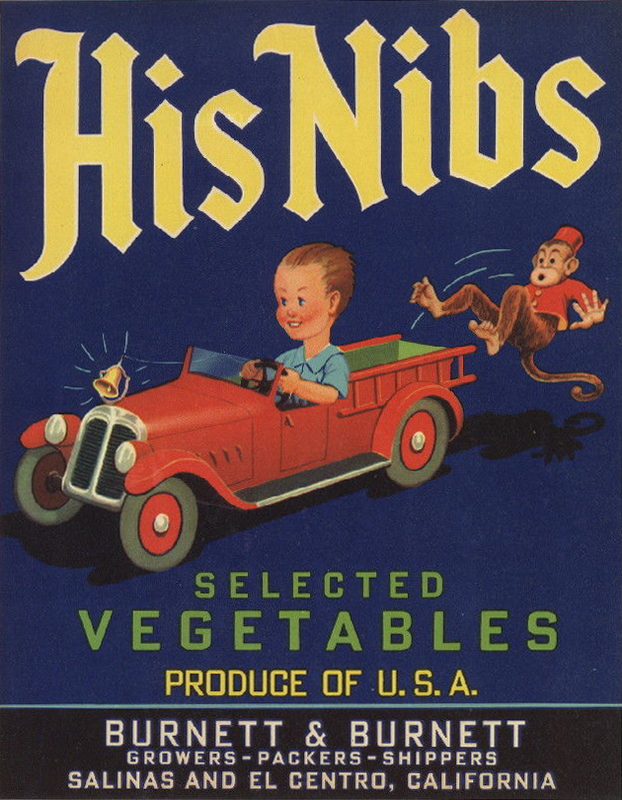
And I wrote, “Pavlo, that’s a relatively new use of the name. Here’s the real “His Nibs”, memorialized on the site owned by John Gwin, “NIBsite”, and “Spectacular NIBS”. Here’s the website of his son and daughter-in-law, “Quills-et-al”, and an earlier version on Wayback. And here are a few lines and a photo from the WES webpage “About the WES”, and a story on Pentrace about the opening of “The Philip Poole Room” in the Pen Room museum in Birmingham. He is also not to be confused with this label from a wooden vegetable crate. Use your Google wisely”.
David Nishimura wrote, “Indeed, this might be cited as another instance of a failure to pass the torch. Although Philip Poole was not as well-known on this side of the Atlantic, especially among those more interested in fountain pens than in other, older writing instruments, I don’t think this appropriation of his sobriquet would have passed uncommented-upon had the collective memory of the pen collecting community remained intact.”
And I wrote, “And by the way, Pavlo, as for “appropriation”, “His Nibs” was more than just Philip Poole’s nickname. It was also the name of his shop on Drury Lane since the 1940s, and its later incarnation at the back of the art materials shop, Cornelissen, in the 1990s.
“In Norman Haase’s defense, he didn’t start using “His Nibs” as the name of his website until 1999 after Philip Poole had passed away. But it’s up to him to say whether he was actually aware of the first “His Nibs” at the time he also chose to use that name. Sure, everything is changing in pen collecting and pen research, but not so much that we should be oblivious to those who came before us, and not so much that I will start using the term “Pendom”. By the way, do you know where that neologism originated? No, not where you thought it came from. It came from a 1940 Parker Vacumatic pen ad that used the ad line, “Jewels of Pendom”, and other earlier instances.”
Pavlo Shevelo wrote, “I questioned Norman, and I place his explanation here in the sincere hope that it will help”.
Quote from an email by Norman Haase, Sept 12, 2008. “After a brief scan of the discussion, the question seems to be whether I knew of Mr. Poole in England prior to naming my company last century. I’m afraid not. At that time, I only did a search for use of the name for business purposes, and did not extend it internationally. There wouldn’t have been any reason to do so. I’ve been aware of the phrase most of my life for its usual usage, and must plead guilty to thinking I was having an original thought when I chose it ;-)—enjoying the slight play on words and the aspect of making fun of my own pomposity. I’d been nicknamed ‘His Nibs’ and alternately ‘the Professor’ while still an adolescent, long before my interest in fountain pens surfaced. I actually had a naming contest amongst my customers back in ’98 or ’99 and ‘His Nibs’ was the one I was pulling for! At some point in the past decade I became aware of Mr. Poole in England (perhaps a customer first mentioned him to me, I don’t recall) and I read about him with great interest. My only regret is that I never had the opportunity to meet him.”
George Kovalenko.
.
August 05, 2015
‘Some Guy’ in the PFC

[Posted on L&P on Sept 6, 2008.]
This is from an editorial by Cliff Lawrence in the Pen Fancier’s Newsletter, March 1981, pp.
5 and 6. “In the seventies, on rare occasions, you would see a fellow pen collector [some guy] usually just in front of you buying a pen that you had been looking for for months. More often you would hear of them from dealers and other collectors. They were almost invariably described as being very frugal and secretive in their pursuance of their hobby. . . . If I had just a dollar for every time a dealer told me that he had just sold a box of beautiful pens to a [some] collector a few minutes before, I’d be quite wealthy now.” Does this sound like a good definition of “some guy”, or “sumguy”, as I like to spell it, or “sumgai”, as Bill Riepl spells it in his “Story Of Sumgai” on the Pentrace homepage? It sounds pretty good to me. Cliff stops just short of actually using the term.
You have to understand that Cliff Lawrence was talking about the seventies when most collectors didn’t know each other, and they didn’t want the hobby to spread because they didn’t want any competition. What I am saying is that they, like all of us, are cheap, and don’t want to pay much for pens, and want all the pens for themselves. Now, that’s a sumguy.
I was a sumguy, once upon a time, when I found a treasure trove of pen parts and pen repair tools. See my posts on “Vintage Pen Repair Tools” and “A Vintage Pen Repair Shop” from my first series on Lion & Pen.
George Kovalenko.
.
August 02, 2015
Cliff & Judy Lawrence
[Posted on L&P on Sept 2, 2008.]
As promised, here’s something more on Cliff & Judy Lawrence. I originally found this message posted by Rob Astyk on Jan 25, 2005 in a thread with the title “Why are we so alone? A discussion of the past and future” on the Fountain Pen Network. I am repeating a portion of it here essentially as written, except for corrections of spelling and grammar. It starts on a cynical note, but it ends on a note of conciliation about using the Web as a collaborative forum for creating something by group effort.
Rob wrote, “Let me tell you a little of the history of this hobby as I know it. Pen collecting began about forty to forty-five years ago as a lonely pursuit of some few folks who liked pens and accumulated them. But pens, up through the mid-1980’s, had almost no open market value. Antique dealers, and I’m using that term loosely, got pens as the freebies when they bought old desks or jewelry boxes or that box of junk on the corner of the table that had all the “smalls” in it at the garage sale. Pens were “found money” in that whatever they brought in was profit for the dealer who’d actually bought some other thing with which the pens were simply a tag-along. That’s why I could collect a couple of thousand pens with an average price of under $5.00 a piece up through 1987.
“At the same time, pens had value to other collectors. Even in the late 1970’s collectors had a sense that certain pens were unusual or rare. Thus, one might find a pre-1920 overlay, eyedropper Parker for a dollar or two and turn it around within the community for several hundred dollars. It was far better than the stock market.
“All collectors and dealers were worried that this secret of theirs would get out. There weren’t any pen shows to speak of and the one and only publication was Cliff Lawrence’s Pen Fancier’s Newsletter, later Pen Fancier’s Magazine.
“When I went to Brimfield in the early 1980’s, I would occasionally run into pen collectors. I can honestly say that the only folks who ever stopped to chat with me were Stuart Schneider and his, then, wife Roberta Etter. The usual scenario when I met another collector, one of whom was the late and much lamented Frank Dubiel, was that I’d introduce myself, offer my hand, the other person would be overcome by this odd expression as if I’d just offered him a poisonous snake, mumble something not necessarily his name and race away. Off the other collector would run, and in those days no one knew my politics. ;-)
“The point is that there was this veil of secrecy that surrounded the hobby. Some were making substantial money off of fountain pens. Others figured that they could make substantial money. And some of us just loved the things and wanted to see as many variants as we could. In any event, I used to tell people who asked about other collectors that there were long-dead people who were more gregarious than pen collectors.
“The hobby was, however, changing. In 1980, Stuart Schneider launched the Fountain Pen Exchange newsletter that complimented and competed with Cliff’s PFC publications. Pen Clubs were informally forming and Glenn Bowen wrote his book, and later launched Pen World. Actual pen shows began to happen in large cities. The PCA grew out of the Southern California Club. The hobby was becoming more public. The secret was out.
“But you must know that not everyone was happy with this opening up. Cliff Lawrence had tried to squelch the Fountain Pen Exchange. Some collector-dealers were very nasty to others in the hobby for actually, or potentially, beating them to some killing on a great pen. Some well-heeled collectors thought of the pen collecting hobby as “their” hobby. It existed for them, primarily so that those few might profit from it. Cliff could not stop the growth of the hobby beyond his control, but his early grasp has served as a kind of paradigm for most, certainly not all, of the relatively small group that controls shows, and publications, and some very lucrative side-lines like authentication for auction houses.
“The next stage in this hobby’s development occurred while I had taken myself mostly out of serious collecting from 1988 to 1998. It’s a stage that I only know from hearsay. What I understand is that there was a great pen “bubble” in the early 1990’s when the silent little men scurrying from stall to flea market stall cashed in their acquisitions. Prices soared. Not coincidentally Ebay began to make its mark on the world at about the same time. “When I decided to get back into pen collecting in a serious way in 1999, I avoided Ebay because I had, neither money to spend, nor a personal computer of my own. Two years later when I broke down and bought a PC, I found a hobby transformed. There were Fora for pen collectors. There were people from all professions, backgrounds, races, and ethnicities in this wonderful hobby, and collectors salted around the world. Moreover, they were all in contact with one another via the Internet.
“Still there is a clique that tries to maintain control of a hobby that’s plainly out-grown their grasp. If you want real information on the esoterica of pen collecting, you have to go to a small cadre of individuals who may or may not respond. Also, no one has settled on standards for the hobby yet. We have the PCA, but it does not have the authority that the American Philatelic Society, for example, has over stamp collecting. There are no standards for terminology, evaluation, and grading of pens, or for dealer conduct. We lack those things because they are not in the interest of an old guard that still views the hobby as a personal profit centre. [To this end, Roger Wooten started Topic 278 on L&P in the “Work Ethics” forum, “Repair and Restoration Ethics, What constitutes going too far?”, where he proposed a new set of rules that he christened “GARM, Generally Accepted Restoration Methods”, but saying further “you can feel free to name it anything you like”. On Jan 5, 2018, Roger sent me this note, “I’m a CPA, and [the name] was in line with the Generally Accepted Accounting Principles, so that’s where it came from”. In a later topic in the “Work Ethics” forum on L&P, Topic 327, Rob started a thread titled “Collector Code, code of ethics for pen collectors, includes GARM disclaimer”, and ran with the ball. I took it into another direction in a thread titled “GARR, Generally Accepted Research Rules”, Topic 1980.]
“We’re in a transition phase right now. At some point the clamour for standards will outweigh personal greed. The hobby will establish regular standards and a code of conduct for dealers and repairers. Some “seal”, perhaps the PCA’s, perhaps not, will become the emblem of trust and excellence that we need, and those who are wary of jumping into the current atmosphere will finally dare to join in, and pen collecting will have its place beside book collecting, and cutlery, and all the other hobbies.
“Until then, the question might better be how we can organize to bring our hobby into the mainstream sooner rather than later.”
[Added on Aug 26, 2010. Here’s the rest of the thread on FPN, “Why are we so alone?”, with Rob’s message, sadly, “removed”.]
Pavlo Shevelo wrote, “Oh, my goodness! Thank you indeed for posting this”.
David Nishimura wrote, “Rob said that the next stage in this hobby was from 1988 to 1998. This is precisely the time when I became involved in the vintage pen scene. The money that came into the field came from a few sources. One major source was Italy, where the economy was booming and consumerism was going wild. For a period of several years, vintage pens could be bought at an American pen show and immediately resold for two or three times the price to Italian pen shop owners, who would in turn make their markups. This came to a crashing halt around 1995 or so, though some of the slack was taken up by buying from other countries—notably Spain, Portugal, and Brazil.
“The other big change that hit at the end of the ’80s was the entry of the watch dealers into pens. Give them credit—they saw objects that were beautiful, uncommon, and undervalued, and they put up serious money for them. For many, it was a natural lateral move, since pens could be bought alongside the watches and jewelry they were already purchasing and advertising for. These watch dealers turned pen dealers turned up some fantastic pens, and did every bit as much to change the pen collecting scene as the foreign buyers. By the mid-90s, however, they were pretty much all gone; it had been profitable for a while, but the easy money was made and prices were dropping.
“Note that Rob’s chronology as regards Ebay is a little confused here. Prices peaked and the bubble burst years before Ebay came on the scene.
“I don’t know whether Rob still feels quite the same way now about ‘a clique that tries to maintain control of a hobby’, and ‘an old guard’. To my mind, the notion of such a conspiracy is laughable. There is certainly a group of veteran collectors who have great stuff and deep knowledge; they have always been very open with me, even back when I was a 20-something grad student with more enthusiasm than capital. Rob is, by his own admission, a rather abrasive personality, so if he’s alienated some of those veteran collectors over the years, I don’t think it’s quite fair to put all the blame on them. And it is particularly mistaken to excoriate this old guard as being motivated by profit. I cannot think of one that does any significant selling, and most are now acquiring selectively and quite seldom.”
And I wrote, “Be that as it may, conspiracy or not, it still makes for a good story from one person’s point of view. I do know that around 1994-96 when the first websites came online, Glen Bowen got together with a few of the members of his board of directors of Pen World, who were also big-time collectors at the time, and they decided that they would not allow the publication of any personal, or commercial ads in Pen World that had website URLs, or email addresses in them, trying to stem the tide of communication outside their control in the same feckless way that Cliff tried to limit backchannel correspondence and dealing between his PFC members. Glen quickly had to change the policy because his advertisers would have none of that. Still, to this day it’s almost impossible to find a price tag on any of the pens advertized, or talked about in Pen World. I shouldn’t make such sweeping, universal statements, though, because someone will dig out some obscure exceptions to the rule of “no price tags” just to prove me wrong. Well, I guess if you have to ask how much it costs, then you can’t afford it.”
David Nishimura wrote, “Interesting thing is that Cliff Lawrence contributed in no small measure to the friction between pen collectors and general antiques dealers. His 1992 guidebook, in particular, listed prices for nearly all the pens illustrated that were way above current retail levels. This book was probably the first to get widely distributed among the US antiques trade, so many dealers innocently used it as a yardstick for pricing their own pens, only to find pen collectors scoffing and offering what seemed ludicrously low sums instead. Nor were all the dealers using the book naive. Many, if not most, were well aware of the unreliability of price guides, and so assumed that expecting to get half the listed price would be reasonable. In this case however, one quarter to one fifth was often more like it. I remember talking to an antiques shop owner back in that era who told me that he had been getting a lot of pens in, and so called Cliff Lawrence to ask what percentage of the guidebook value he’d pay. Expecting to hear something like a half or a third, he told me he was taken aback to be told 20%!”
Pavlo Shevelo wrote that Rob’s post, even though it was “much later than when Cliff was, kinda, the ruling king, or at least tried to be, and taking into account that ‘clique’ doesn’t mean ‘conspiracy’, Rob’s point might not appear to be so ‘laughable’”.
David Nishimura wrote, “Sorry, I stand by what I wrote. Rob has some very strong opinions about how the world should work. There are others who see things differently—including quite a few prominent veteran collectors. That they disagree with Rob doesn’t make them either conspirators, or even a clique—however much Rob may believe that only malicious intent could possibly explain their failure to see things his way.
“Yes, some of these veterans have run shows heavy-handedly. Many have not been overly willing to hand over the hard-won fruit of their research and experience to those who rubbed them the wrong way. But this is hardly the stuff of totalitarianism. In fact, if anybody wants to “control the hobby” nowadays, it’s someone like Rob, with his calls for a powerful governing body setting uniform standards for grading, classification, and methods of restoration.”
Rob Astyk wrote, “I suppose that you could shoehorn my calls for standards and standard terminology into a specious pejorative like “an attempt to control the hobby”, but I think that Pavlo has seen the reality of what I suggest. I’m the last person who wants to control anything. But I do believe that the complexities of this hobby are many and great enough already without newcomers having to decide whether David’s grading of a pen is the same as Rob Morrison’s, or Richard Binder’s, or Bob Novak’s. What I would like to see are some simple, regular, and consistent standards. And, honestly, David, the only people discomforted by a consistent “language” for referring to the various aspects of this hobby are people who profit from the prevailing confusion.
“If I were trying to control anything, I’m sure doing a piss-poor job of it. I don’t see any progress on standards of any kind. Besides, the whole point of standards is democratization of the hobby. Making pen collecting more regularized makes it more intelligible. Making it more intelligible makes it easier for newcomers to the hobby to get their bearings. If that’s a bad idea, then I don’t know who’s being more offensive.
“I have offered suggestions about how standards could be enforced so that they become universal. People claim that it’s impossible to set standards across the hobby. I’ve argued that it’s not impossible. Enforcement is necessary until those standards gain sufficient weight and universality to enforce themselves.
“As for my statement about people controlling the hobby, I never thought that they were completely effective. As you point out, David, in a hobby as broad and diverse as pen collecting, iron control is just not possible. On the other hand, as one reaches more rarified levels of collecting, the number of people involved gets ever smaller, and the pens involved increasingly rare. At those levels a relatively small group of people can exert a lot of control. Is it so impossible that some of that might be going on?
“As for being “abrasive”, I plead guilty in the first degree. As I’ve said before, stating an opinion and arguing for it will offend some. I consider that the inevitable result of stating the opinion in the first place. I’d rather be known as abrasive and honest than pleasant and duplicitous any day. That said, even I think I carry the abrasion too far sometimes, but that’s a different story.
“This is a very interesting conversation from which I’ve tried to absent myself to allow it to develop on its own, but I just can’t allow the charge of “control” to go unanswered.”
Claes Lindblad wrote, “Sigh. Of course we need some kind of definition(s). We cannot even agree on what a “collector” is.
“Some like to accumulate (he who has most X when he dies wins).
“Some love to buy every Limited Edition, manufactured in 4810 copies per country, put them into the bank and believe to Become Rich when they sell them in a year or so.
“Some are interested in certain brands, technical developments, filling systems, special nibs, etcetera.
“Some want their fountain pens to work. You’d be surprised to hear how many present day pens do not work properly.
“Some solely look for Waterman 53s. :-)
“And so on. And all are collectors. Or aren’t they? Would proper definitions help? Those belonging to one faction rarely stand those adhering to other groups, so what good would it do to put labels on them?
David Nishimura wrote, “We are treading on sensitive ground here, and praise is warranted all around for the forbearance shown so far. I, too, like to be able to call things as I see them, with no offence intended or taken—but with the calling done with sensitivity and sympathy. Lest anyone doubt it, I think we can aver that we share more than we differ in our goals, however much we may differ in our opinions on how best to get there. I will say, however, that I agree with the following quote, ‘What I would like to see are some simple, regular, and consistent standards. And the only people discomforted by a consistent language for referring to the various aspects of this hobby are people who profit from the prevailing confusion’.
“Why do you persist in believing that the only reason anyone might disagree with your ideas is greed? Uniformity isn’t always optimal or desirable. Your castigation of your opponents echoes that of the proponents of more government surveillance, who claim that only those who have something to hide could possibly object. The grading system that I use is the best I’ve been able to come up with. Others have come up with other systems, some wildly impractical. I don’t want to have a bunch of armchair authorities impose their grading system on me, nor do I want to impose my system on anyone else. Is this a desire to profit from confusion? No, it is a very reasonable desire to be left alone—and to stick with the good enough, rather than go chasing after the perfect. Things can be improved. It is best done from the bottom up, though, and through persuasion, not compulsion.
“As for “democratization of the hobby”, not everyone likes democratization imposed upon them. The EU has given us some good illustrations of how and why this happens. Paradoxically, if one were to look at pen collecting primarily as a business, then standardization and regularization might make sense. Most participants, however, look upon it as something more, perhaps a place to explore, to discover, to socialize. Pen collecting is a culture—and more often than not, attempts to standardize matters cultural do not turn out well.
“And as for making pen collecting “more intelligible for newcomers to the hobby”, is the imposition of compulsory standards the only, or even the best way to make pen collecting intelligible? Might I suggest that my website, my publications, and my contributions to online discussions have all been directed to precisely that end, albeit by different means? It’s as if you were one of those reformers campaigning fervently for simplification and rationalization of the English language, while I’ve chosen to spend my efforts teaching people to read.”
And John Chapman wrote, “While I could opine a few answers to the questions David raises here, I am afraid it has the potential to poison a very interesting thread about the history of pen collecting. Might I suggest that some of the back-and-forth on the subject of standards, control of hobby, etc., be moved to its own thread, in a way that does not strip out what is relevant to the core subject matter here? Understanding the hobby requires understanding the way that personalities and agendas have influenced its growth, and I wouldn’t want to see that removed, but the current argument detracts from the rest.”
And I wrote, “Thanks, John. Now, to get back to pen history, sort of”.
George Kovalenko.
.
July 31, 2015
Canadian Collectors

[Posted on L&P on Aug 31, 2008.]
I asked Stephen Overbury why he wasn’t chiming in, and he said that when he realized that not much was being said about the early Canadian group, he started to get angry. He thought better of it, though, and decided he would stay in lurking mode and say nothing himself, but he decided, by his own admission, to put his “attention deficit disorder personality on hold” long enough to relate these stories to me.
Stephen was another of those who attended some of the earliest pen shows in the US. He recollects that one the first was organized by Lavin and Fultz in a small shop in Ohio, well before the Chicago race track shows. Stephen began co-organizing shows in Toronto around then as well. He had the help of Ken Rowe, the senior official who ran Toronto’s Sick Children’s Hospital, and a seasoned collector of postal items and other writing equipment, and Bill Gardiner, then president of Sheaffer Canada. They started the first pen club in Canada, a thankless job to be sure. Stephen was the first president, and they produced a newsletter of about 100 pages in total.
At those first meetings a lot of rare pens showed up and collectors, Stephen included, didn’t realise just what they were giving up when they sold or traded them. He remembers trading away his full size Conklin crescent filler Endura after a lot of pressure from an American collector. Even Glen Bowen got in on the act of trading by mail up north, making one collector promise not to tell a soul that he had traded a BHR Sheaffer for that collector’s red hard rubber Waterman’s with a fine silver overlay! Talk about being taken to the cleaners, eh? He ended by saying, “There are likely about twelve or thirteen of us on the entire planet that truly care about learning about the history of writing equipment in some depth, as opposed to merely chasing it, bragging about it, and making a killing as the only goals”. But that’s just a bit of Stephen’s usual hyperbole, the part about the 12 or 13, not the last part.
George Kovalenko.
.
July 29, 2015
Johnny Cuevas
Nassau, December 1956, Cuban-American Johnny Cuevas with his Porsche Speedster.
, and the New York City collectors.
[Posted on L&P on Aug 31, 2008.]
Nishimura wrote that Johnny Cuevas was a hugely important figure for New York City collecting, but Cuevas was before his time. “Others will have to fill in his story”, he wrote, “but I know enough to know it deserves amplification”. I mentioned three people who held pen shows in 1978 and 1979. I already talked about Fred Krinke above, but George James was a National Science Foundation official who worked in the field of rocket science for the US government. He also authored the 1979 article about writing instruments in the Time-Life series, Encyclopedia of Collectibles, where he described himself as a Buck Rogers fan as a teenager when he bought his first fountain pen, a Parker 51 whose sleek, streamlined design reminded him of his teenage hero’s spaceship. Now, as promised, here’s something more about Johnny Cuevas.
There were some interesting threads on Pentrace a while back about the origins of pen shows, and about the most important and influential pen collectors and researchers. These threads are now all long gone from Pentrace, but I archived them in my own personal library. Concerning Johnny Cuevas, there was a thread on Pentrace in May 2005 called “Shapers and Changers”, and here’s the portion of that thread that dealt with Cuevas. I archived it on L&P on Aug 31, 2008, and now I am saving it here.
Daniel Kirchheimer posted on May 17, 2005, “In the mid-1970’s, I got my summer-camp friend Richie Golden interested in pen collecting, and subsequently, he met Johnny Cuevas at a flea market where he was set up as a general dealer. Johnny already collected lighters, but Richie got him interested in pens, and since I lived in NYC and Johnny was in a basement apartment in the east ‘60s, we ended up spending a great deal of time together. In exchange for teaching him about pens, he transported me to all the flea markets he was dealing at on weekends, and, of course, he got me in during dealer set-up!
“Johnny’s first major find was at the flea market at Madison Square Garden in the late ‘70s. He was meeting me at a deli on 8th Avenue to take me into the show early, but he had already walked around the show, and grabbed a Waterman 448, silver filigree overlay safety pen for $70.
“Of course, he went on to be a major dealer in the early days. We didn’t stay in contact so much after he had sold his whole collection, though he was continuing to collect. As a teenager, the whole thing was a hobby for me, done out of love, and Johnny had bills to pay and had to make the hobby pay for itself, I think. But I miss him. He was a really kind guy, and he treated me like a prince, even though I was a punk kid who thought he knew it all. Has anything changed?
“By the way, Johnny had an entire fascinating life before getting into the vintage stuff business. He was a championship race car driver, and at one point he owned 17 cars. He would show me his scrapbooks. It’s fair to say he was cool.”
Don Lavin posted, “Thanks for the stories about Johnny. Do you know who he sold his pen collection to? Try Ed Fingerman of the Fountain Pen Hospital. And that is a story in itself. I always enjoyed talking to Johnny. Here is one story for the readers. John had customers who wanted Waterman 58 ripples, so he concocted a story that there were 7 distinct patterns of 58 Ripples. In this way he could continue to sell 58s to the same collectors long after they had acquired their first one! A bit of a scam to be sure, but I still laugh at his salesmanship. I also love the way he always referred to me as Laddie. Laddie this, Laddie that. I knew that he was from Cuba, but I did not know about his racing past. Quite a guy.”
And Daniel replied, “Yep, I knew about the deal with Ed. I was withholding the name to protect the guilty! I must confess that I served as an appraiser for that sale. I should have stayed out of it to keep my conscience clear.
“Cuevas was a top-tier racer who placed well at Sebring, etc., in the late ’50s early ’60s, I believe. Raced Porsches, if I recall correctly. Tooled around town in a gull-wing Mercedes.”
Thanks for the stories, Don and Daniel.
George Kovalenko.
.
Subscribe to:
Posts (Atom)