collection1b

collection1b

November 27, 2014

The Straight Pen


      Have you ever wondered where the term “straight pen”, as a synonym for “penholder”, or “dip pen”, originated?  If you don’t have enough information, you just blunder about.  But it all starts to become clear with a consideration of Copperplate script, or English round hand, which evolved into Platt R. Spencer’s version of the style, called Spencerian script, and the patents for writing instruments used for such scripts.  The angled nib required for Spencerian script lead to penholders that would hold an ordinary steel nib at an angle.  His son, Harvey A. Spencer, held two patents for such penholders along with co-patentee Robert S. Cutting.  US patent no. 89,354 from Apr 27, 1869 was for a penholder “for holding the pen with a hinge-piece, to swing on a pivot in a slot”, so that the nib was held at an angle for Spencerian script, and patent no. 285,578 from Sept 25, 1883 was for another oblique-angle holder for Spencerian script.  George W. Michael’s patent no. 346,670 from Aug 3, 1886 was also for an oblique penholder for Spencerian script.  Harlow C. Clark’s patent no. 554,503 from Feb 11, 1896 was for a penholder with both left-and-right-handed oblique angle nib sockets for Spencerian.  And Albert Jahn’s patent no. 878,004 from Feb 4, 1908 was for another Spencerian penholder, but with an ergonomic finger grip.
      The angle nibs were already quite common, and could not be patented themselves, but Bartlett M. Worthington’s US design no. 7,205 from Feb 24, 1874 shows an example of a design for an angle nib for Spencerian script, made so “a more graceful aspect...is presented” to the writer while writing.  Ignaz Bergmann’s patent no. 431,245 from July 1, 1890 was for a variation on the Spencerian-type crooked nib with an extra-thin, elastic portion in the angled shank.  Albert Jahn’s patent no. 920,874 from May 4, 1909 was for another elbow-angled Spencerian nib that was also “cranked or angularly set off in regard to the shaft”.
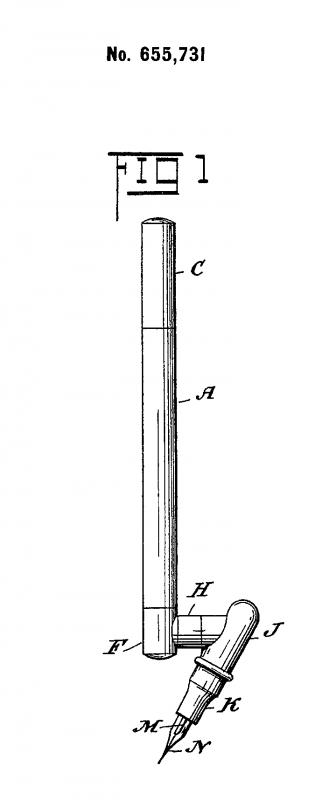
      It wasn’t long before fountain pens were also devised to suite the Spencerian writing style.  James P. Hoyt & Ferdinand Bartram’s patent no. 325,211 from Aug 25, 1885 was for a fountain pen with a feed for normal nibs, but also one with a feed for a “crooked pen”, that is, a laterally shifted Spencerian nib and a “correspondingly crooked” s-curved feed to follow the nib.  Percy E. Pierce’s patent no. 655,731 from Aug 14, 1900 was for a
crooked fountain pen with a zigzag barrel at the nib end, so that the nib was offset obliquely for Spencerian, or Copperplate script.  [See the illustration.]  Felix L. Sturm’s patent no. 849,513 from Apr 9, 1907 was for a “Fountain-Pen Handle” with an awkward change of angle in the section, first upward and then back down.  It had a zigzag “elbow connection” like the angled Spencerian nibs, but offset obliquely upward, “a construction that will be at once efficient and commodious”.  But it was nothing of the kind, especially not the latter.  It probably took a lot of pensmithship to master the pen.
      And then along came William L. Gordon’s patent no. 904,059 from Nov 17, 1908 for a penholder with a nib socket that allowed the holder to be “adapted for use as either a straight or an oblique penholder”, that is, to hold the nib in line with, or at an angle to the holder.  Since my childhood I have wondered where the term “straight pen” came from, and the above patent revealed its etymological source in one fell swoop.  It’s a retronym that was created in response to, and in order to distinguish it from the term “oblique penholder”.  It’s a straight pen as opposed to a crooked pen!  And it all fits together and makes sense, now, and the universe is whole again.

George Kovalenko.


.
 

November 24, 2014

Stub and Italic

 
The illustration in this patent shows a double-ended nib, both a stubby italic and a long-pointed flex, all in one.

        Italic writing originated in Renaissance Italy as the script used in the papal chancery for writing official Vatican correspondence and documents.  The scribes found the Carolingian Minuscule script too cumbersome and slow, because the pen had to be lifted from the paper after each letter.  They were looking for a truly cursive script where the pen needed to be lifted only at the end of a word.  One could even tease the Caroline script by saying, “That’s not writing, that’s printing and lettering”.  Italic script is by definition cursive, and this style of script came to be called “cancellaresca corsiva”, or the chancery cursive, but later it came to be known as “italic”, meaning “from Italy”.  And by extension, the word “italic” also came to be applied to the type of nib that produced these distinctive shaded effects.
        Well, I might be taking a “chancellorisk” by broaching the topic, but there has been some talk recently on the fountain pen collecting websites and message boards, a lot of positing about the putative distinction between italic nibs and stubs.  They claim that a stub is inherently different from an italic, that a stub has an iridium tip or point with rounded edges and corners, so that it writes smoothly, as opposed to an italic with its sharp, chisel-pointed edge, which makes it more italicky and scratchy.  So, let’s look at the patent record and see whether there is any merit to this modern claim, and whether there are any historic precedents for such a distinction.


        Henry A. Walke received US patent no. 274,679 for a “Fountain-Pen” on Mar 27, 1883.  This patent is not for a complete fountain pen, but the special nibs that are designed to work with the tubular feed of his earlier pen, US patent no. 235,396 from 1880.  Fig. 5 in the 1883 patent, an illustration of “a stub-point pen”, shows exactly what was meant originally by a “stub” nib, and Fig. 7 shows a long-pointed shading nib.  Now, here is the correct distinction, that between the stub-point and the long-point.  I don’t think it’s possible to make this difference more graphic.  
It has the look of a cut quill.  One of the objectives stated in the specification is “to increase the elasticity of the ordinary stub-pen without making it a shading pen”.  It makes it obvious that it refers to a nib with very short, shallow shoulders and stubby points, traditionally used for italic nibs, and that’s all.  An italic nib gives shading to one’s handwriting without the on-off pressure required with a flexible nib.  And a modern stub nib is just an italic nib that’s afraid of being too ethnic.  In other words, it’s afraid of being a true chisel-point, so it gets a neb job.  And what’s a “neb”?  Simply “nose”, or “point”, or an archaic version of the word “nib”.

 
        Frank H. Burdsall received US design no. 32,730 for a “Design For A Stub-Pen”, on May 29, 1900.  The specification reads in part, “The leading or material feature of my design consists in... the abruptly-divergent concave curved point edges a”.  That’s a perfect description, and the picture is a perfect illustration, of a stub nib.  If you want to see a long-pointed nib that nicely contrasts with this illustration, take a look at US patent no. 506,853.  The nib in the original illustration is a fine flex, but the nib could easily be worn down and altered into an italic flex.
 

        Joseph L. Petit’s US patent no. 663,782 for “Metallic Pens”, Dec 11, 1900, is for a nib described as having a “narrow stem-like point” projecting abruptly from the main body of the nib, thus giving it “an elasticity more or less resembling that of the goose-quill”.  Now, here is an extreme stub-italic nib, although it isn’t designated as such in the specification.  It almost looks as if it were giving the finger to the whole stub-or-italic controversy.
        And here are some more textual references.  Abraham L. Baer’s
US patent no. 704,691 from 1902 is for a fountain pen in which “any form of steel pen, sharply-pointed or stub-pointed, can be used”, which shows the original meaning of the word “stub”.  Warren N. Lancaster’s 1906 US patent no. 816,344 for a “Fountain-Pen” was actually for a specific design for a feed, which “makes it perfectly feasible to use the ordinary long-point pen as well as a stub”, and again shows the original meaning of the word “stub”.  The specification goes on to say, “It is my purpose to provide a feed for fountain-pens which will make it possible to use any style of pen, quantities of which are at present a drag on the market, because they cannot be utilized on any known form of fountain-pen, it being the custom almost exclusively to use the so-called ‘stub-pen’ ”.  A stub nib is obviously one with short, stubby tines, the type most often used for italic nibs because they didn’t need to be flexy to yield shaded effects in writing.  That’s all.  Walter King’s “Penholder” from 1910, US patent no. 964,650, is said to be “arranged as to hold a plurality of nibs or pen-points... whereby the pen-man may have at hand with the one pen-holder, say, a sharp pointed pen and a stub pen”.  That’s the only distinction that needs to be made, the one between a pointed, flexible nib and a rigid, stub-italic nib, not between stub and italic.
        Nowhere in Edward Johnston’s Writing & Illuminating & Lettering does he ever mention a stub nib, let alone a stub nib as distinct from an italic.  He does, however, make a distinction between a long nib and a short nib when he writes, “The pen may be made more pliant by scrapping it till it is thinner, or by cutting the ‘shoulder’ longer, or stiffer by cutting the nib back until the ‘shoulder’ is short”.  He then goes on to say, “A gold pen is probably the best substitute for a quill, and if it were possible to have a sharp, ‘chisel-edged’ iridium tip on the gold nib, it would be an extremely convenient form of pen”.  Johnston, in his Formal Penmanship, defines the italic nib as, “The typical nib...must be stiffly springy...a broad nib, sharp edged and sharp cornered”, but a nib with eased edge and rounded corners would do just as well.  He goes on, “Such a nib in normal use will make its own thick and thin strokes naturally (without pressure)”.  And among the list of “tools” used in penmanship, along with “all other instruments and substances used”, he includes “our hands”.
        And what do the patents say about the stub-or-italic distinction? 
Zip, Nada, Rien, Nichts, Gornisht!  I’m sick and tired of this totally specious modern distinction between stub and italic, this recent construct that has no basis whatsoever in fact, this modern fiction created out of ignorance of the real past, the true past.  There is no historic record of any pen company having these two separate nibs, one called an “italic” and another called a “stub”, both at the same time.  Take two classic pens, for example.  The May 24, 1922 ad for the Duofold in the Chicago Tribune offers the pen with five different nibs, among them a “Stub”, but no nib called an “Italic”, because the stub is an italic.  In the Duofold ad in the Saturday Evening Post, Aug 22, 1925, the stub is said to be a nib that “gives a hand distinctive character and interestshaded, bold, and free”.  The Waterman’s No. 7 pen was offered with color-coded nibs, and the “Blue” one was at first called a “Blunt—An improved stub...[that] makes thick or thin characteristic stub strokes as desired”, and later it was called solely a “Stub”.  There is simply no basis in historic fact for this modern claim.  You can posit all you want, but that doesn’t make it so.  “Do not posit!  Either it is, or it is not.  There is no posit.”  So don’t be a mumpsimus.
        Now, there is this notion of the “etymological fallacy”, which says that it’s a fallacy to think that
the “true” meaning of a word is its historically “original” meaning, but I say that it’s a fallacy to say that the “true” meaning of a word is not based on its historically “original” meaning.  Actually, all the different meanings of a word are there together in a dictionary definition.  You just choose the one that suits your purposes, and you might not like some of the other meanings.  In fact, the true meaning of a word encompasses all its meanings.  This isn’t exactly forensic linguistics, which is all about looking for the smoking gun in a text, but it is etymological diagnostics, or diagnosis of problems in etymology.  I guess that makes me a sumpsimus.
        If you still want to retain the distinction between stub and italic in the modern sense, then at least don’t use an old, established word for a new, arriviste concept.  Don’t call it a “stub”, but rather a “blunted italic”, or an “eased italic”, or a “rounded italic”, or an “ovalic”.  Anyone who wants to keep making the distinction between stub and italic, go ahead and dig your grave, but dig it deep, so that this modern misconception will stay buried this time.  Quick, give me a wooden stake!  No, the big stake!  I want it to stay dead this time.  It’s not that we have on the one hand a stub, and on the other an italic.  A stub is an italic, and an italic is a stub.  You’ll notice that the title of this piece is not “Stub Or Italic”.  This type of nib is both.  It’s a “stub-and-italic”!


George Kovalenko.

.


[This article was first posted in 1999 on Bruce Marshall’s website.  It was also posted a little later on Richard Binder’s website, but somehow the crucial sentence with the “m” word got cut out of the text, so I am posting this here to restore it.]
 

November 22, 2014

The Founcil combo


, and the Esterbrook Duograph combo.


[Posted on L&P on Jan 26 and Jan 30, 2012.]
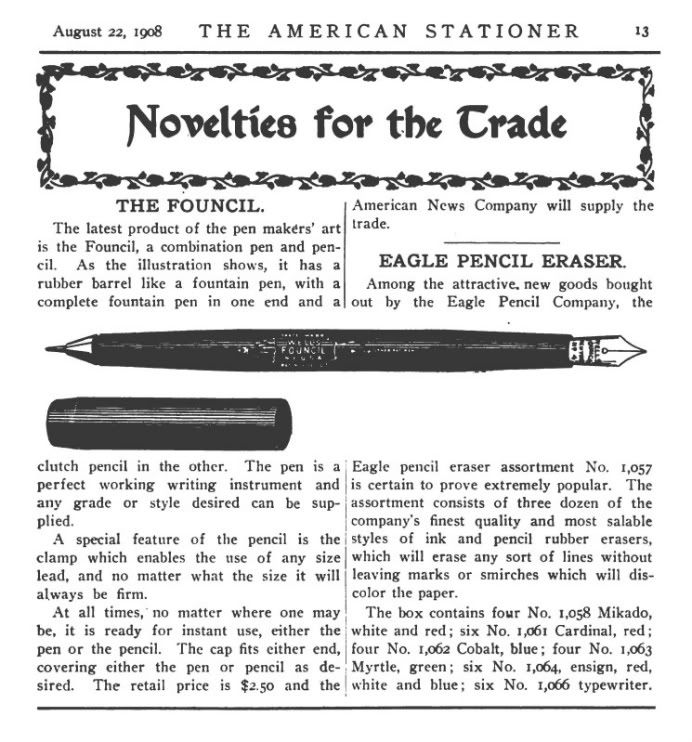
      If you like combos, here’s an early one, the Founcil combo featured in an article in American Stationer, Aug 22, 1908, p.13.  And here’s the trademark for the word “Founcil”,
71,461, said to be used since November 1907 by Frederick R. Wells who was doing business at 103 Halsey St., Brooklyn, N. Y.  It’s probably an eyedropper-filled combo.  And even though there is no “t” in the spelling of the name, the “t” is not exactly silent.  It’s implied, and it’s still partially there in the pronunciation of the name, sort of like the Swan “Fountpen”.  Well, it’s a “Fountpencil”.  Also check out these two threads on FPN, one, and two.


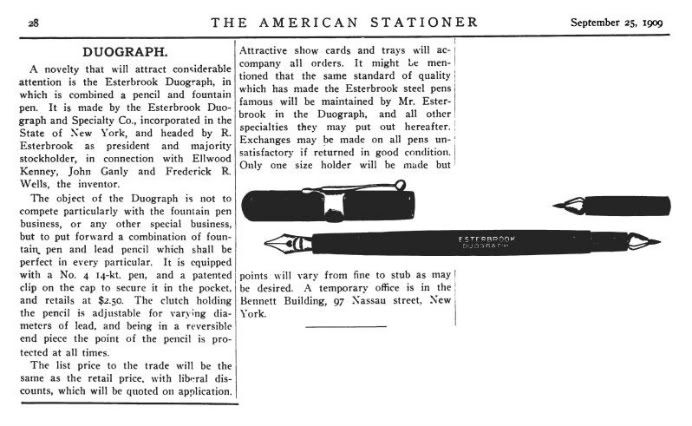
      Has anyone ever heard of an Esterbrook combo?  And do you want to know more about the “Founcil” combo?  Well, here’s the “Founcil” smoking gun.  I ran across the above article from Am. Stat., Sept 25, 1909, p.28, about the Esterbrook “Duograph” made by the Esterbrook Duograph and Specialty Co. headed principally by Richard Esterbrook and, get this, by Frederick R. Wells, called “the inventor”.  This is the same Wells who received the trademark for the above-mentioned “Founcil”.  So the “Founcil” and the “Duograph” are one and the same!  I’m also going to go out on a limb and say that these two combos, really just one combo under two different names, are the “first” ones of their type.  And by that I mean that they are the ones that really got the ball rolling and started the onslaught of imitators that ended up in the classic combos of the late 1920s, combos such as Gilliam’s “Dubel Servis”, and Schnell’s “Penselpen”.  There are earlier ones, most notably the all-metal, glass-cartridge Eagle combo with a wooden pencil holder, but this is the first one that really looks like a modern hard-rubber, or plastic combo with a mechanical pencil.  And the Founcil-Duograph was followed by a slew of imitators including Eagle’s black hard rubber combo, but this combo started it all.  As I said below, at this late stage in the game, there is still some
new, obscure stuff out there just waiting to be found.

George Kovalenko.

.
 

November 21, 2014

Waterman’s in Canada


[Posted on L&P on Jan 1, 2008.]
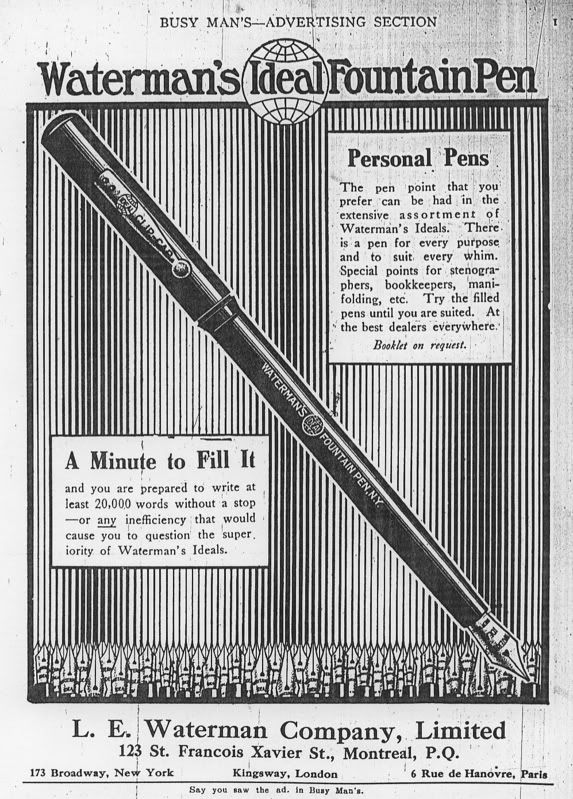
       Here’s an article from The Busy Man’s Magazine, January 1909, p.152.  It’s titled “The Fountain Pen Industry in Canada”, written by Edward J. Kastner, the manager of the Canadian branch, but it’s really about the new Waterman’s factory in Canada, not the whole fountain pen industry in Canada.  The magazine was the predecessor to the modern MacLean’s Magazine, a magazine similar to Time, or Newsweek, but earlier it took a format more like that of Saturday Evening Post, or Life.  The word “employes”, which appears four times in the article, is not a mis-spelling.  It’s just an old-fashioned spelling of the word “employees” that isn’t recognized by spell checker any more.  Check out the picture in this ad from the August 1910 issue of The Busy Man’s Magazine, p.1, for examples of the “large variety of sizes and styles” of “Personal Pen Points” made by Waterman’s at the time.

 
 I first wrote about this picture in the first post in my first thread on L&P on May 27, 2005, “Repair Tools 1”,
also found in this article on my blog, but I didn’t find copies of the ad until Sept 5, 2007,
and again on Jan 30, 2012 in this version from The American Stationer, Apr 16, 1910, p.1.
Someone really should collect all these early Waterman’s ads and publish them in a book, or on a USB memory stick.


The Fountain Pen Industry in Canada
       
The starting of the large Waterman’s Ideal plant in St. Lambert marks the growth and development, in Canada, of an Industry which is of personal interest to us all.  Of all the arts and inventions with which man has enriched the world none has proved as serviceable as the art of writing.  A visit to the new Waterman plant is convincing of the undertaking of this firm to so prepare its output as to make it of such a degree of fineness as to equal perfection, and afford a most perfect and complete pocket writing instrument.  Thus, the art of writing, in the present age, has become one without the many inconveniences of the past.  It is learned that the enormous capacity of the new Waterman factory, as described hereinafter, is so arranged that the increasing demands of the public, through the trade of Canada, may be always promptly supplied.  An idea of the necessary preparation to insure this is conveyed through the output of this firm’s United States factory, which, in 1906, was called upon to supply, for the year, Waterman’s Ideals to the enormous extent of $2,500,000 in value.
       
The new Canadian factory is a three-storey and basement building, 85 x 150 feet, with approximately 25,000 square feet of floor space, constructed entirely of reinforced concrete, is absolutely fireproof throughout, and so built that there is practically no vibration whatever from the action of the machinery.  All modern appliances have been installed.  The ceilings are high, the ventilation is exceptionally well regulated, and even the most remote corners require none other than the natural light, which the construction and arrangement of the building permits during the working day.
       
The power is electricity, generated by the plant and controlled from a switchboard.  The present capacity is 150 horse-power for immediate use, although an additional 150 horsepower is provided for.  The boilers are fitted with the modern Parson’s Improved Blower System.  The engine is one of the latest and best types, and the exhaust steam from the engine heats the entire building.  The generators are of the 65 kilowatt type, alternating current, and the connecting motors used throughout are the alternating current type.
       
A trip through the building is convincing of the enormous preparation necessary to the starting of this plant, which commenced operation on December lst [1908] with a small force of skilled employes, although it is estimated that the capacity of the working force of the complete plant is in excess of 400 employes.  The first pen manufactured in the new factory is planned to be presented to the Premier, Sir Wilfrid Laurier.  The planning and installation of the complete equipment and starting of the new Waterman plant is under the direct management of William I. Ferris, Vice-president of the Company, John Seiler being the Superintendent in charge of the works.
       
On the first floor of the building is the office of the Superintendent of Manufacture, in addition to the Rubber Department, with a capacity for 125 employes.  In this department is received the finest grade of Para rubber, from the South American forests, where it is selected by Waterman representatives.  The conversion of the crude rubber into the four simple parts of the finished pen requires 130 careful operations, most all of which are executed on modern machinery of special type.
       
On the second floor is the Smelting Room, where the gold metal is melted and placed in a crucible, which stands over a furnace that heats it to a temperature of 1,900 degrees Fahrenheit.  Here is added an alloy of silver and copper bringing the gold down to 14 kt., the correct standard of fineness required for writing purposes.  Ingots are then formed of a size about one inch in thickness.
        These are then passed to the Gold Pen Manufacturing Department on the same floor, which has a capacity for 150 mechanics.  The production of Gold Pens requires well-skilled help, most of whom it will be found have devoted a lifetime to this art.  Each gold pen passes through about eighty operations, and is finally tempered, and, in this same department, tipped with iridium, which renders the pen point stronger and more durable than any other metal ever mined.  It is said that in this department are made gold pens of such a large variety of sizes and styles that the exact requirements of every style of handwriting can be fulfilled.
       
On the third floor are departments for the assembling of the parts, the chasing or engraving of the rubber holders, and the mounting with gold and silver.  The working capacity of this floor, in these departments, is 100 employes, and each of the operations, or handlings, through which the pen here passes, is as technical and careful as those of the formation departments.  The five parts, when carefully assembled to fit to an infinitesimal fraction of an inch, are submitted to trained hands—experts in the use of the pen—to test the quality of workmanship submitted to them.  The pens before leaving this department receive the trade mark of the manufacturers, which is the permanent guarantee, and has built the enviable reputation connected for many years with Waterman’s Ideal Fountain Pen.
       
The Canadian Headquarters of the manufacturers are located at No. 136 St. James Street, Montreal, with a large and active selling force under the management of the Secretary of the company.

        Olle Hjort posted this
Waterman’s ad from 1907 to show what was happening on the different floors, but it needed to be turned upside down.  The ad reads from top to bottom, opposite to the way the building floors are laid out in the article from 1st floor to 3rd.  You can find more info on Waterman’s in Canada in the article by Joan Geschlecht and Peter Markman in Pen World, Vol. 13, No. 2, Nov/Dec 1999.

George Kovalenko.


.

[Addendum, new pics added on Dec 29, 2015.]
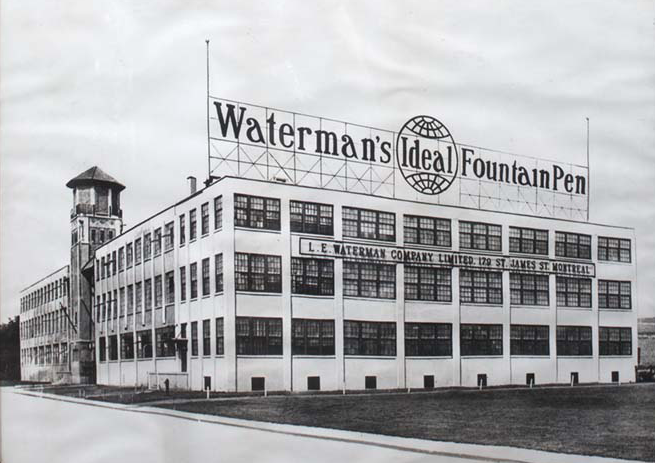
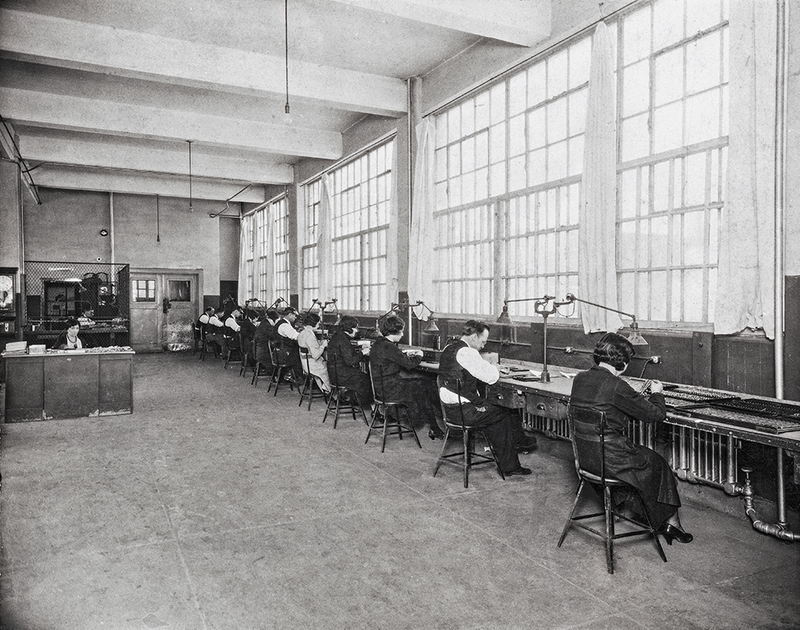
        Here are two vintage photographs owned by Derek Lepper showing the Waterman’s Montreal factory.  He photographed them in their original frames, and kindly supplied me with copies and gave me permission to place them here.  One shows the
exterior of the factory in St. Lambert, Que., and the other one shows an interior shot of one of the factory assembly lines.


[Addendum, new pic added on Mar 1, 2021.]
        This photo from the Mouillepied Historical Society in St-Lambert, Québec, sent to me by Lise Latremouille, shows the original building described in the above article.  Her mother worked there in the gold nib department, and her grandfather, Louis Juster, was an American nibmaker for Waterman’s who was brought over to Canada in 1908 to establish the pen manufacturing plant, and later became a vice-president and director of the Canadian company.  He stayed in Canada and had a family of nine kids, including Lise
’s mother, and stayed with the Waterman’s company for fifty-five years.  From 1917 to 1955, he served as the plant superintendent.  Lise said that Waterman Pens was a very important part of her family, and of many family friends.  The company employed a lot of St-Lambert residents.
        The building as it stands today is
L-shaped, and the original building in the photo below is the projecting, lower part of the L-shape.  The photo in the above Addendum of the “exterior” shot helps to explain it.  That picture shows the original building as an extension projecting from the longer building with the tower over the entrance.


  

November 19, 2014

The Waterman’s Baseball Team


[Posted on L&P on Mar 2, 2012.]
        It’s almost a general rule when doing research in The American Stationer, that if you’re looking for one thing, you’re bound to find something else as well, or instead, along the way.  One of the unexpected bonuses that I found was a group of articles about a stationers’ baseball league in New York, some with pictures of the Waterman’s baseball teams.  A whole world that I wasn’t aware of simply opened up before my eyes.
        It started with an article titled “Baseball League”, June 8, 1907, p.20, with a proposition to organize a league in the New York stationery trade.  There were five “teams already in the field”, and a game on June 1 between the Waterman’s team and the Stationers’ Association team was reported on.  The score was 16 to 9 in Waterman’s favor.  In the June 15, 1907, p.40, article a couple more games are reported on, with the Waterman’s team winning against the Metropolitan Bank team, 19 to 8.  The June 22, 1907, p.20, article reports that the Waterman team won against the McMullen Advertising Agency, 4 to 0, and the June 29, 1907, p.12, article reports yet “Another Win for the Ideals” with a score of 31 to 3 against “The Tec’s” of the Technical Supply Co.  With that score, perhaps the mercy rule should have kicked in, but the Waterman’s company was not known to show mercy.
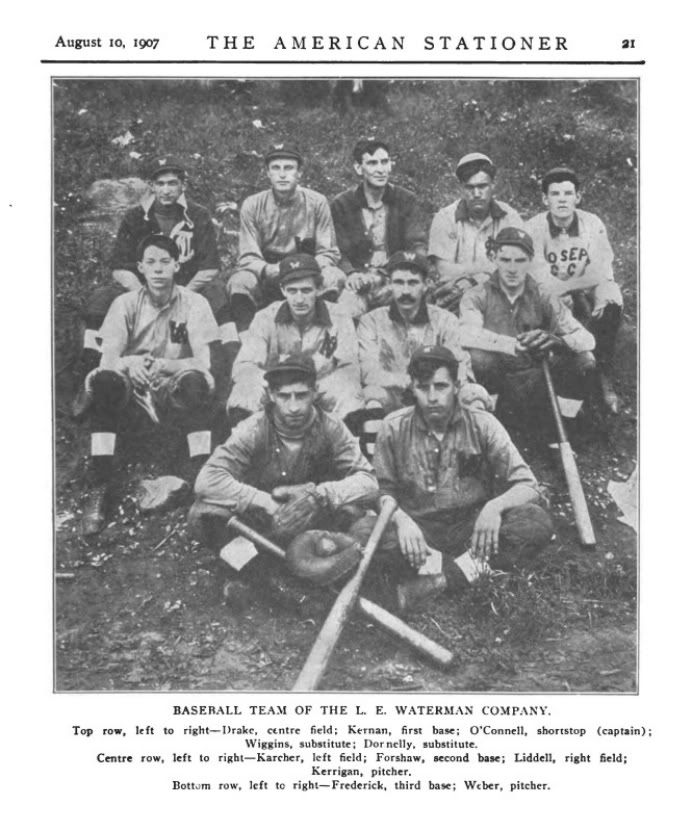
        Then an article on July 13, 1907, p.32, reported on a game between the Waterman’s New York team, “the pen shop boys”, and the Waterman’s Rubber Factory team in Seymour, Conn.  “Last Saturday was an Ideal day”, it said, and “The Ideal baseball team, which has been walloping everything in sight in New York all season, was defeated by the Seymour team by a score of 10 to 7”.  A party of 84 made the trip to Seymour in a special train car reserved for the company.  Seymour, it said, was “where the team from the offices goes regularly once each year to get defeated”.  There was “a good dinner, an excellent supper, good speeches, and a brand of good fellowship which will not be forgotten”.  Some of the “mottoes” on the banners in the hall where the supper was served included variations of some of the sayings from The Pen Prophet.  One of them was, “It is easier to make a mark around the world in New York than to get around the bases in Seymour”.  In another article about that baseball game on Aug 10, 1907, pp.21-22, the two Waterman’s teams are called
“The Ideals” and “The Rubbers”.  Nice names!  The article also includes, as it says, “excellent pictures of both teams”.  That article goes on to say that, “Baseball has been a matter of more than ordinary interest among the stationary houses this season”, and “It looks like a league and a hot race for a pennant next season”.
        Early the next year, on Jan 11, 1908, p.40, an article says that, “Efforts are being made to organize a stationers’ baseball league in New York this season”.  An article on Jan 25, 1908, p.8, reports that, “A meeting of those interested in organizing a stationer’s league is called for February 6 at 173 Broadway”, the Waterman’s “Pen Corner”.  Also an article titled “Interest in Baseball Growing” appears on Feb 29, 1908, p.30, but then we see nothing else in Am. Stat. about the New York league for the rest of the year.
        It’s the same in 1909, no news about baseball in N. Y., but then some articles about bowling teams and a bowling league start showing up instead.  The only two articles about the N. Y. baseball league all year appear on June 19, 1909, p.8, and Aug 7, 1909, p.12.  The second of these mentions an upcoming game between the two Waterman’s teams, and “a silver mounted cup for [which they] will play”.  The trophy was “generously offered by Frank D. Waterman”, but this time the game was to be played at Jersey City on August 28, and “half of the New York trade [was expected] to be present”.  No matter how hard I tried I couldn’t find any reports in Am. Stat. of the game in 1909, but then early in 1910 a photo with the title
“Waterman Baseball Trophy” appeared all by itself with no accompanying article, on Feb 19, 1910, p.14.  Under the title there is also one short line that reads, “The body is made of vulcanized rubber, the same material used in the Ideals”.  It’s a Waterman’s black hard rubber and silver filigree cup, made the same way they made their pens, and probably made in one of their shops or factories.  That means that they probably also made the filigree.  If you look closely, you can just make out the name of the first recipient of the trophy, “1909 Seymour Team 9-6”.  Has anyone ever seen the actual Cup, and does anyone know of The Cup’s whereabouts?
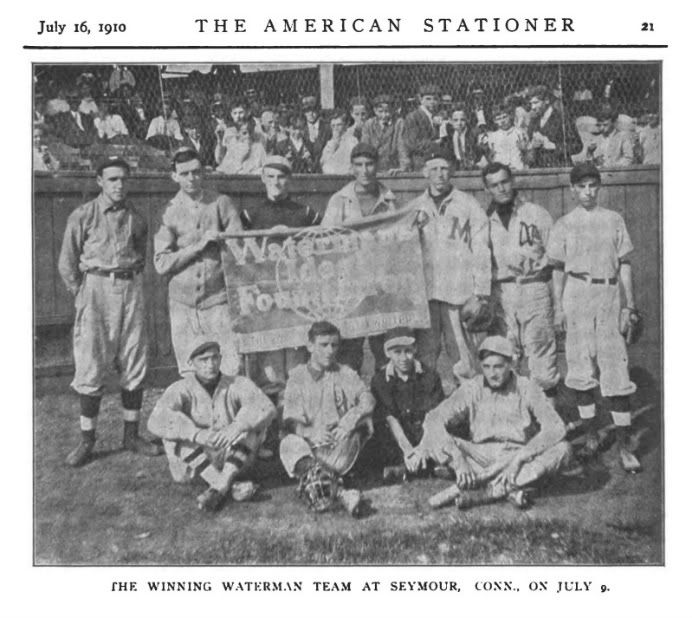
        The only two articles on baseball in 1910 appeared on July 9, 1910, p.32, and July 16, 1910, p.21.  The first of these articles announced the annual “Waterman Outing” and second baseball game, again to be held in Seymour, Conn.  It also mentions the “handsome trophy made from fountain pen rubber, decorated with chased silver filigree, which was won last year by the Connecticut ball players”.  The second article reports on the outing and the game.  Three private cars were chartered to transport 170 employees from the N. Y. office, “170 happy members of the Waterman Family”.  This time, however, the city team won by a score of 9 to 0.  The trophy is described as “a handsome cup made from rubber used in the famous Ideals.  It stands nearly three feet high and is covered with delicate filigree silver”.  The article is accompanied by the following photo of “The Winning Waterman Team”,
The Ideals.
        I found nothing more in Am. Stat. about the Waterman’s baseball teams except the report on “The Waterman Outing” and baseball game on June 27, 1914, reported on in the July 4, 1914 issue, pp.3-4, also the occasion of the presentation of the giant key in the shape of a pen to F. D. Waterman.  The penmakers played against the Delford Athletic Club and won by a score of 3 to 1, but there are no pictures of the teams, just pictures of the officials and directors.  There was also no mention of the Waterman’s trophy, although there was room on the cup to list the annual winners at least up to 1914.  Perhaps WWI, which began on July 28, 1914, put an end to all their fun, or perhaps the other pen and stationery companies, or the other sports leagues complained about all this one-sided attention paid by Am. Stat. to the Waterman’s company baseball teams, and the straw broke the camel’s back.  But in the meantime, they documented those teams, and they got to print that picture of “The Cup”, and I’m certainly glad they did.
        Olle Hjort asked whether some of the team members might possibly be identified.  Could the manager of the Seymour team, he wondered, be Charles Nichols who received patent 726,561, and might Liddell on right field be the same as Robert C. Liddell who held patent 1,762,104?  We might never know for sure, but I think he’s right about those names.  And that was the whole point of this article.  It’s not the baseball that’s important, it’s the guys.  They’re all penmakers, or somehow else involved with running a penmaking company.  And that Cup, which is a bit of a masterpiece, might have been made by some of them.  It’s too bad that they didn’t include at least the initials of the men, let alone their full given names.  Since I found these photos, I have found the given names or initials of a few of the men in other articles and ads in Am. Stat.  Mortimer “Mort” L. O’Connell, W. H. Kernan, and Robert C. Liddell all appear and are named in the Waterman’s ad on Dec 25, 1909, p.1, which has pictures of twelve of the company’s directors.  

It’s nice to put a face to a name.
 

George Kovalenko.

P.S.  By the way, here’s the
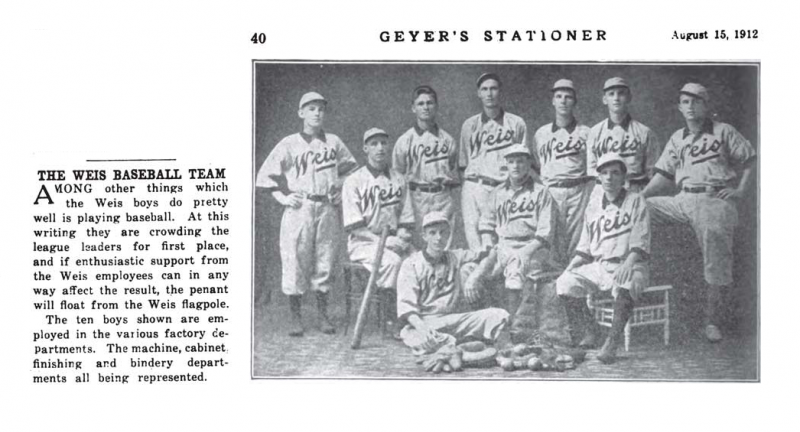
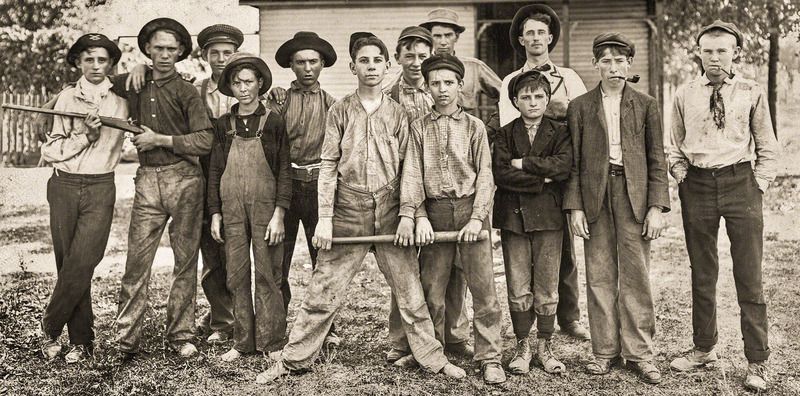
Parker baseball team, and the Weis baseball team.  And here’s a Lewis Hine photo of a 1908 baseball team composed mainly of glass bottle factory boys.

.

[Addendum, added on Nov 4, 2015.
        Since I first posted this, I found a few more references to the Waterman’s baseball team in American Stationer.  The article “The Waterman Ball Tossers” on Aug 25, 1906, p.16, tells of the forthcoming game in Seymour, Conn., between the team from the office and gold pen factory and the team from the rubber factory.  And the article “‘Ideal’ Ball Game” on Sept 1, 1906, p.26, reports that the score was 5 to 3 for the rubber team, and that the ceremonial first pitch was hit with a bat shaped like a Waterman’s Ideal fountain pen.  There is no photo, but all the players are listed by surname.  Another article titled “Ideal Ball Tossers” on May 18, 1907, p.13, relates that a baseball team is being “organized among the employes of the L. E. Waterman Company”, and that the team “is looking for other teams who can be led to the slaughter”, and “is searching for victims so they can get into practice” to take on the rubber team again after their defeat the year before.  The article simply titled “Baseball” tells us that the 1907 game “was a sequel”, and the score was 10 to 7 for the rubber team even though The Ideals “had been walloping everything in sight in New York all the season”.  And “Every employe who had a wife [or girlfriend] took her along”.  The game was held again at Seymour, where it was said “the team from the offices goes regularly once each year to get defeated”.  One of the mottoes in the supper hall was, “It is easier to make a mark around the world in New York than to get around the bases in Seymour”.  The article “Waterman Ball Game” on Sept 4, 1909, p.8, calls the game that year “the third annual baseball game”, so that proves that there was, indeed, no game in 1908.  And again the rubber team won.  This time they won by a score of 10 to 6, which “earned for them the loving cup”.  That’s what the trophy pictured above was called, but the actual score recorded on the cup was “9-6”.  Also, more than 1,500 invited guests attended.  And then two items appeared on Sept 20, 1913, p.30.  One item was a photograph without an accompanying article, but the caption said that it was another Waterman baseball game, this time in St. Lambert, Que., Canada, a “game between the New York [and] Montreal teams”.  On the same page, however, was an article titled “New York Stationers’ Bowling League Forming”.  The inaugural meeting was held at the office of the L. E. Waterman Co., and the person listed as the one to contact for “information concerning this league” was Mort O’Connell, “care of” the Waterman’s company.  This was the guy who played in almost all of the baseball games, and who was instrumental in forming the New York baseball league.  Perhaps the Baseball League was replaced with a Bowling League.  Perhaps they got old, and ran out of steam, and started a bowling team.  And perhaps the baseball players had become old
tossers.
        There is one more article, on June 20, 1914, p.5, but it is only an announcement of the upcoming 1914 game, the one in which the Ideals finally beat the Delford team by a score of 3 to 1, and one of the other “attractions” was to be “a special fat man’s race”.]
 

November 18, 2014

An 1898 Parker ad


[Posted on L&P on July 18, and July 27, 2012.]
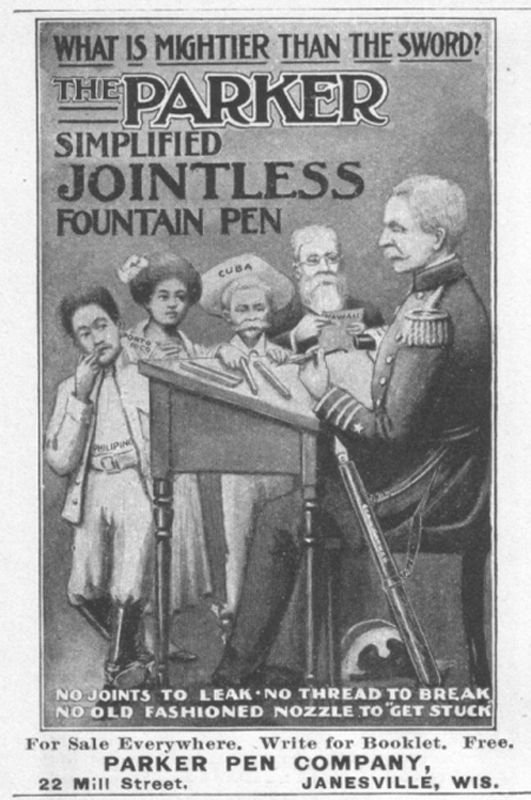
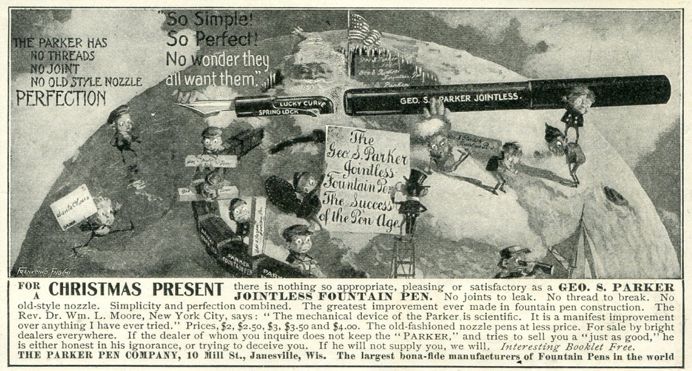
        Parker got an introductory advertising article in the magazine called The Office as early as July 1891, p.viii.  His pen was at first produced as an overfeed, a pen where “the supply of ink is furnished at the top of the pen instead of underneath”.  That must have really rattled the chains of Wirt’s bulldogs.    Here’s another early Parker ad, and another version of an ad with a “Pen is mightier than the sword” theme.  And again the patriotic event that is the occasion of the ad is the signing of the Treaty of Paris at the end of the Spanish–American War, and the annexation of Hawaii and Puerto Rico, and the so-called “liberation” of Cuba.  The ad is for the “Jointless” pen, ca.1898-99, and look where the jingoistic pen is this time.  It’s in the place of the scabbard, of all things.  That’s like saying, “The pen is a sword”.  Or, “The penis is a sword”.
        Here’s another Parker “Jointless” ad from
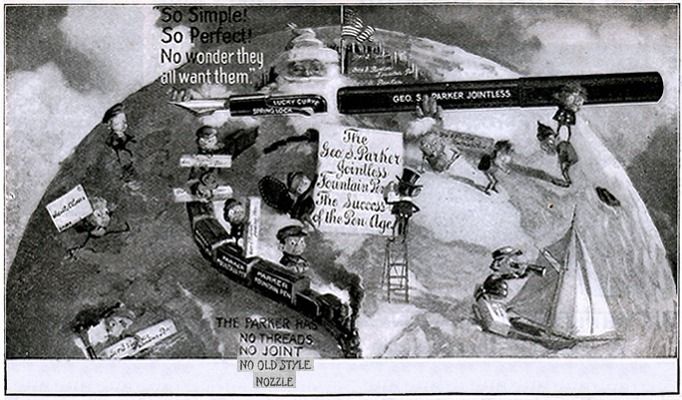
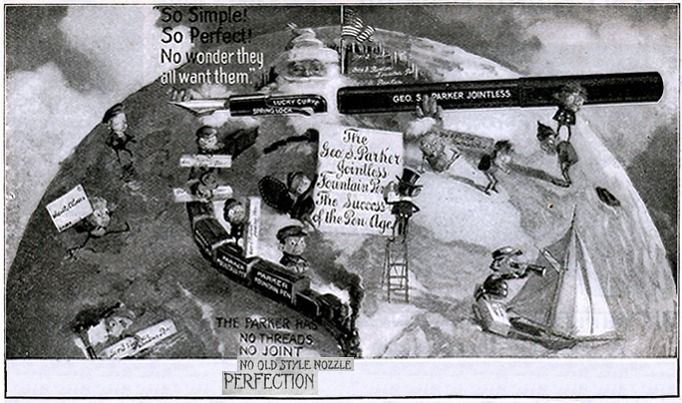
Christmas 1898.  This ad was originally posted on Zoss by Steve Nelson in December 2007 as part of his “Twelve Days of Xmas” series, one ad per day for 12 days.  This one was on day 2.  There are b&w versions of the ad that are cropped versions of the color ad, and from the telltale cropping at the bottom of the color ad, there may have been another even larger version of the color ad.  There are versions with the ad-line “No Old Style Nozzle” just at the bottom edge of the ad.  By the way, Parker stopped using that “old style nozzle”, the one with an overfeed, in order to get away from Wirt’s bulldogs.  It looks like the Parker pen boxes are orange, and it also looks like the pens are being made, not at the North Pole, but at Janesville, Wis., which seems to be right under Santa’s armpit.  The train takes the pens from there to an east-coast port city, probably New York, and from there the sailboat takes them around the world.  I wonder how much of the illustration is missing at the bottom.
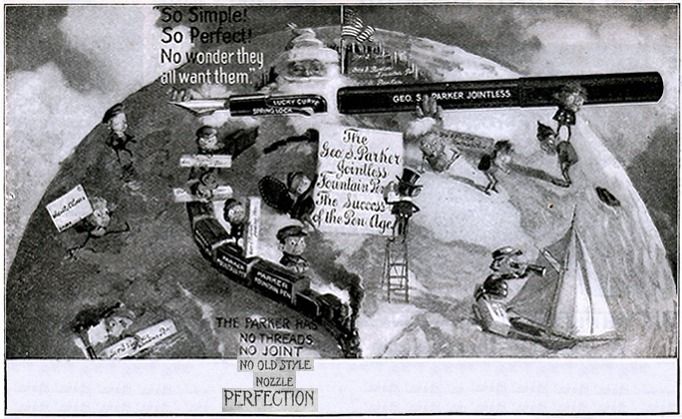
        Here’s a
b&w version of the ad with exactly the same image, but with different ad copy below it.  And here’s one of the cropped versions to which I was referring.  It was posted by Tsachi Mitsenmacher on Pentrace on Sept 1, 2011.  He said he found it in an 1898 issue of The Ladies’ Home Journal.  The text that was below the train in the color image was moved up into the clouds in the cropped version.  That’s why I say the line “No Old Style Nozzle” is cropped off at the bottom of the color ad and your b&w image.  Even the color ad, not just the b&w versions, are cropped.  I wonder what the whole picture looked like.  They probably cropped the ad to suit the various sizes of the ad spaces in the different magazines in which they advertised, and we will find out what the whole picture looked like only if they used this image in a full-page ad.  But in the meantime, here are some possibilities that I photoshopped.
        These versions show just the image portion of the b&w ad, but altered at the bottom to put back the possibly excluded content.  And the blank space would just be filled in with an extension of the background-globe imagery.  The first image shows the line that I think is missing from the bottom of the image,
“No Old Style Nozzle”.  The missing line is a bit long and might overlap the cowcatcher on the front of the train, so they may have split it into two lines.  The overlap might not have mattered, if the letters were orange like the letters at the top, but the dark letters are a problem against a dark background.  They may not have included the word “Perfection” in the full ad, but if they did, the ad would have been a little taller, yet, and the two ads would have looked like these, depending upon whether they split that long line, or not.
        Otherwise, the only other consideration is at the bottom left.  There’s a little elf carrying an orange box under his arm who is cropped a bit.  The elf in the boat at the right isn’t cropped, and isn’t an issue, and I don’t think there’s anything else below him, but we’ll have to wait and see.  I think the first version is the most likely candidate because that missing line and the elf at the left are the only things necessary to complete the cropped image.  But again, we’ll have to wait.  By the way, did you notice the two words in the bottom left corner of Tsachi’s ad?  They’re not there in the other ads, and I can’t quite make them out, but they may be the name of the illustrator who painted the picture, or the graphic designer, or ad agency that created the whole ad.

George Kovalenko.

.
 

November 17, 2014

The Waterman’s Jointless Pen


  , another obscure Waterman’s pen.


        Has anyone ever heard of a Waterman’s Jointless pen?  The pen is truly rare, and so obscure that an example of the pen has not been found and does not appear in any of the Waterman’s books, including the one by Max Davis & Gary Lehrer.  Even Michael Fultz did not include it in his list of Waterman’s filling methods in his Penbid column.
        It did show up in the following advertisements, though not in any articles that I could find.  The American Stationer, Mar 26, 1910, p.39, Apr 2, 1910, p.1,
Apr 16, 1910, p.1, May 14, 1910, p.1, and Bookseller & Stationer, May 1910, p.4, June 1910, p.4, and July 1910, p.4.  Surely it must have appeared in some issues of The Pen Prophet from that period.  It might appear in a Waterman’s catalogue from mid-1910, if one were ever to be found.
        It was the 5-month wonder.  It came and went even faster than the thimble pen, the sleeve filler, and the pump filler.  It wasn’t jointless, though.  It had a joint at the barrel tip, which was underneath the cap when the cap was posted, and it probably leaked like the proverbial sieve because it didn’t have the double seal of the A. A. Waterman middle joint pen, thus “insuring an absolutely tight union”.  The 1899 A. A. Waterman patent with its “inner union independent of the outer joint” “insured an ink-tight joint”.  The joint also had to be “sufficiently removed” from the suction and friction of the slip cap “to avoid disturbance of the joint when the cap [was] being removed or replaced”.  The Waterman’s Jointless pen might also have been in conflict with Eagle’s so-called jointless patent pen from 1898, which also had a barrel-end joint.
        Now, this is truly a case where “it is not in any official Waterman catalogues, and most significantly, no such pens have, to my knowledge, ever turned up”.  At this late stage in the game, there is still some
new, obscure stuff out there just waiting to be found.

P.S.  Take a look at this other Waterman’s jointless pen.

George Kovalenko.

.
 

November 14, 2014

Duncan MacKinnon


, the stylographic fountain pen and its inventor.


“DUNCAN MACKINNON, The Canadian druggist who invented the fountain pen”,
from ProQuest Historical Newspapers, “The Globe and Mail (1844-2011)”,
The Globe, Apr 11, 1914, in the “Saturday Magazine Section”, p.2,
as far as I know, the only known photograph of MacKinnon.

        Here’s an article from The Toronto Globe about Duncan MacKinnon, and a letter to the editor about the article, both of which can be viewed on ProQuest Historical Newspapers, “The Globe and Mail (1844-2011)”.  I can’t post links to the actual newspaper because it is on a website that requires a login with a host library.  Luckily the website has alliances with various public and university libraries, and the newspaper can be viewed at any of them.  I got a copy of the article from microfilm in the 1990s, but I recently reviewed the article on ProQuest at the university library here in my city.  The article was published in The Globe on Apr 11, 1914, in the “Saturday Magazine Section”, on p.2, and the letter was printed on Apr 17, 1914, p.6.  The pen is called a “fountain pen” throughout the article and the letter, even though it should more rightly be called a “stylographic pen”, and it’s the first successful pen that they’re talking about, not thee first pen.  The article is titled, “The Fountain Pen And Its Inventor”.  I wonder what the occasion was.

The Fountain Pen And Its Inventor [sic, Stylographic Pen].
        How a Canadian druggist living in Stratford, Ontario, was induced to try his hand at devising a fluid pencil, and how he finally succeeded in perfecting a useful commercial article.
        Books of reference, even dictionaries, name and describe the fountain pen, but in such a way as if it had been the product of spontaneous creation.  None of the writers seem to know the name of its inventor.  Watt, Morse, Howe, Bell, and other names of inventors and discoverers are household words, but no one apparently is familiar with the name of the inventor of the fountain pen.  This can scarcely he said of the inventor of any other instrument of equal utility.  Yet the personal element is most interesting in all spheres of human action.  The fountain pen is now made by scores of competing manufacturers the world over, and the business has risen into millions [of dollars].  All since [1875], when patents were issued
to the inventor at Ottawa [and London,] and [in 1876 at] Washington.
        Born in York County.
        Duncan MacKinnon was born in the township of Vaughan, county of York, Ontario, in 1838, and died in 1882.  He received a liberal education in his native county.  After teaching school for a short time he took up pharmacy, and the year 1874 found him the proprietor of a drug store In the city of Stratford.
        About this time he read a paragraph in The Scientific American asking some inventive genius of the world to produce a “fluid pencil”, that is, a writing instrument much like a lead pencil, substituting ink for the lead.  Mr. MacKinnon was at once seized with the importance of the suggestion and was soon at work, using the metal penholders of the time for his experiments.
        No attempt will here be made at describing details, nor the many difficulties encountered before the invention was put on the market.  A few facts alone In this connection will be noticed.  The chief difficulty lay in securing control of the ink-flow.  This was finally accomplished by putting an air tube in the centre of the fountain.  This was, and is to-day, the most essential part of the mechanism.  Without it there would have been no fountain pen.  Before final results were reached Mr. MacKinnon made trips to various cities in search of skilled artists, including Providence, New York, Philadelphia, and Cincinnati.
        Difficulties Overcome.
        The pen was first made in soft metal.  This experiment failed, for the ink corroded the metal, and the points soon wore off.  Hard rubber was next chosen and proved so successful that it is still the material used.  There was still one difficulty to overcome, and that was to secure a hard metal point.  This, too, was finally accomplished by the use of iridium, the hardest of all metals, and with which the gold pens now attached to the fountain are tipped.
        It will be noticed that what the inventor kept steadily in view was the production of a “fluid pencil”.  He had no thought for attaching an ordinary pen to the fountain.  This fluid pencil, although still in the market, is not suited to fine penmanship.  Others soon discovered this. Cross of Providence, R. I., was the inventors manufacturer.  This gentleman conceived the idea of substituting an ordinary pen for the point [sic, substituting a spring for the weighted needle], and proceeded to manufacture and sell, regardless of business ethics or possible infringement, calling his. pen the stylographic.  Other makers, the world over, followed in quick succession.  The rest is present-day history.
        Like many other inventors, Mr. MacKinnon ploughed the field and sowed the seed, but others reaped the harvest.  [More georgic metaphors.]
        First Described In The Globe.
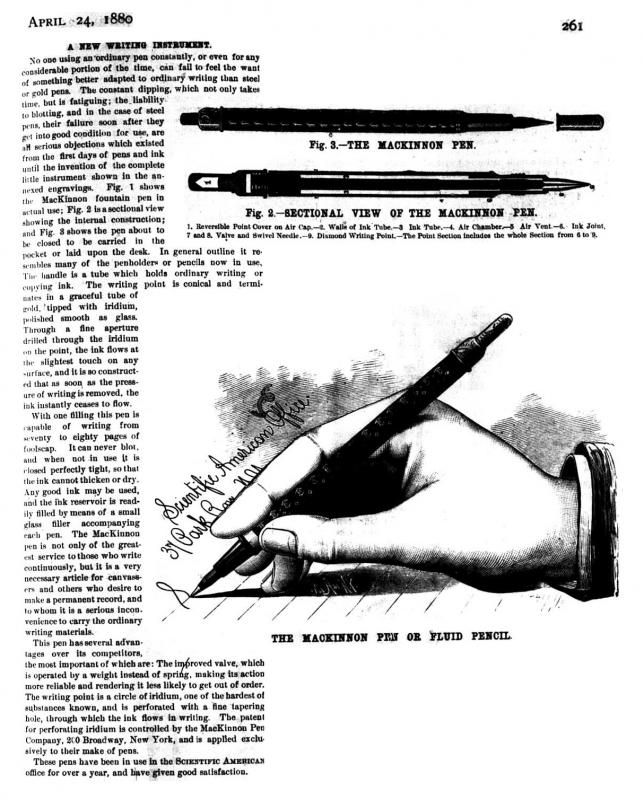
        The Globe was the first Canadian paper to publish an account of Mr. MacKinnon’s invention.  That was in 1878 [?].  In the United States, The Scientific American was the first to publish a description of the new writing instrument [in an article on Aug 10, 1878, p.80].  The writer [also] has before him [an article from] the last-named journal [on] the date April 24, 1880[, p.261].  The description is somewhat lengthy and is accompanied by an illustration of “The MacKinnon Fountain Pen”.

        And here’s the letter by Angus G. MacKinnon to The Toronto Globe, Apr 17, 1914, p.6.
The Inventor Of Fountain Pens
[sic, Stylographic Pens].
        To the Editor of the Globe; I thank you for the article on the invention of the fountain pen.  It is excellent and gives a just presentiment of my brother’s claim to be the inventor.  I am glad to think that, after having been forgotten so many years, his great accomplishment should be recognized and his memory honored.  He was a man who in his life was liked and respected for his social qualities and business ability, and in death he is remembered for the good he did.  Had he entered into a partnership with Cross & Son he would likely have had a greater return for his labor and expense. Several years of impaired health preceding his death were possibly not without influence on the outcome.  There are slight inaccuracies or discrepancies in the article.  Duncan MacKinnon was not born in Vaughan, but in Markham, in the old homestead near Unionville, one-quarter mile distant [
just north of Toronto].  A few years of his boyhood were spent in Vaughan and a short time later, but nearly all his work was done in Markham until he went to Western Ontario at the end of 1868.  Your date of the first Globe article on the pen [1878 ?] does not agree with the date written on the clipping I have.  I can hardly believe that my date is wrong.  There may have been two Globe articles.  [He didn’t give the date, but its probably the next one below, from 1876, or they may have confused it with the Sci. Am. article below, from 1878.]
        Angus G. MacKinnon, Sonya, Ont., April 13.

        Here’s the first article about the MacKinnon stylo in The Toronto Globe, Mar 9, 1876, p.4.
The MacKinnon Pen.
An Important And Useful Invention.
        We have been shown and have had the privilege of testing one of the most ingenious and useful inventions brought under our notice for a long time.  The invention is called “The MacKinnon Pen”, and its name sufficiently indicates to what use it is applied.  This novel instrument in outward appearance much resembles an ordinary gold pencil case.  It is made of metal, and is double plated with gold both inside and out to prevent corrosion by the ink.  It is composed of a barrel and a point.  The barrel has a small air tube extending from the top down to where the point is united to the barrel by means of a screw.  The point is composed of a valve chamber and slender perforated point, in which plays a valve having attached to it a needle.  The ink is readily placed in the barrel by a little instrument called the dropper.  To make the pen ready for use, all that is necessary is to let in the air, which is done by giving a turn to a screw-cap placed on the upper end.  It will thus be seen that the instrument works on a hydro-pneumatic principle.  Of course we are unable to give more than a general idea of this elegant, ingenious, and useful invention.
        The merits of this pen over all other pens and pencils are numerous, and must be obvious to all who examine and use it.  First, it is an inkstand, pen, and pencil all combined in one, and, in travelling, carrying of all these is obviated, and one is at all times armed for the purpose of writing, as the instrument may be carried in the pocket like a pencil; it does away completely with all blotting, soiling of fingers, and sharpening of pencils; it economizes time by obviating the necessity for constantly dipping for ink; the point being smooth, round, and without a split, it glides along on the paper so easily that no pressure whatever is required, and the writer has simply to guide itthus enabling him to write more rapidly and with greater ease than it is possible to do with any other pen or pencil; it writes with ease on the roughest paper, and for the purpose of ruling must excel everything else, since blotting is rendered impossible.  To put it in brief, the merits of The MacKinnon Pen are, that it is always ready for use, at all times and placesthat it is perfectly clean; that it economizes time, and enables us to do more work with less labor than we have ever before been able to do.  These advantages should make it a welcome boon to all who use a pen.  We have no doubt this new pen is destined to displace the ordinary pen to a very large extent, and that the ingenious inventor will be amply rewarded for the industry and perseverance[,] which he has bestowed upon his invention.
        The inventor is Mr. Duncan MacKinnon, of Stratford, Ontario.  About five years ago, Mr. MacKinnon read in The Globe an article taken from the Pall Mall Gazette, in which the writer had adverted to some of the drawbacks to the ordinary pen and lead-pencil, and called attention to the fact that while improvements had been made, and were constantly being made, in every other department, no improvement worthy of the name had been made for ages in writing instruments.  After calling attention to these facts[,] the writer proceeded to call upon the scientific world to produce an indelible pencil that would supersede both the pen and pencil in common use.  After some thought and ineffectual experiments with a view to produce such a pencil, Mr. MacKinnon turned his attention to an endeavour to construct an instrument which, though using ink as the marking agent, would yet possess all the advantages demanded by the writer in the article referred to.  He was not long in discovering the general principles of such an instrument, and had one made, which, though necessarily imperfect, satisfied him that his object was attainable; but, engaged in [other] business, he was unable to give the matter much attention until a little over a year ago, when he began to apply himself to its perfection.  After many discouragements, chiefly of a mechanical nature, he has at length been able to produce his invention in the shape above described.  Although simple enough in some respects, yet it is an instrument calling for the very finest of workmanship, and it was not until Mr. MacKinnon fell in with Messrs. Cross & Son, pen and pencil case manufacturers, Providence, R. I., that he was able to obtain a sample complete and satisfactory in all its parts.  The specimen in our hands is a highly finished and beautiful looking article, and will make a handsome appendage, to say nothing of its usefulness, to the writing desk, either lady’s or gentleman’s.
        Mr. MacKinnon has obtained letters patent for his invention in Canada, the United States, and Great Britain.

        Here’s the second article about the MacKinnon stylograph in
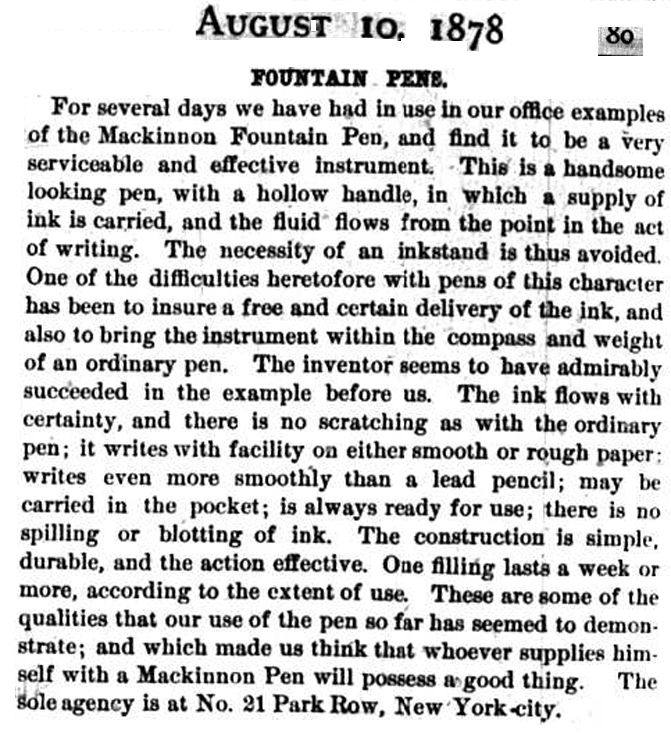
Sci. Am., Aug 10, 1878, p.80.
Fountain Pens [sic, Stylographic Pens].
        For several days we have had in use in our office examples of the MacKinnon Fountain Pen, and find it to be a very serviceable and effective instrument.  This is a handsome looking pen, with a hollow handle, in which a supply of ink is carried, and the fluid flows from the point in the act of writing.  The necessity of an inkstand is thus avoided.  One of the difficulties heretofore with pens of this character has been to insure a free and certain delivery of the ink, and also to bring the instrument within the compass and weight of an ordinary pen.  The inventor seems to have admirably succeeded in the example before us.  The ink flows with certainty, and there is no scratching as with the ordinary pen; it writes with facility on either smooth or rough paper: writes even more smoothly than a lead pencil; may be carried in the pocket; is always ready for use; there is no spilling or blotting of ink.  The construction is simple, durable, and the action effective.  One filling lasts a week or more, according to the extent of use.  These are some of the qualities that our use of the pen so far has seemed to demonstrate; and which made us think that whoever supplies himself with a MacKinnon Pen will possess a good thing.  The sole agency is at No. 21 Park Row, New York City.

        Here’s another article about the MacKinnon stylograph in Sci. Am.,
Apr 24, 1880, p.261.
A New Writing Instrument.

        No one using a pen constantly, or even for any considerable portion of the time, can fail to feel the want of something better adapted to ordinary writing than steel or gold pens.  The constant dipping, which not only takes time, but is fatiguing; the liability of blotting, and in the case of steel pens, their failure soon after they get into good condition for use, are all serious objections which existed from the first days of pens and ink until the invention of the complete little instrument shown in the annexed engravings.  Fig. 1 shows the MacKinnon fountain pen in actual use, Fig. 2 is a sectional view showing the internal construction; and Fig. 3 shows the pen about to be closed to be carried in the pocket or laid upon the desk.  In general outline it resembles many of the penholders or pencils now in use.  The handle is a tube which holds ordinary writing or copying ink.  The writing point is conical and terminates in a graceful tube of gold tipped with iridium, polished smooth as glass.  Through a fine aperature drilled through the iridium on the point, the ink flows at the slightest touch on any surface, and it is so constructed that as soon as the pressure of writing is removed, the ink instantly ceases to flow.
        With one filling this pen is capable of writing from seventy to eighty pages of foolscap.  It can never blot, and when not in use it is closed perfectly tight, so that the ink cannot thicken or dry.  Any good ink may be used, and the ink reservoir is readily filled by means of a small glass filler accompanying each pen.  The MacKinnon pen is not only of the greatest service to those who write continuously, but it is a very necessary article for canvassers and others who desire to make a permanent record, and to whom it is a serious inconvenience to carry the ordinary writing materials.
        This pen has several advantages over its competitors, the most important of which are:  The improved valve, which is operated by a weight instead of [a] spring, making be action more reliable and rendering it less likely to get out of order.  The writing point is a circle of iridium, one of the hardest of substances known, and is perforated with s fine, tapering hole, through which the ink flows in writing.  The patent for perforating iridium is controlled by the MacKinnon Pen Company, 200 Broadway, New York, and is applied exclusively to their make of pens.
        These pens have been in use in the Scientific American office for over a year, and have given good satisfaction.

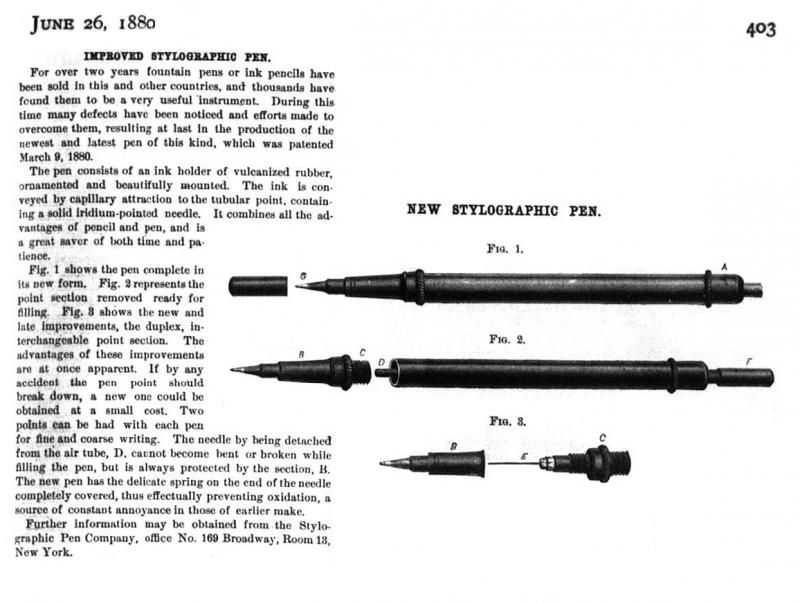
        And just for good measure, here’s the article introducing the Livermore stylograph, which used the MacKinnon patent, in
Sci. Am., June 26, 1880, p.403.
Improved Stylographic Pen.
        For over two years fountain pens or ink pencils have been sold in this and other countries, and thousands have found them to be a very useful instrument.  During this time many defects have been noticed and efforts made to overcome them, resulting at least in the production of the newest and latest pen of this kind, which was patented March 9, 1880.
        The pen consists of an ink holder of vulcanized rubber, ornamented and beautifully mounted.  The ink is conveyed by capillary attraction to the tubular point, containing a solid iridium-pointed needle.  It combines all the advantages of pencil and pen, and is a great saver of both time and patience.
        Fig. 1 shows the pen complete in its new form.  Fig. 2 represents the point section removed and ready for filling.  Fig. 3 shows the new and late improvements, the duplex, interchangeable point section.  The advantages of these improvements are at once apparent.  If by any accident the pen point should break down, a new one could be obtained at a small cost.  Two points can be had with each pen for fine and coarse writing.  The needle by being detached from the air tube, D, cannot become bent or broken while filling the pen, but is always protected by the section, B.  The new pen has the delicate spring on the end of the needle completely covered, thus effectually [effectively] preventing oxidation, a source of constant annoyance in those of earlier make.
        Further information may be obtained from the Stylographic Pen Company, office No. 169 Broadway, Rm.13, New York.


Canadian patent no. 4,809, p.7, May 1, 1875.

George Kovalenko.

.
 

Addendum 1, Nov 16, 2014, and Jan 6, 2015.
Some of these items were among the ones I submitted to The Pennant, Spr/Sum 1995, pp.6-8.
Also see my blog posts “MacKinnon v. Cross?” and “MacKinnon v. Cross!”.

 
Addendum 2, Aug 1, 2016.

The following information was found by Doug Stapleton, a genealogical researcher in Sarnia, Ont.
        “While researching Duncan MacKinnon, I found his surname, and that of his brother Angus, misspelled as “McKinnon” several times.  I have been unable to find where he was born, or the names of other family members.  I did find both brothers in the 1871 Census for Sarnia in Lambton Co.  Angus McKinnon, age 37, was listed as a physician, Sarah his wife 32, Agnes 7, Norman 5, Flora 1, and Duncan 32, druggist.
        “The 1880 US Census was undertaken in June, and I next found them in Adrian, Lenawee County, Michigan.  Adrian is 30 miles south of Ann Arbor and was the county seat for Lenawee.  Angus age 46, physician, Sarah 41, Flora 10, Jessie 2 and Duncan 41, brother of the head of household, druggist.  During further online research, I found that both Norman and Agnes died in the mid-1870s.  The 1881 Canadian Census was undertaken in April, and although I have searched several spellings of the MacKinnon surname in Lambton County, I have not found them.  They must have moved to Alvinston after April 1881, and thus would not have been enumerated.  And continuing with the 1891 Canadian Census for Lambton County, I found Angus age 55, a physician and surgeon in the town of Alvinston, Sarah 48, Flora 20, Jesse 13, but no trace of Duncan.  I also didn’t find any info online connecting him to Stratford.
        “I did a search of deaths and found that Duncan McKinnon died on March 18, 1882, age 43, in Alvinston, listed as a druggist.  His brother was listed as his physician and informant.  His death was due to chronic pneumonia, and he had been suffering for 6 years with this illness.
        “I visited Lambton County Archives and found that he is buried in the Alvinston Cemetery in Brooke Township.  His brother and family are also buried in the same row.”
        I always had unspoken reservations about the death certificate shown in The Pennant,
Spr/Sum 1995.  The middle initial “H.”, the age “49”, his marital status “married”, the number of years in the US “9”, and the occupation “carpenter” are all wrong.  And he caught his pneumonia six years before in Providence, R. I., while dealing with Cross, and he never got over it!  This new death certificate vindicates my suspicion.  It made no sense that he was still in New York in 1882, when he was no longer a principal in the company he started.  And nine years before his death, he was still a druggist in Stratford, not in the US.  He was in Stratford for only a few years in the 1870s, according to an article in the Stratford Beacon, Mar 1, 1873, and an ad and a listing in the Stratford Business Directory in 1876, all of which were part of the original packet I submitted to The Pennant, but which weren’t published.  As well, his patents in 1879 and 1880 place him in Stratford and Lucknow, Ontario.  So, I went back and checked my copy of the death certificate, and the surname there was actually spelled “McKinnion”, twice!  This death certificate is for a totally different Canadian, and the surname was altered, or “corrected”, by the editor of The Pennant, to try to make it fit.  We are indebted to Doug Stapleton for finding the actual death certificate of Duncan MacKinnon, thus helping to clear up and correct this glaring mistake in the pen history record.  By the way, I got the packet of information that was published in The Pennant from the Stratford Perth Archives, so they should be informed that they had the wrong death certificate in their files all along.
        I am still waiting for and hoping to get these crucial bits of the official record.
        1. Duncan MacKinnon was born in Unionville, near Markham, just north of Toronto, so the 1861, 1851, and 1841 Canadian censuses for Unionville and Markham still need to be checked.
        2. The new death info is the best part!  If it is from a death certificate, I am hoping to get a photocopy, or digital copy of the certificate, so that I can post a link to the image here to correct the death certificate in The Pennant.
        3. I am also hoping to get a photo of the headstones in the
Alvinston Cemetery in Brooke Township, not just his, but those of his brother and the rest of the family, the whole row.  All the birth and death dates should literally be carved in stone there.
        By the way, here’s the information about Duncan MacKinnon’s birthplace in Unionville, Ont., near Markham, Ont.

Duncan MacKinnon was born in Markham [ca. 1839], in the old homestead near Unionville, one-quarter mile distant, in the letter by his brother Angus G. MacKinnon to The Toronto Globe, Apr 17, 1914, p.6.
And I added the information about Duncan MacKinnon as a penmaker to the Wikipedia page for the city of Stratford, Ont., in the “Notable past and present residents” section.
Duncan MacKinnon was a druggist in Stratford, 1873-76, and a penmaker, the inventor of the stylographic fountain pen in 1875, cf. the article in The Toronto Globe, Apr 11, 1914, in the “Saturday Magazine Section”, on p.2.

Addendum 3, Aug 11, 2016.

The MacKinnon pen was still being reviewed, and favorably, as late as 1885, as shown by this article in The Engineer, Mar 27, 1885, p.250, even after the failure of the company in March 1884.
The MacKinnon Pen
        Although the pen is as old as the sword or the plough, its original form is still retained; but the material of which it is made is now drawn chiefly from the mineral instead of from the vegetable kingdom.  About the year 1875, Duncan MacKinnon, a druggist of Stratford, Canada, read a statement in the Scientific American to the effect that he who would devise an ink-writing instrument, as convenient as the lead pencil, would achieve both fame and fortune.  This stimulated his inventive powers, and abandoning the usual form of split nib, he started from the stylus of the ancients.  In a couple of years he had produced an instrument which, though far from perfect, was welcomed in the United States, and, after a year’s constant use, was stated by the above-named journal to have “given good satisfaction”, while the Science and Art Committee of the Franklin Institute also reported favourably on the invention.  But, though the correct principle had been attained, the practical difficulties of manufacture were far from being surmounted.  The metal cases were too heavy, besides being liable to corrosion by acid inks; and the platinum points wore away quickly.  Ultimately, vulcanized india-rubber was adopted for the case, being both light and proof against corrosion.  Glass was tried for the points, but, though hard enough, was found too brittle.  Iridium answered the purpose admirably; but it took six and a half hours to drill the first point with a hole too large for the needle, besides wearing out a 10-dollar diamond drill.  Later on, a Swiss succeeded in drilling two small holes of the required size, and hoped to accomplish six or eight holes a day.  The process of drilling was secured by patents; and the successive improvements in the pen itself were patented in [Canada], the United States, Great Britain, and other countries.  The MacKinnon pen now became a fact, and its success induced pencil-case makers to imitate it as closely as possible; but the points were made with a platinum alloy of uncertain hardness, the durability of which could not be depended upon.  The MacKinnon is chiefly distinguished from other forms of stylographic pen by the iridium point, which is practically unwearable.
       The needle which regulates the flow of ink at the orifice is also controlled mainly by a weight, forming a clack valve, which is lifted by pressure of the pen on the paper, the needle projecting slightly beyond the point when there is no contact with the paper.  A weak spiral spring is, however, added probably to overcome the friction and inertia of so slight a weight.  The annexed
views, partly in section, will assist in understanding the construction and working of the pen, which is really an ingenious piece of mechanism.  The tube or holder G is filled with ink, which should be of good quality, and especially of uniform composition, but not too thin, as might have been supposed the best.  The orifice is closed by screwing in the needle chamber D, a slightly enlarged detail of which is shown in section.  Inside the holder is the tubular air chamber F, with its outlet E, and an inlet at I, the open end of the tube being closed by the cap H; but a flat side is formed upon the screw, for admitting air on the cap being unscrewed.  As the ink in the holder is used, the air, entering to supply its place, maintains an even feed and flow.  C is the hollow iridium point, and E the needle, made of gold and tipped with iridium, that works therein, breaking up air bubbles and displacing minute extraneous particles that would otherwise collect at the point and intercept the flow of ink.  A is the cover for protecting the point when the pen is not in use, and which, for convenience, is placed on the projection at the other end when the pen is being used.  In the newest form of MacKinnon pen this cap is made longer and of the same diameter as the holderas shown in the second viewso as to add to its length, a great convenience in writing, besides giving the pen s simpler and more business-like appearance.  The inside of the cap is also provided with an india-rubber cushion, which completely closes the point when not in use.
        This pen is really a very delicate instrument, so constructed as to withstand ordinary rough usage.  Various hypotheses of a very ingenious character have been published as explanations of the working of the pen; but it is quite clear that the idea that capillary attraction would prevent the flow of the ink down the very small space between the needle and the very small hole in which it fits is erroneous.  When in use, some of the ink is rubbed off the point to the paper; and the molecular cohesion of the fluid is sufficient to cause the flow of more ink to the point, this flow being permitted by the air supply from above, and capillarity really helping in the work of drawing the ink along the tiny channel allowed it.
 

Addendum 4, Aug 14, 2016.
Here are some more of the crucial bits of the official record found by Doug Stapleton.
        “The 1842 Assessment, not a census, lists only the head of the household, so until I discover his father’s name, I can’t do much else.
        “I searched the 1851 Census for York Co., Ont., which includes Markham and Unionville, and if the birth date of 1839 is correct for Duncan, I should have found a family group with his listing at age 11-12, and Angus 16-17, but with no luck.
        “The 1861 Census for Vaughan, York Co., lists Duncan McKinnon, 22, a school teacher living with Hugh age 24, farmer, Donald 23, and five other children ages 19 to 6, probably his brothers and sisters, and Flora McKinnon age 48 born in Scotland, housekeeper.  Elsewhere in this census district there is an Angus McKinnon age 28, a school teacher living on his own.
        “Here is the death certificate from the “Ontario Deaths 1869-1937”, p.469, record
no. 008451, County of Lambton, Division of Alvinston. “Duncan McKinnon [sic], 18 March 1882, Male, age 43, Druggist, born in Ontario, died of chronic pneumonia, duration of illness 6 years, his physician and informant Dr. Angus Mackinnon [sic] MD of Alvinston, death registered on Mar 27, 1882, religion Presbyterian”, estimated birth year 1839[?].
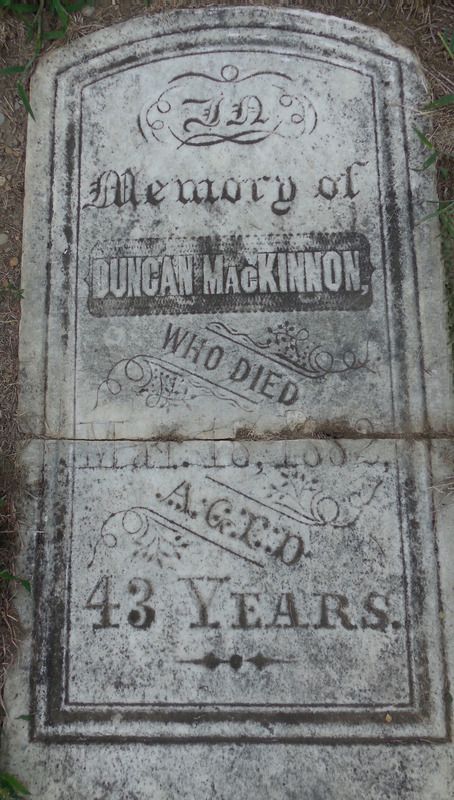
        “I visited the Alvinston Cemetery and took a photo of Duncan MacKinnon’s
headstone.  He is buried in Range 13, Lot 10.  Besides Duncan’s headstone, the only other MacKinnons were Aggie and Norman, children of Dr. Angus and Sarah MacKinnon.
        “I went back to the Lambton County Archives and a wonderful archivist named Patricia McEvoy helped me find information contained in an Alvinston book published as a centenary project, 1880-1980.  In it I found information about Dr. Angus MacKinnon, including, “In 1881, Dr. McKinnon [sic] opened a medical practice.  He gave devoted service for 20 years, then retired to Los Angeles”.  I found him in the 1910 US census for San Gabriel, Los Angeles, indicating that he and his wife immigrated to the US in 1902.  Angus MacKinnon died on Aug 3, 1918.  The 1920 US Census found Sarah living in Glendale, Los Angeles, with her daughter Jessie and son-in-law George Lockwood, a high school teacher.  I have created a memorial for Duncan in the Alvinston Cemetery in a Genealogy website called FindAGrave.com,
#168225642.  I used info for the bio from parts of your blog, The Globe article, and Angus’s letter to the editor.  I’ve also included the obituary and the photo of the headstone.  I also discovered that someone took a photo of Angus’s headstone in California, memorial #145376726.  His wife Sarah, memorial #145376727, died on Jan 24, 1926. [And here are their daughter Jessie and her husband George, memorials #85453297 and  #85453290, and their daughter Flora, memorial #145376728.  It looks like Angus and Flora might have been victims of the Spanish flu, dying just days apart in August 1918.]
        “Patricia McEvoy also helped me find Duncan MacKinnon’s obituary, which appeared in the Watford & Alvinston Guide-News, Mar 24, 1882, p.5.  “Mr. Duncan MacKinnon, brother of Dr. MacKinnon, who had been ill for some time, died on Saturday last, and his remains were interred on Monday of this week.  Mr. MacKinnon was not very extensively known in this neighbourhood.  He was a gentleman of culture and refinement”.”