collection1b

collection1b

February 11, 2015

John Peters Humphrey’s Fountain Pen

 
This stamp and a short version of this post were first printed in the
Journal of the Writing Equipment Society, No. 55, July 1999, p.9.

        Many people don’t recognize this man’s name, but they should.  John Peters Humphrey is 
the one who is now credited with writing the Universal Declaration of Human Rights.
        “In 1946, Humphrey became Director of the Human Rights Division in the UN Secretariat and was tasked with drafting the declaration.  The declaration is now considered one of the greatest achievements of the United Nations.  It espoused non-discrimination based on race, colour, sex, language, religion, and politics, and asserted that individuals have a fundamental right to health care, education, and work.  It recognized that
fundamental human rights and freedoms are a matter for international concern.  Adopted on Dec 10, 1948, the declaration served as a model for many constitutional documents throughout the world, including the Canadian Bill of Rights and Freedoms.  Now, it should be understood that he was just one member of a larger committee preparing the declaration.  The committee also included Eleanor Roosevelt, who called it the Magna Carta of Mankind.  Unfortunately, his contribution somehow became obscured, and a representative from France was later credited with the declaration and awarded the 1968 Nobel Prize.  More recently, however, researchers uncovered Humphrey’s type-written draft with his hand-written annotations, and he was subsequently credited with writing the bill, and was honoured with a UN Human Rights Prize.  In an interview, Humphrey humbly said, “To say I 
did the draft alone would be nonsense.  The final declaration was the work of hundreds”.
        “In October 1998, Canada Post marked the 50th anniversary of the declaration and honored its New-Brunswick-born author by issuing a commemorative domestic-rate
stamp.  The stamp celebrates the author of the declaration and consists of a portrait of Humphrey positioned above an actual type-written page from his draft, annotated in his own handwriting.  A period fountain pen points to the words “human freedom and dignity”.  A multi-racial crowd of people forms the background, suggesting the declaration’s impact on international human rights.  The style of the stamp is vintage, reminiscent of the 1940s, yet the layout, design, colour, and look are unquestionably contemporary.”
        The preceding was adapted from an article announcing the stamp in the magazine Canada’s Stamp Details,
Vol. 7, No. 5, 1998, pp.22-24.  The fountain pen in the stamp looks a lot like a Waterman’s #52 leverfiller with either a solid-gold or a gold-filled overlay, possibly a filigree.  There isn’t enough of the trim showing in the picture to be able to tell which one it is, but in any case, it’s a little too early to qualify as a “period fountain pen” from the late 194os.  Canada Post does not claim that it was one of his pens, but it’s a valiant effort, in any case.  If they had wanted to be absolutely correct, they could have done so.  All they needed to do was ask any old pen collector, or pen historian.

George Kovalenko.

.
 

February 09, 2015

A Vintage Pen Repair Shop


  , and a Waterman’s knock-out block.


[Posted on L&P, May 27, 31, & Oct 23, 2005, and Sept 5, 2007, & Jan 30, 2012.]
        In 1993 when I was researching all the old theaters in my city, I stumbled upon the last effects of a pen repair shop here in my city, including all the tools in my
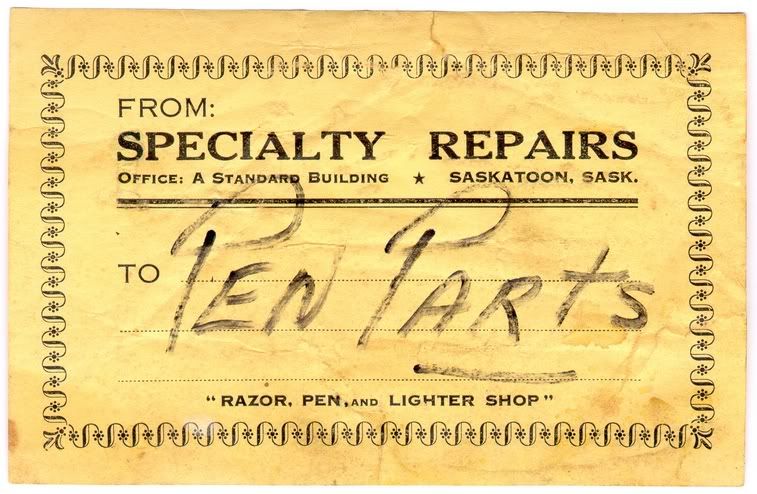
“Vintage Pen Repair Tools” blog post.  Along the way I got to know an old jeweler, Ray Willey, who sold me some old, unrepaired pens from his old business, including a Moss Agate Patrician.  I was looking for a lathe, and he told me about the son of another jeweler who still had his father’s lathe.  The son sold me the lathe, and when he found out that I collected and repaired fountain pens, he mentioned that his father’s jewelry shop in the Eaton’s Store was just one block away from a pen repair shop called Specialty Repairs in the Standard Trusts Building.  I rushed over to an archival library that deals with the history of my city, a library where I have now been working since 1994, and located the address of the shop, and found out that it was in business from 1945 to 1965.  I also found the name of the proprietor of the shop, Albert Wendland, and where he lived.  I quickly grabbed a current telephone book, and discovered that someone with the same surname was still living at that address, his son.  When I contacted the son I was pleasantly surprised to discover that they had a box of his repair shop effects.  As well as pen repair tools, many of which were proprietary tools made by specific pen companies and issued exclusively to repair shops, there were long pen boxes and envelopes full of mint repair parts, and I mean mint, straight from the various pen company repair-parts departments, some in little envelopes with the part numbers written on them, a cigar box full of little boxes with 200 gold nibs in them, a display board with all the stages of the “Process Of Manufacturing Waterman’s Fountain Pens”, exactly one shipping label with the shop name and address, a few hundred rubber sacs that are still good to this day, and many carcasses of broken pens and pencils.  I’m sure that some of the pen repair tools are homemade.  They are just a little too crude to be mass-reproduced tools.  They were probably made by the repairman for his own use, and they must have served their purposes well because he retained them.  I have kept most of the boxes and envelopes of mint parts intact and have only very sparingly dipped into them.  I know a lot of this because of that single shipping label.
        It was my great fortune to be first to find this treasure trove, and they felt that the box had found a good home, so they let it go.  So, do you think that this qualifies me as a sumguy, at least for that year?  In 1998, I had some color photos taken by professional photographer Gene Hattori, and the pics were just kicking around, so I thought I’d share them in the links in the above blog spot.  They’re not the best quality images because they are scans from the photos, which pushes them three generations away from reality.
        I found one very interesting item in the batch of
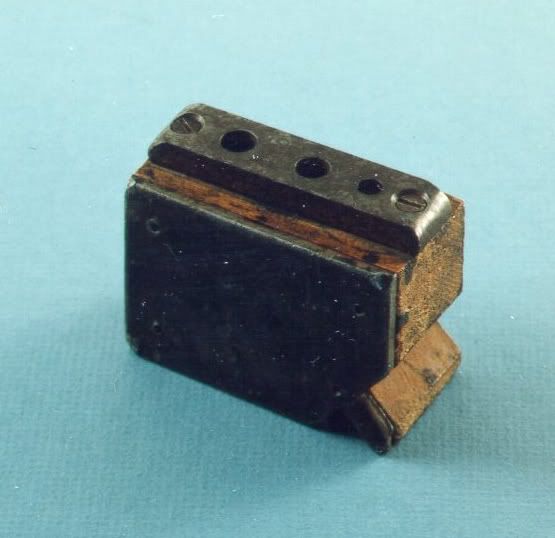
pen repair tools.  At first I thought it was just a generic knock-out block that the local repairman made for himself.  It’s made from a nice block of shellacked or varnished golden oak that’s been drilled out with 3 holes, and reinforced with a top metal plate.  On one side it has a lead plate attached, and one corner of the block is shaped into a protruding stem.  I’m only guessing, but the soft sheet of metal and the rounded stem seem like they would serve perfectly as a nib anvil.
        Well, the golden oak wood looked so good, despite the fact that the wooden side was scorched by a cigarette burn.  The repairman must have forgotten his cigarette butt on the wooden side of the tool one day, I guess, so I decided to remove the burn, take the lead plate off, refinish both surfaces, and use it as my own knock-out block.  But then I made a fascinating discovery.  Look at what I found underneath the lead plate, on the
underside of the plate.
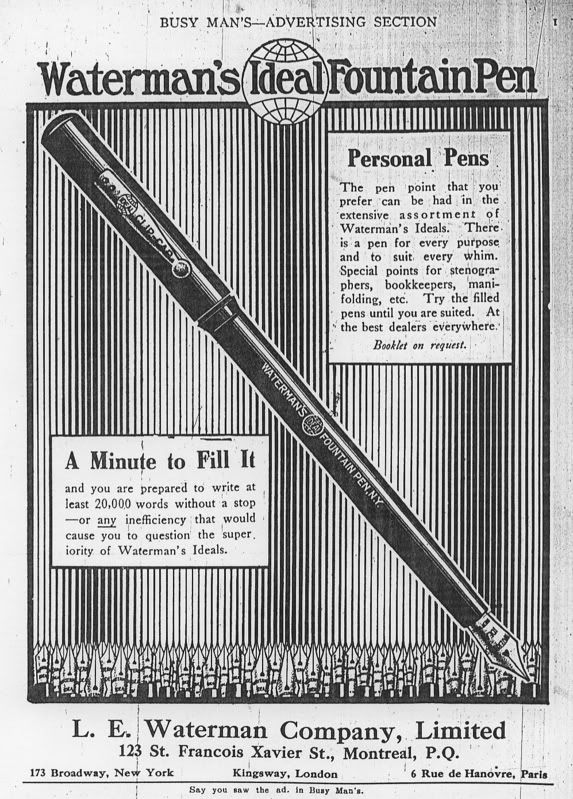
        I removed the lead plate very carefully, saving the nails, and trying not to damage the plate.  To my surprise, there was an image engraved on the underside of the lead plate.  It was part of a Waterman’s pen advertisement!  This lead sheet was part of a printing plate for a very cool, recognizable Waterman’s ad, the one with a row of various styles of nibs along the bottom edge with various widths of ink lines extending up from the iridium points, and an eyedropper pen placed diagonally across the ink lines.  The advertisement appeared in The American Stationer,
Apr 16, 1910, p.1, and another version of the ad with different ad copy appeared in the Canadian magazine The Busy Man’s Magazine, August 1910, p.1.  The two ads used the ad lines “Personal Pens”, and “You Can Suit Every Hand”, meaning, of course, that you had a large selection of nibs from which to choose, and with their legion of nibs marching towards the viewer, they also look like illustrations of the slogan, “The Army of the Dip-No-Mores”.  Someone really should publish a comprehensive book, or CD of all the early Waterman’s ads.
        Waterman’s must have had a stack of these types of lead printing plates kicking around in 

the warehouse and decided to pull them out of storage and put them to good use.  I have since restored the piece and replaced the plate, even to the extent of taking great pains to replace the nails in their original holes.  Each nail head had a distinctive shape and left its unique imprint in the lead.
        I found four historic photos, in the public library archival room where I work, that show the building called the Standard Trusts.  They’re actually just a few of the 68 pictures that you’ll find when you perform a search for the name Standard Trusts in this
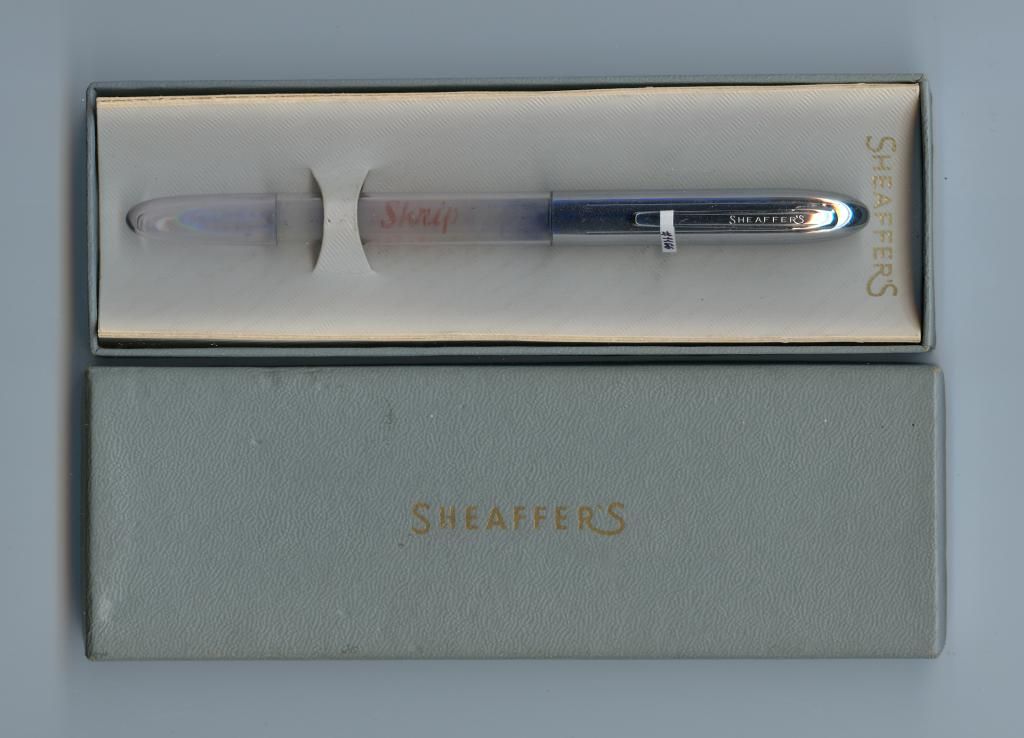
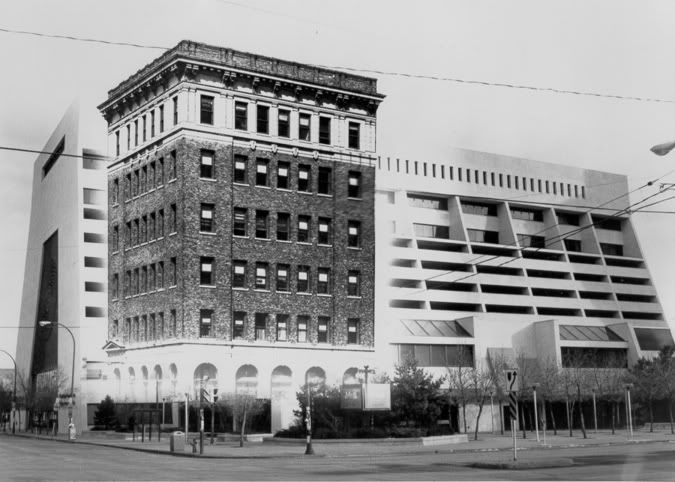
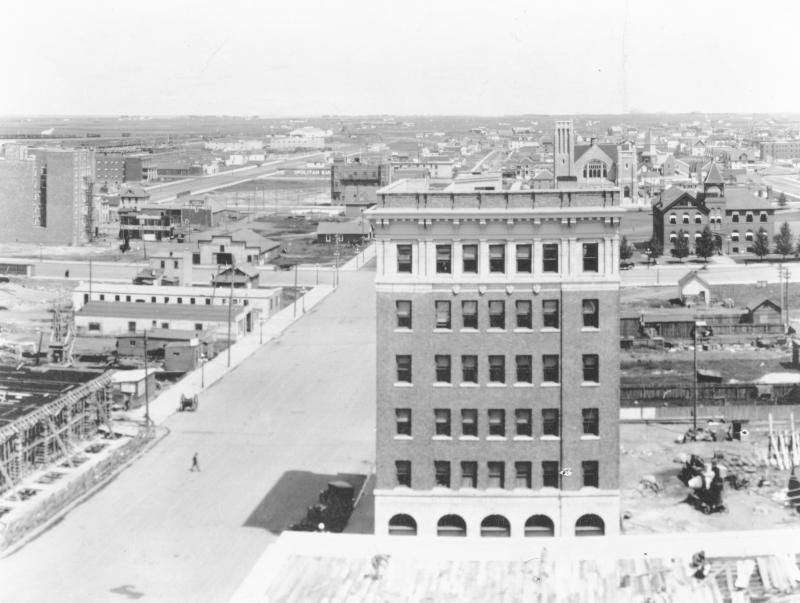
search window.  The repair shop was in the basement of the building, the tall one in SPL-LHR photo number LH-6109-B.  And one of those tiny basement window wells on the front is probably the one for the broom-closet of a shop that he had.  Across the street is a stationery store called Hazen’s at the time of the photo, but at the time that the repair shop was in business, 1945-65, it was known as Hazen Twiss.  The two photos in this article in Bookseller & Stationer, March 1915, p.30, show what the facade and interior of this stationery looked like in 1915.  This is what the Hazen Twiss building looked like in the 1950s in SPL-LHR photo number B-1992, and this is what their bookseller label looked like, as seen on Fred Mason’s website, This Modern Epoch, dead link, but saved on Wayback.  I have fond memories of buying some of the last remaining stock of Sheaffer “Skripsert” cartridge pens with pastel green and clear barrels before they went out of business.  I couldn’t afford to buy the Parker 75s and 61s and 51s, to my regret to this day.  Sad to say, most of the buildings in the above picture were demolished, including the one that housed the repair shop where all those tools were once used, and where many “Razors, Pens, and Lighters” were repaired.  This is what the city block on which the Standard Trusts Building was located looks like in SPL-LHR photo number PH-96-33-1, but with the now-demolished building ghosted back in where it should have been.  The archival library where I work is just behind the new building in the background.
        In the late 1990s, decades after the stationery store had closed, my photographer friend from above was digging around in the encroachment under the sidewalk in front of the Hazen Twiss building before the encroachment was filled in.  You can see the glass-block prism lights being installed in the vault ceiling in the sidewalk in SPL-LHR photo number
PH-88-634-6, at the left.  He found some old Waterman’s master ink bottles from the late 1910s or early 20s stored in the encroachment, and knowing of my interest in pens, he gave them to me.

George Kovalenko.

.

 

February 07, 2015

The Montblanc Splat


[Posted on L&P on June 1, 2009.]
        Have you ever wondered what happened to August Eberstein after he left the Simplo Filler Pen Co. in disgrace?  No?  Well, some of the early “Montblanc” and “Rouge Et Noir” and “Boston Pen Co.” collectors certainly might be interested.  To those who aren’t familiar with Eberstein, he was the factory manager and engineer for American Fountain Pen Co., which made the Moore’s Non-Leakable Safety eyedropper.  He had one early US patent in 1903 that was unassigned, while his other US patents from 1904-5 were assigned to Charles Brandt, also of American Fountain Pen Co., Boston Fountain Pen Co., and later Moore Pen Co.  Eberstein left for Germany around 1905-7 and worked with Eugen Hahn, with whom he shared a patent, before he helped start up the Simplo Filler Pen Co. and served as their first factory manager and engineer.  He provided the technical and engineering expertise, and the patents and the look and designs for the early “Rouge Et Noir” pens from 1907-9, the precursors to the early “Montblanc” pens.  To his disgrace, he secretly sold off the company equipment and raw materials in order to finance his lifestyle, and was taken to court before disappearing with his family back to the US.  But later he reappeared in the UK and worked with Ernest Macauley Wade, with whom he shared another late patent in 1912.  Well, these two patents provide clues as to his later fate.
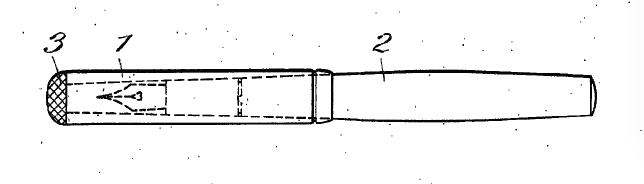
        After he left the US, Eberstein joined forces in Berlin with the merchant Eugen Hahn, and together they received UK patent no.
13,900 from 1907, applied for on June 15, 1907.  The illustration shows both an ordinary eyedropper and a safety eyedropper.  The latter is shown with a push-rod mechanism reminiscent of the Moore safety pens, although he also produced safeties with a spiral-screw mechanism.  The safety pen is also shown with an internal cap stopper with the silver rod to help avoid accidents, a fail-safe mechanism in case the nib was not retracted.  None of these ideas were original by that time, and none of them were the subject of this patent.  All the patents were in the public domain, but he provided the expertise to meld these various functions together, and also predisposed the look and the design and the style of the Simplo safety pen.  But more importantly, this patent provided the original rationale for the colored cap end.  The specifications state in part, “The invention relates to a fountain pen holder in which the closing cap for the end carrying the pen is provided with a distinctive colour, 3, which enables the position of the pen to be recognised when the holder is closed.  By means of the invention it is therefore possible to avoid inserting the penholder [in a pocket] with the pen downwards, and the resulting escape of ink. . . . The colour, 3, shows that the fountain penholder always must be carried or held upright in the closed position, that is to say, with the pen and the mouth of the socket upwards, in order to prevent the ink from flowing out and the holder from being soiled”.  So that’s the origin of the red-colored end of the “Rouge Et Noir”, and later the solid white top, and yet later the white six-pointed-rounded-star of the “Montblanc”, sometimes irreverently referred to by pen collectors as the “snowflake”, or the “bird splat”.  I guess that makes this the Ur-splat.  All other reasons and explanations for the splat are after-the-fact rationalizations.
        In a message on Zoss on Dec 20, 1998, and here in my blog post about Freud’s fountain pen
I wrote this about Freud’s large RHR Montblanc safety eyedropper.  “It’s an enormous, almost tumescent, all-red pen, except for the suggestive, white, dripping star on the tip of the cap”, a different kind of splat.  Papa Freud liked his pens big and red.  Here’s a more recent picture of a large RHR Montblanc safety pen at the October 2008 Hamburg pen show on Azad Kurdistan’s “MrGoldfink” blog spot, and at the October 2014 Hamburg pen show on Simone Piccardi’s “Pencyclopedia” website.  The pen is owned by Horst Max Schrage, and it shows up on his “Maxpens.de” website.  The name “Montblanc” wasn’t trademarked until 1910 in Germany, after Eberstein had left, and the US trademark for the white splat, TM 839,016 from Nov 21, 1967, stated that the first use of the splat in commerce wasn’t until 1913, when it was first trademarked in Germany.  And the special process of inlaying the splat in the end of the cap wasn’t patented until 1914.  But Eberstein and Hahn started the whole idea in 1907.
        And where did Eberstein end up?  Most versions of his story say that he went back to the US after his disgrace.  But UK patent no.
29,078 from 1912, applied for by August Eberstein and Ernest Macauley Wade on June 13, 1912, shows that he ended up in England, doing business at 13 Hope St., in Liverpool.  This patent was for a spoon-shaped feed with a “plurality of grooves or slots” that communicated with the “ink passage” and “air duct”, and the nib needed to be immersed only to a depth sufficient to seal these openings.  So that’s where he was.  He continued to invent and create new fountain pen technology to the end, or at least a little while longer.

P.S.
Also take a look at the Anti-Splat pen in this blog post.

George Kovalenko.

.
Shiraboshi  whitestar


February 04, 2015

RHR patents and trademarks

 
And this is what the cap on my RHR Namiki should have looked like.

[Posted on L&P on Aug 13, 2010.]
        Actually, red hard rubber pens weren’t red in the first place.  They were more of an orange-red.  First of all, they were
burnt orange, maybe even a pompeian orange, then they were bright orange.  But they were never red.  Modern red hard rubber was a bright orange hard rubber.  Here are some of the patents for the coloring agents in vintage RHR to prove my point.
        UK patent no. 11,616 from Mar 10, 1847 is for “An Improved Mode Of Preparing And Obtaining Certain Colors”, including “Orange Red sulphuret of antimony”.  US Patent no. 51,846 from Jan 2, 1866 is for an “Improvement In Colored India-Rubber”, the addition of vermillion and “sulphuret of zinc” to vulcanite to make red hard rubber.  US patent no. 51,849 from Jan 2, 1866 is for an “Improvement In The Manufacture Of Colored India-Rubber”, adding vermillion again, and the use of red and golden antimony.  Also see US patent nos. 51,847 and 51,848.  US patent no. 53,643 from Apr 3, 1866 is for an “Improvement In The Manufacture Of Hard Rubber”, a method of incorporating waste hard rubber, which included such ingredients as litharge, or red lead, and white lead, and magnesia, and lamp black.  US patent no. 99,885 from Feb 15, 1870 is for “Coloring Matter To Be Used In Vulcanized Rubber”, the use of red antimony and golden antimony.  US patent no. 99,956 from Feb 15, 1870, and assigned to the India Rubber Comb Co., is for an “Improvement In Coloring Vulcanite Or Hard Rubber” with antimony.  US patent no. 255,970 from Apr 4, 1882 is for an “Apparatus For The Manufacture Of Red Lead”, or minium, or litharge.  US patent no. 278,816 from June 5, 1883 is for a “Method Of Producing Golden Sulphuret Of Antimony” from gray sulphide of antimony known as “antimony glance”.  UK patent no. 11,666 from 1889 is for “Orange-red coloring matter”.  US patent no. 431,026 from July 1, 1890 is also for a “Process Of Manufacturing Red Lead”, or minium, or litharge.  US patent no. 556,793 from Mar 24, 1896 is for “Reducing Lead Scum Or Litharge”, or red lead, or minium.  US patent no. 588,883 from Aug 24, 1897 is for a “Process Of Making Litharge Or Protoxid Of Lead”.  US patent no. 639,209 from Dec 19, 1899 is for the “Manufacture Of Lead Oxid”, or litharge, or minium.  US patent no. 674,031 from May 14, 1901 is for a “Process Of Making Lead Oxid”, or red lead.  US patent no. 920,335 from May 4, 1909, and assigned to Picher Lead Co., is for a “Method Of Manufacturing Litharge”, or red lead.
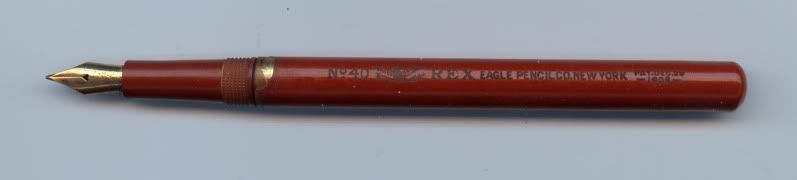
        And here are the trademarks for some red hard rubber pens.  US trademark no. 66,269, Joseph F. Kearney & Co., “Stylographic Fountain-Pens”, Nov 19, 1907, used since October 1904, is for the “Red Dwarf”, a red hard rubber stylo.  US trademark no. 69,444, James W. Laughlin, “Stylographic Pens”, June 16, 1908, used since Jan 13, 1908, is for the “Red Gem”, another red hard rubber stylo.  US trademark no. 71,543, John Blair, “Stylographic And Fountain Pens”, Dec 1, 1908, used by Blair’s Fountain Pen Co. since Nov 9, 1907, is for the “Red Robin” red hard rubber stylo with an image of a robin.  US trademark no. 71,551, Parker Pen Co., “Fountain-Pens”, Dec 1, 1908, used since Jan 1, 1908, is for the “Red Giant”, a large red hard rubber pen, as opposed to the “Black Giant”, the later large black hard rubber pen.  US patent no. 907,722, Claes W. Boman, “Fountain-Pen”, Dec 29, 1908, assigned to the Eagle Pencil Co., the cheap
“Rex” eyedropper pen made of an unfinished hard rubber reservoir covered with a japanned metal case and cap “finished to match the finish [and color] of the tip”, or section, which is specified to be “made of hard rubber–preferably of russet color–and is polished and finished”.  Also see his US design no. 20,156 for this pen.  It’s almost a Pompeian Brown.  Even though it was not the first red hard rubber pen, it was the first pen in the US patents specifically said to be made of red hard rubber.  I’ll save the trademarks for the red hard rubber Duofolds for another thread, but next, watch out for the Montblanc splat.

George Kovalenko.

.

 

February 01, 2015

Red Hard Rubber


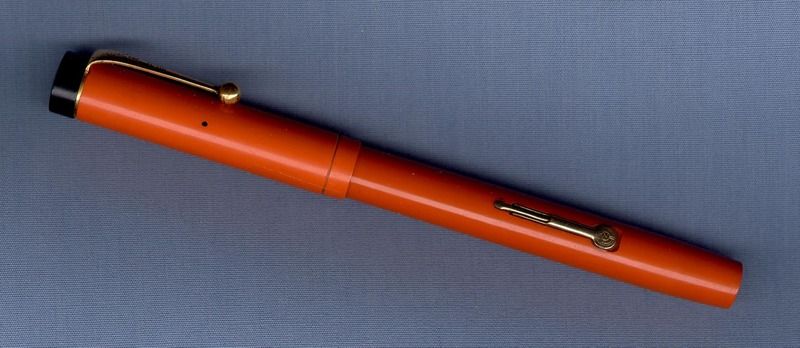
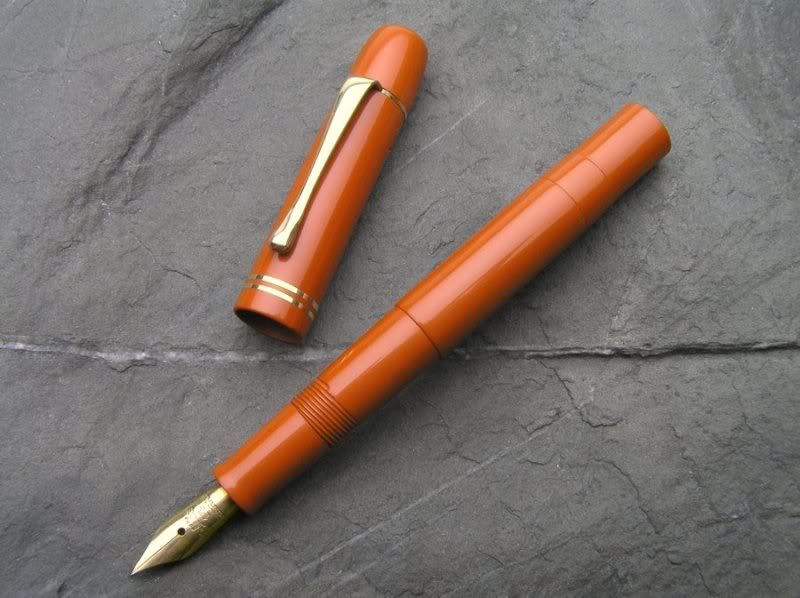
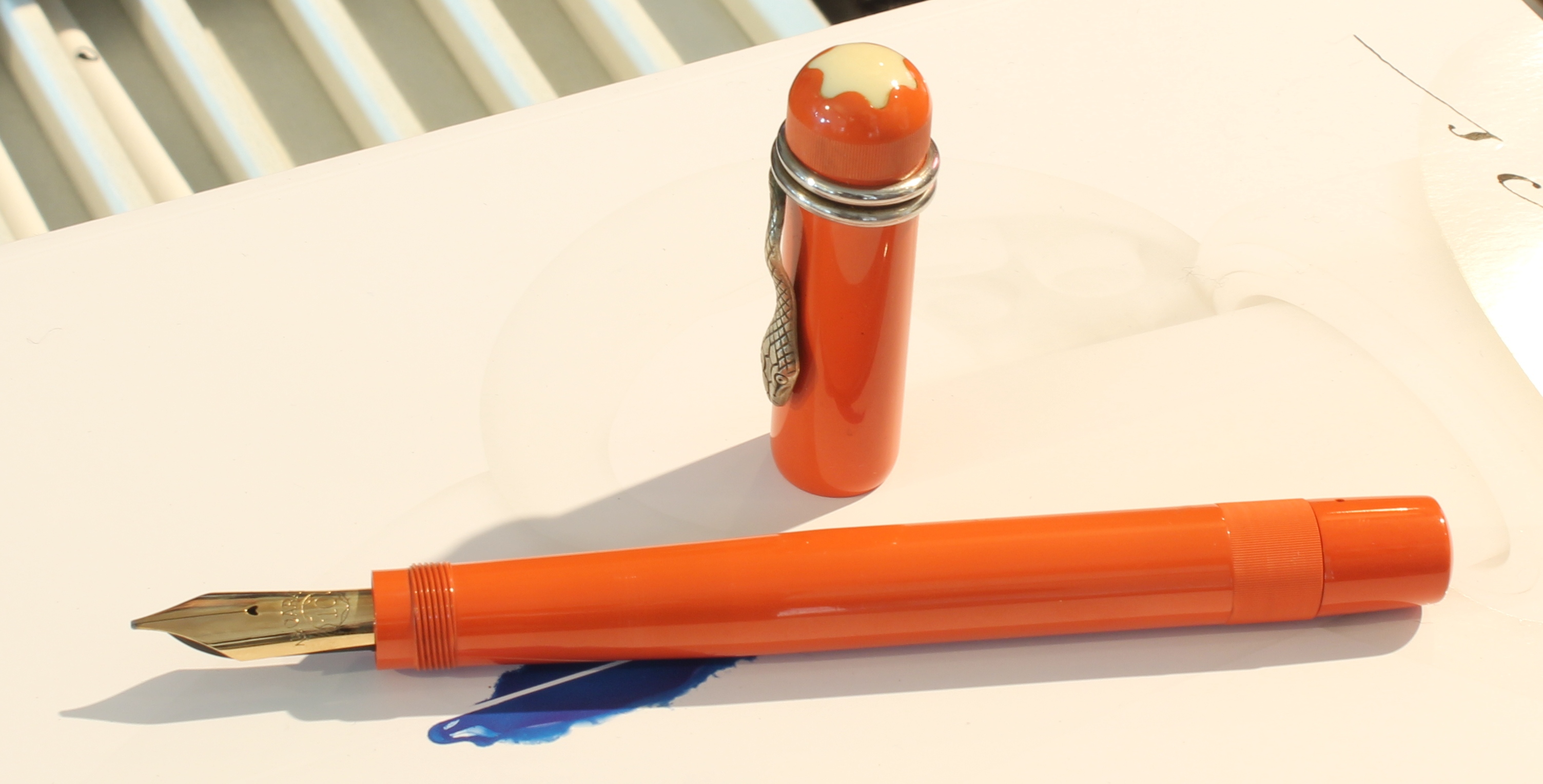
A red hard rubber Namiki fountain pen from the 1920’s with a cracked Sailor cap, from my collection.  Every pen company
had its own formulation for RHR, which can be seen in the color difference between the cap and the body in this picture.

[Posted on Zoss on Feb 13, 2000, Apr 21, 1999, and Mar 13, 1999, and on L&P on Dec 30, 2005.]
        I collect pens, pencils, penholders, and inkwells made of red hard rubber, RHR, exclusively, so I guess you could say I sort my collection by color, one color, red.  Actually it’s sort of an orange color, but the traditional name for it is red. One true method of telling RHR from plastic is to smell it, so I guess you could also say that I do my pen sorting by pen snorting.  If you’re not sure whether an item is made of hard rubber, here’s my favorite test.  Place the pen right under your nose like a moustache.  Breathe out onto the pen through your nose, and then right away breathe in through your nose.  If it’s hard rubber, whether red or black, it will smell like an old tire tube, or a rubber ball.  The warmth and humidity of your breath will bring out the sulphurous, latex smell within a breath, or two.  If you can’t get any smell out of it, it’s plastic.  If the plastic is celluloid, and if you don’t smoke and have an acute sense of smell, you should be able to detect the smell of camphor.  And from bakelite, you should smell formaldehyde, or the smell of rotten eggs.  There is also a definite difference in the smell of BHR and RHR.  I have gotten to the point where I can identify the color of hard rubber blindfolded, by smell alone.  That prompted Xan Nyfors to quip that I had really good RHR Radar.  The black hard rubber is sharp and pungent, and the red hard rubber is more subdued, and has almost a gentle, creamy smell compared to the black.  I would almost go so far as to say it’s dreamy.
        But then, you know me.  I think that RHR is HRH, as far as I'm concerned.

[Posted on L&P on Dec 23, 2004.  Also placed on the
Lion & Pen homepage.]
        I posted this a while back over on Pentrace, when they were talking about red and orange hard rubber, but since my post has long ago disappeared from the Pentrace message board, I thought I’d post a new version of my response here to archive it.
        Syd Saperstein was right when he talked about orange hard rubber.  Red hard rubber pens “weren’t red in the first place”.  They were orange.  First of all, they were burnt orange, then they were bright orange like
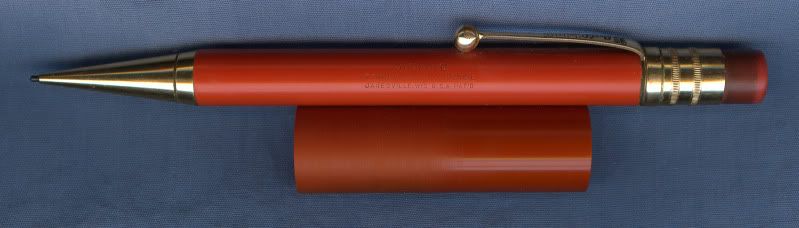
these two examples.  But they were never red.  Vintage red hard rubber was a bright orange hard rubber.  Well, that’s not always true either.  The lighter ones sometimes darken where the cap fits over the section onto the barrel, but they were originally brighter in color.  Some people say it’s the other way around, but I don’t buy it.
        Some batches of RHR have iron oxide, or hematite in them, which makes them brownish red to start off with.  It is the pigment most often used in soft elastic rubber.  But the major constituent coloring agent of RHR is cinnabar, or vermilion, which is orange-red in color to start off with, but it slowly darkens to a rusty brown with exposure to sunlight.  Chinese and Japanese lacquer are colored with it, and are typically called “red lacquer”.  Some other red pigments that were used in RHR are minium, or red lead, and litharge, or yellow lead.  In Japan, where cinnabar, minium, and litharge are used as artist’s pigments, it is well documented that the red colors in paintings unpredictably darken and often turn rusty brown over time, so the same kind of thing probably goes on in RHR as well.
        Some of the red pigments actually revert to black versions of their natural minerals.  In the case of cinnabar, the culprit is
UV-light.  When exposed to sunlight, it turns black.  The substance responsible for turning red lead to black is sulphide, and since sulphur is the vulcanizing agent in hard rubber, any RHR that darkens in the absence of light probably contains a high percentage of minium or litharge.
        In order to make the RHR brighter in color, scarlet antimony and golden antimony were added to the mix, as well as other yellow pigments.  Black and white pigments were also very important in attaining the right shades.  I’ve seen a lot of early formulas and recipes for RHR, and they all contained these pigments to various degrees.  These deadly heavy-metal pigments are no longer allowed for safety reasons, and the contemporary substitutes just don’t cut it.  That’s why Chris Thompson is having such a hard time approximating the old color in the red rod stock he is having made for him.  Parker used a synthetic dye in the middle and late RHR Duofolds called Vulcafor Orange, which made the rod stock lighter in weight as well as in color.  It is why those later RHR Duofolds look so glorious.
        Some companies had their own supplies of RHR, and their own proprietary formulations for their distinctive shades of red rod stock.  Sheaffer red is much darker than Parker Duofold red, and Wahl Eversharp red is almost a creamy coral.  The brightest oranges are the Onotos and the Conway Stewarts and the Duofolds, but then I’ve seen darker ones as well.  There’s no general rule.  Sometimes Waterman’s red is light, and sometimes it’s dark.  It’s highly unpredictable and very infuriating.  Some of the early Parker RHR is slightly darker, but the Vulcafor Orange Duofolds make up for it.  After those glorious RHR Duofolds, the red plastic ones are a huge disappointment.

[Posted on L&P on Feb 14, 2005, revised Feb 1, 2015.]
        Over on Zoss, Glenn Craig asked whether any brave new company was working on a modern red hard rubber.  Well, the only things holding it up are economics, and the further complication of safety standards.
        Let’s start with the safety issues.  The old red hard rubber formulas incorporated not only mercury in the form of the mineral vermillion, or cinnabar, but also minium, or red lead, and litharge, or yellow lead, and golden and scarlet antimony.  All these heavy metals are highly regulated and restricted in the workplace today, and that makes the old formulations of yesterday impossible today.  There are at least two companies in the US that could make red hard rubber, but they can’t use these old colorants.  Chris Thompson is working with one of these companies to try to develop a RHR rod stock, but this is exactly the problem that he has run up against.  He has a darker shade of RHR, but not the desired brighter orange tint.  Also, the developmental costs of experimenting and trying to achieve that brighter color are quite high, so if he does succeed, the rodstock won’t be cheap.
        There are also three European companies that make hard rubber, two in Germany, and one in Italy.  One German company,
New-York Hamburger Gummi-Waaren Compagnie, or NYHAG, was based in Hamburg-Barmbek, and had been in the trade since the 1870s.  They also made a darker shade of RHR, but there was another problem.  A few years ago, the minimum order used to be 1000 meters of rodstock.  Now, the minimum order is about 100 meters, but that might still be too much for some penmakers.  All pen repairmen could use a few meters at least, and pensmiths such as Paul Rossi and Michael Fultz could make use of a few dozen meters or more, [and some small pen companies such as Howard Levy’s Bexley Pen Co. and Brian Gray’s Edison Pen Co. could utilize a hundred meters or so,] and even I could use a few meters, so that I can stick it in a corner and admire it for ten years like Brad Torelli.  Perhaps we’ll have to get together a red hard rubber cartel.  Schönberger Ebonite Manufaktur, or SEM, is a young German company dealing in a variety of ebonite products including some very high quality ebonite rods for penmakers.  They were founded in May 2006, after this article was first written, by partners who had worked for New-Yorker Gummi-Waaren for a long time.  They produce the best quality rods without bubbles, free of pores and blow holes, without smell or taste, and easy to polish.  They produce a red rodstock, but the color is still too dark because they use the same machines to produce darker colors and black, and the machines can never be cleaned completelyTo produce ebonite you need a lot of machinery, and they cannot afford to dedicate the necessary machines to red hard rubber production exclusively.  They have no minimum order, but smaller runs of rodstock are understandably more expensive.  Volonta Anselmo is the Italian company making hard rubber in Varese, Lombardy, in northern Italy.
        But that still doesn’t solve the problem of the color.  Some might want a darker shade to repair older pens, and others might want the orange shade more common in the 1920s, to repair Duofolds and Watermans and the like.  It might not be possible to please everyone, and the cartel will fall apart.
        There might be a solution, though. In 1992, “Pen World” published a series of articles by Bob Tefft on “Materials Used To Make Pens”.  In one of them, he gave the formula for the RHR used in the later hard rubber Parker Duofolds.  The early Parker RHR contained the usual heavy metals, but the RHR from the later-Duofold era substituted a synthetic aniline dye called Vulcafor Orange.  That’s the secret of those glorious orange later hard rubber Duofolds.  The dye goes under about 50 different trademarked names, depending upon which company makes it.  These names include “Tiger Orange”, “Pyrotone Red”, “Pigment Scarlet”, “Tanager Red”, “Blazing Red”, “Flaming Red”, “Fast Orange”, and “American vermilion”, all commercial names for chlorparanitraniline red, otherwise known by the chemical names, 2-Naphtalenol 1-((2-chloro-4-nitrophenyl) azo), and 1-((2-chloro-4-nitrophenyl) azo)-2-naphthol.
        Perhaps someone can be persuaded to take it upon himself, or herself, to get in touch with 

the companies producing hard rubber rodstock for fountain pens, to see whether a special formulation using Vulcafor Orange, or some other correct orange-red colorant, would be possible.  Then it’s just a matter of getting the cartel together.
   
[Posted on L&P on Dec 29, 2012.]
        I know a pen collector, and pensmith, and hard rubber maker in Poland, Lukasz Marszalek, who is a designer in his day job, but in his spare time, he is a penmaker.  Luk isn’t a professional penmaker with a company of his own, but an amateur in the true French sense of the word, “someone who does something because he loves it”.  Now, when I say he makes pens, I mean he makes pens!  He makes pens from scratch, that is, he makes his own hard rubber rodstock in many different colors, and then he makes pens from those rods.  Here’s an example of a loving, faithful reproduction of a
Pelikan 100N made from some RHR rodstock that he also made.  The ebonite production is still in the experimental stage, and he’s not ready to start mass producing the rods, or the pens, but you can see the quality of the workmanship.  This picture is just to wet your appetite, but perhaps he can be persuaded to join the cartel, and to make some more pens and rodstock for sale.  Here’s a copy of a tiny Montblanc RMHR eyedropper that Luk also made.  It looks a lot like this tiny Montblanc No. 0 safety and this No. 00 safety on Tom Westerich’s website, minus the Montblanc splat.

[Addendum, Feb 1, 2015.]
        David Nishimura & Mark Hoover’s company
American Art Plastics has started selling hard rubber rod stock made for them with pigments that are not classified as hazardous materials by the US Department of Transportation.  The dust produced while working their hard rubber is not toxic, though it is an irritant.  They have two types of orange-red.  They say that their first type, “Classic Orange”, is “the closest thing yet to vintage red hard rubber”.  It is not an exact duplicate of any single vintage color, though it is right in the vintage color range resembling coral.  Weight and feel are also true to the era.  Their second type of “Orange”, which they also call “Tangerine”, is a true orange in comparison to the vintage red-orange.
        The thing about vintage RHR was that every pen company had its own formulation, and Conklin, Conway Stewart, Namiki, Onoto, Parker, Sailor, Simplo-Montblanc, Waterman
, and Wahl had some of the best.  There is nothing like the color, or the smell, or the feel of the old stuff.  In my opinion, none of these modern reds produced by all the contemporary companies are correct.  They are all still wrong when compared to the pens produced in the late 1910s and the 1920s by the above vintage pen companies.  But their worst down falling is that they smell bad.  The components of the new rodstock are all wrong.  When new pens made from the new rodstock are warmed up in the hand, they just don’t smell right.  In fact, they stink, both literally, and metaphorically.
        And if you’re still not sure whether a pen is made of red hard rubber, here’s another test.  Rub the pen 2 or 3 times on one tiny spot with a clean, damp, white cotton cloth.  If the spot on the white cloth turns orange, it’s RHR.  No amount of rubbing, even aggressive rubbing, will turn the cloth orange, if it’s a plastic pen.  These tricks of the trade are all part of being a pen pusher, someone who tries to get you addicted to pens.
        As Meike Huijssen, managing director of SEM, likes to say, “I love my ebonite”.
 
George Kovalenko.

.


Addenda et Corrigenda, Feb 14, 2015.
        Here are some additions and corrections, with thanks to penmaker Tom Westerich.
        NYH produced for a long time in Hamburg, Harburg, but some years ago they moved south of Hamburg near the city of Lüneburg.  The minimum order today is 90 kilograms of material for colors, and black rodstock is a minimum of 1000 Euros per diameter.  Ages ago, their ebonite factory complex used to be in Hamburg, Barmbek, but now what is left of the buildings houses the “Museum der Arbeit”.  SEM was founded by one ebonite engineer defecting from NYH.  She was funded by Meike Huijssen, but has since left SEM.  Quality is fine, but some colors are prone to bleaching, including some lots of black ebonite that have come out coffee brown.  I’m not sure Volonta Anselmo still produces.  I tested his stuff some years ago, must be 10 years ago already, and the quality wasn’t there.  The stuff with the crazy colors made in China is $10 per rod, if you buy 3000 metres, but the quality is bad.  Their coral red is quite a good color, but it’s too soft, and it smells like chopping up rubber tires when working it.  Do not forget
Nikko Ebonite Mfg. Co. in Japan, very good quality rodstock.  They also make pens, and have a separate website for their Eboya pens.  Forget the Indian rubber company.  Their stuff is porous.  Well, if you pay less, you get less.

 
My shoulder patch.
 

January 29, 2015

The Civil War Pens


, and other writing instruments at the signing of the Surrender at Appomattox.


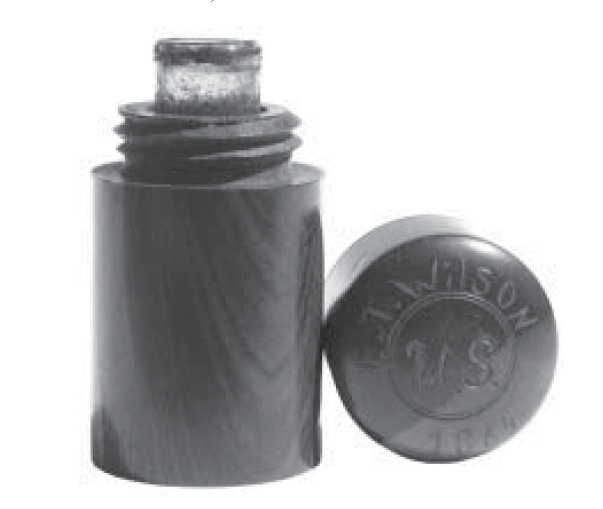
From Ed & Lucy Faulkner’s ink bottle book, boxwood pocket inkwell, ca. 1864.

[Posted on L&P on Jan 27, 2013.]
        I was blundering about online looking for copies of The Century Magazine that didn’t have their ads stripped out, but before I could get smart and give up on that, I found this mention of the scarcity of pencils, and pens, and ink, and inkstands, and traveling or pocket inkwells, and paper in the Civil War battlefield at the signing of “The Surrender at Appomattox”.  As reported by Lt. Colonel Horace C. Porter, the signing took place in Wilmer McLean’s home, a brick house in “the little village of Appomattox Court House, with its half-dozen houses [on] its single street”.
        “Lee felt in his pocket as if searching for a pencil, but did not seem to be able to find one.  Seeing this and happening to be standing close to him, I handed him my pencil.  He took it, and laying the paper on the table noted the interlineation.  During the rest of the interview he kept twirling this pencil in his fingers and occasionally tapping the top of the table with it.  When he handed it back it was carefully treasured by me as a memento of the occasion.
        “General Grant then said: Unless you have some suggestions to make in regard to the form in which I have stated the terms, I will have a copy of the letter made in ink and sign it....
        “He handed the draft of the terms back to General Grant, who called Colonel T. S. Bowers of the staff to him and directed him to make a copy in ink.  Bowers was a little nervous, and he turned the matter over to Colonel Ely S. Parker, whose handwriting presented a better appearance than that of any one else on the staff.  Parker sat down to write at the table which stood against the rear side of the room.  Wilmer McLean’s domestic resources in the way of ink now became the subject of a searching investigation, but it was found that the contents of the conical-shaped stoneware inkstand which he produced appeared to be participating in the general breaking up and had disappeared.  Colonel Marshall now came to the rescue, and pulled out of his pocket a small boxwood inkstand, which was put at Parker’s service, so that, after all, we had to fall back upon the resources of the enemy in furnishing the stage properties for the final scene in the memorable military drama.
        “Lee in the meantime had directed Colonel Marshall to draw up for his signature a letter of acceptance of the terms of surrender.  Colonel Marshall wrote out a draft of such a letter, making it quite formal, beginning with I have the honor to reply to your communication, etc.  General Lee took it, and, after reading it over very carefully, directed that these formal expressions be stricken out and that the letter be otherwise shortened.  He afterward went over it again and seemed to change some words, and then told the colonel to make a final copy in ink.  When it came to providing the paper, it was found we had the only supply of that important ingredient in the recipe for surrendering an army, so we gave a few pages to the colonel.
        The pocket inkwell might also have been made of hard rubber, which, in its discolored form, can look like boxwood.

George Kovalenko.

.
 

January 27, 2015

The Eyedropper Era


[Posted on L&P on June 16, 2007.]
        Someone on a pen message board used the term “the eyedropper era”, and it got me thinking. What exactly constitutes the eyedropper pen era?  And more to the point, when exactly did the eyedropper pen era start?  In order to have an eyedropper era, you must first have an eyedropper.  And not all pens capable of being filled with an eyedropper fall within this eyedropper era.  For instance, all the Bion-type pens going back to 1650-1700 could now be filled with an eyedropper, but at the time they were made, they were filled either by pouring the ink in, or with a glass-tube pipette.  What’s needed for the eyedropper era to begin is, first of all, the invention of soft, pliable rubber, and then, secondly, the invention of squeeze-bulb technology.  The former didn’t come along until Nathaniel Hayward’s 1839 US patent for soft rubber, assigned to Charles Goodyear, and Goodyear’s own improved 1844 US patent for soft rubber, and Thomas Hancock’s 1844 patent for the same in the UK.  But that’s not the beginning of the eyedropper pen era, yet.  You still need the later squeeze-bulb technologies to be discovered and perfected and popularized before that potential is recognized and utilized and adapted for medicine droppers and ink eyedroppers.
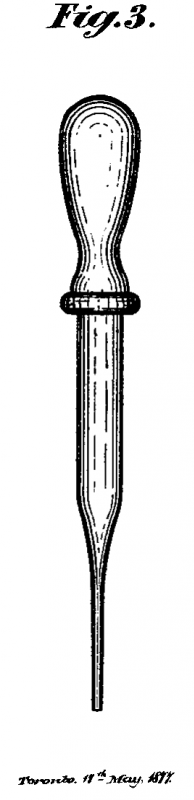
        According to Mike Woshner’s book, India-Rubber And Gutta-Percha In The Civil War Era, the first squeeze-bulbs didn’t make their appearances until the late 1840s and early-to-mid 1850s.  They were used for such purposes as artificial nipples, breast pumps, saliva pumps, various dental and medical pumps and syringes, enema pumps and syringes, and air pumps.  There is even an 1856 pneumatic fountain inkwell with a squeeze-bulb, US patent no. 14,451.  In the 1877 Canadian patent for Might & Taylor’s fountain pen, no. 7,617, and US patent no. 195,719 later the same year, in Fig. 3 in both, there is an illustration of an eyedropper, although it’s called simply an “ink filler”.  Even as late as 1879, the Franklin Institute report on the MacKinnon Pen Co. stylographic pen, or ink pencil, or “Fluid Pencil” that I mentioned before in this blog said that the pen’s ink reservoir was “filled by an elastic syringe”.  It still used an archaic term, not the word “eyedropper”.  In fact, eyedroppers used to be known as Pasteur pipettes, named after Louis Pasteur, who used a variant of them in his research in the late 1800s.  And the Random House Dictionary places the origin of the word
“eyedropper” in 1935-40, which seems a little late to me, and places the term itself well outside the eyedropper fountain pen era.  It’s probably a term for fountain pens that was adopted and popularized by pen collectors, and well after the fact of the eyedropper era.  Before that, it was just called an ink filler that consisted of a pipette with an elastic rubber bulb.
        In spite of all my efforts, I couldn’t find a patent for the eyedropper itself, but perhaps it was already common knowledge by the time the first eyedropper patents were applied for, and it was considered prior art, and unpatentable.  Maybe it’s just a matter of finding the right title, or name, or search term.  So the eyedropper probably dates to some time in the late 1840s to mid 1850s.  In any case, the first “Medicine Dropper” patent that I could find wasn’t until 1868, US patent no. 79,487, and that one doesn’t fit into the Civil War era, so it isn’t included in the Woshner book.  But it would make a great traveling inkwell.  Even so, most of the pens of the period were still said to be filled “by pouring the ink in” rather than being filled with an eyedropper, US patent nos. 6,672, and 16,299, and 123,263, or filled with a funnel, no. 31,298.  Has anyone else been able to find an early patent for the eyedropper, or medicine dropper?  There are some US patents such as nos. 206,200, 256,206, and 296,963, for pens that incorporate a messy rubber filling bulb in the pen, and US patent no. 542,450 has one of the first US patent illustrations of an eyedropper being used to fill a pen.  Another later “Medicine Dropper”, US patent no. 448,555, is merely a pipette with a hole in its side to release the pressure, like an Aerometric filler tube, and it has no squeeze bulb.  The idea of the hole in the side of the pipette was also used in US pen patent no. 717,425, on its integral eyedropper stored in the end of the pen.
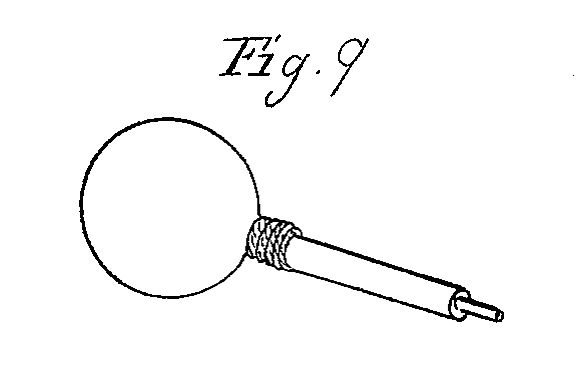
        Olle Hjort suggested another earlier patent with a possible first illustration of an eyedropper being used to fill a pen, “US patent no. 5,789 from 1848 showing a separate eyedropper for filling the pen.  The ‘india-rubber pump’ looks like an eyedropper but is used to force [or inject] ink into the pen instead of dropping it in”.  He’s right.  The illustration in patent no. 5,789 is probably the earliest representation of what may generously be called an eyedropper for a fountain pen, but it doesn’t look like one, and it isn’t referred to as such in the specifications.  It’s called an “elastic pump”, and an “india-rubber pump”, and it looks more like a turkey baster that’s used to squirt the ink into the pen.  It
also looks sort of like a balloon on a wand, but not Lenny Bruce’s.  ;~)


And the pen came in two versions.  The other one had a rubber sac and could be filled as a finger-press filler.  That makes two balloons!
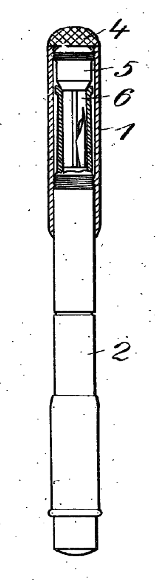
        Here’s one of my favorite images of a fountain pen, US patent no. 630,526, Sheet 2, actually a gravity filler being filled with a quirky, proprietary, custom-fit, large-mouth eyedropper.

George Kovalenko.

.
 

January 23, 2015

The MacKinnon Pen


, in the Franklin Institute.


      In an advertizing pamphlet published ca.1879 by the MacKinnon Pen Co., they mentioned that their pen was “hailed by The Scientific American in an exceedingly complimentary editorial”, which “gave the key-note to the press throughout the country, and the name of MacKinnon was heralded far and near”.  The pamphlet also described the A. T. Cross stylo as “a delusion and a snare”, and that Cross was “wilfully or ignorantly deceiving the public” because they did not have the MacKinnon “weighted needle” and the “circle of iridium”.  It also says that the pen “received a practical test for over six months in the hands of the able professors of [the Franklin Institute]”, which issued a report dated May 7, 1879.
      The Committee on the Sciences and Arts constituted by the Franklin Institute of Pennsylvania, to whom the “MacKinnon Fountain Pen” was referred for examination,
reported that, This is one of the latest forms of pocket or desk pen for miscellaneous use.  It resembles in general outline other contrivances for the same end.  Its main body or handle is a hollow tube of vulcanized rubber.  This tube is the ink reservoir, and is filled by an elastic syringe [eye dropper], which accompanies the pen.  The point of the pen is actually a ring of iridium attached to a gold tube surrounding a delicate shaft of the same metal which protrudes through the tube in the manner of the famed Addison lead pencil of half a century since.  The pressure of the writer upon the paper opens the supply aperture of the ink reservoir, which closes immediately on lifting the pen, thus preventing evaporation and other means of waste.  It is at once tasteful and useful, and for the service rendered is not costly”.
      And finally, in The Journal of the Franklin Institute,
June 1879, p.432, there was a report of the proceedings at their May 21, 1879 meeting, which mentioned that one of the items on their agenda was “the MacKinnon Fountain Pen, the iridium ring of which was exhibited with the micromegascope on the screen”.  The micro-megascope is described in The Journal of the Quekett Microscopical Club, 1883, p.171. There’s also a description in The Microscope and its Revelations, v.1, p.108, but no illustration.  A picture of a similar demonstrating microscope on p.101 gives an idea of what it might have looked like, except the lamp-and-slide are replaced by the illuminated-object-and-mirror.  Its purpose was to demonstrate small objects to an audience, or large group of spectators, and the microscope was converted into a telescope and a projector.

George Kovalenko.

.
 

January 21, 2015

The Fountain Pen Ballpoints


, so-called.

 
[Posted on L&P on Aug 2, 2006, and June 26, 2007.]
        The First Ball-Pointed Pen isn’t what you think it is.  You probably thought I was going to dredge up the old, familiar saw about Loud’s 1888 ballpoint in US patent no. 392,046 being the first ballpoint.  But the patent I’m really referring to is Hezekiah Hewitt’s US patent no. 295,395.  It was a steel nib with a curved point “to provide a smooth and flexible curved writing-surface”, or tip, and they were marketed under the name “Ball-Pointed Pens”.  Also see Hewitt’s UK patent no. 429 in 1883 , and US trademark no. 32,598.
        This also isn’t about the Biro, or the Bich, or the Reynolds patents from the 1940s and 1950s being the first ballpoints.  One of the many “first” commercially successful ballpoints is not what you expect, if you’re American, that is, the Reynolds “Rocket”, but it is what you expect if you’re from Britain, or “the continent”.  It’s the “Biro” in US patent no. 2,258,841.  Biro preceded Reynolds by about 3 or 4 years, but there are many ballpoint patents that preceded the Biro, and many that came after it.  However, in Europe “a Biro” has almost become synonymous with a ballpoint, in the same way that “an Eversharp” has become synonymous with a mechanical pencil in the US.  The name was co-opted by the public in the same way that trademarked names such as Celluloid, Linoleum, Kleenex, and Aspirin were taken over.  The capitol letter was turned into a lower case letter, and the companies lost control of their words.  There’s an article about this in The American Stationer,
Sept 25, 1920, p.22.  “If the public chooses to adopt your trade name as a generic term to refer to all articles of the same sort, the public is pretty likely to have its way about it.”  The name “Celluloid” was a coined-name trademark that was the exclusive property of the Celluloid Co., but “The dear public applied that name to the substance wherever it was found, quite irrespective of its origins.  The public”, so to speak, “took the bit in its teeth and ran away with the whole load of apples”.  Large-c Celluloid becomes small-c celluloid, and the company is at the mercy of the public, and has no say in the matter.
        But here’s the goofy thing about almost all of these leaky, smudgy, undependable, early ballpoint pens, the ones with the ink that wouldn’t dry.  The patents for almost all of them refer to the instrument as a “Fountain Pen” in the title of the patent.  They sometimes even refer to the ball-tip as a “nib”.  Now, that’s really quaint.  Yeah, and annoying, too.  It was such a new thing that they didn’t know what to call it yet, in order to differentiate the ballpoint from the true fountain pen, so they used the same old name for it.  It leads to such bastardizations as “Fountain Pen Of The Ball Point Type” in US patent no. 2,592,406.  The problem was compounded by the fact that most of these early ballpoints filled directly into the barrel like fountain pens, instead of having their own proprietary refills.  This went on from 1941 until well into the 1950s, when the problematic ballpoint finally became more dependable and quite ubiquitous.  Then, finally, it got its own name, usually “Ball Point Writing Instrument”, or “Ball-Point Pen”, or “Ball-Tipped Pen”, or some variation on that.  I call it simply a ballpoint, simply and unceremoniously and with no respect.  You see, this is what a “Fountain Pen Ballpoint” should look like, US patent no. 2,487,340, maybe.  The nib looks like the nose of a proboscis monkey.
        Edward Howland posted on Sept 15, 2011 that he was listening to a vintage radio program, an episode of Dragnet from the early 50’s, and a certain piece of evidence in the case was referred to as a “ball point fountain pen”.  It caught his attention, and he wondered just what sort of writing instrument they were talking about.  “The characters apparently saw nothing unusual in the terminology”, he added.  That usage is a nice find.  It occurs in just the right era for this kind of early, mixed-up terminology, a time when the consensus of opinion hadn’t yet finalized the terms and settled upon those with which we are now familiar.  It’s too bad that all those early radio and television show scripts have not been digitized and placed online in a word-searchable form, otherwise a lot more of those kinds of gems would be turning up.
        But I’ll have no truck with the ballpoint.  As the character Peter Engel in Monique Genuist’s novel Racines de sable also says, “The ballpoint pen has
killed the art of calligraphy in everyday handwriting”, meaning that it has killed the calligraphic quality of everyday writing.  This is what the ballpoint should have been called, “Writing instruments of the ball tip type”.
 
 
George Kovalenko.

.