collection1b

collection1b

November 14, 2014

Duncan MacKinnon


, the stylographic fountain pen and its inventor.


“DUNCAN MACKINNON, The Canadian druggist who invented the fountain pen”,
from ProQuest Historical Newspapers, “The Globe and Mail (1844-2011)”,
The Globe, Apr 11, 1914, in the “Saturday Magazine Section”, p.2,
as far as I know, the only known photograph of MacKinnon.

        Here’s an article from The Toronto Globe about Duncan MacKinnon, and a letter to the editor about the article, both of which can be viewed on ProQuest Historical Newspapers, “The Globe and Mail (1844-2011)”.  I can’t post links to the actual newspaper because it is on a website that requires a login with a host library.  Luckily the website has alliances with various public and university libraries, and the newspaper can be viewed at any of them.  I got a copy of the article from microfilm in the 1990s, but I recently reviewed the article on ProQuest at the university library here in my city.  The article was published in The Globe on Apr 11, 1914, in the “Saturday Magazine Section”, on p.2, and the letter was printed on Apr 17, 1914, p.6.  The pen is called a “fountain pen” throughout the article and the letter, even though it should more rightly be called a “stylographic pen”, and it’s the first successful pen that they’re talking about, not thee first pen.  The article is titled, “The Fountain Pen And Its Inventor”.  I wonder what the occasion was.

The Fountain Pen And Its Inventor [sic, Stylographic Pen].
        How a Canadian druggist living in Stratford, Ontario, was induced to try his hand at devising a fluid pencil, and how he finally succeeded in perfecting a useful commercial article.
        Books of reference, even dictionaries, name and describe the fountain pen, but in such a way as if it had been the product of spontaneous creation.  None of the writers seem to know the name of its inventor.  Watt, Morse, Howe, Bell, and other names of inventors and discoverers are household words, but no one apparently is familiar with the name of the inventor of the fountain pen.  This can scarcely he said of the inventor of any other instrument of equal utility.  Yet the personal element is most interesting in all spheres of human action.  The fountain pen is now made by scores of competing manufacturers the world over, and the business has risen into millions [of dollars].  All since [1875], when patents were issued
to the inventor at Ottawa [and London,] and [in 1876 at] Washington.
        Born in York County.
        Duncan MacKinnon was born in the township of Vaughan, county of York, Ontario, in 1838, and died in 1882.  He received a liberal education in his native county.  After teaching school for a short time he took up pharmacy, and the year 1874 found him the proprietor of a drug store In the city of Stratford.
        About this time he read a paragraph in The Scientific American asking some inventive genius of the world to produce a “fluid pencil”, that is, a writing instrument much like a lead pencil, substituting ink for the lead.  Mr. MacKinnon was at once seized with the importance of the suggestion and was soon at work, using the metal penholders of the time for his experiments.
        No attempt will here be made at describing details, nor the many difficulties encountered before the invention was put on the market.  A few facts alone In this connection will be noticed.  The chief difficulty lay in securing control of the ink-flow.  This was finally accomplished by putting an air tube in the centre of the fountain.  This was, and is to-day, the most essential part of the mechanism.  Without it there would have been no fountain pen.  Before final results were reached Mr. MacKinnon made trips to various cities in search of skilled artists, including Providence, New York, Philadelphia, and Cincinnati.
        Difficulties Overcome.
        The pen was first made in soft metal.  This experiment failed, for the ink corroded the metal, and the points soon wore off.  Hard rubber was next chosen and proved so successful that it is still the material used.  There was still one difficulty to overcome, and that was to secure a hard metal point.  This, too, was finally accomplished by the use of iridium, the hardest of all metals, and with which the gold pens now attached to the fountain are tipped.
        It will be noticed that what the inventor kept steadily in view was the production of a “fluid pencil”.  He had no thought for attaching an ordinary pen to the fountain.  This fluid pencil, although still in the market, is not suited to fine penmanship.  Others soon discovered this. Cross of Providence, R. I., was the inventor’s manufacturer.  This gentleman conceived the idea of substituting an ordinary pen for the point [sic, substituting a spring for the weighted needle], and proceeded to manufacture and sell, regardless of business ethics or possible infringement, calling his. pen the stylographic.  Other makers, the world over, followed in quick succession.  The rest is present-day history.
        Like many other inventors, Mr. MacKinnon ploughed the field and sowed the seed, but others reaped the harvest.  [More georgic metaphors.]
        First Described In The Globe.
        The Globe was the first Canadian paper to publish an account of Mr. MacKinnon’s invention.  That was in 1878 [?].  In the United States, The Scientific American was the first to publish a description of the new writing instrument [in an article on Aug 10, 1878, p.80].  The writer [also] has before him [an article from] the last-named journal [on] the date April 24, 1880[, p.261].  The description is somewhat lengthy and is accompanied by an illustration of “The MacKinnon Fountain Pen”.

        And here’s the letter by Angus G. MacKinnon to The Toronto Globe, Apr 17, 1914, p.6.
The Inventor Of Fountain Pens
[sic, Stylographic Pens].
        To the Editor of the Globe; I thank you for the article on the invention of the fountain pen.  It is excellent and gives a just presentiment of my brother’s claim to be the inventor.  I am glad to think that, after having been forgotten so many years, his great accomplishment should be recognized and his memory honored.  He was a man who in his life was liked and respected for his social qualities and business ability, and in death he is remembered for the good he did.  Had he entered into a partnership with Cross & Son he would likely have had a greater return for his labor and expense. Several years of impaired health preceding his death were possibly not without influence on the outcome.  There are slight inaccuracies or discrepancies in the article.  Duncan MacKinnon was not born in Vaughan, but in Markham, in the old homestead near Unionville, one-quarter mile distant [
just north of Toronto].  A few years of his boyhood were spent in Vaughan and a short time later, but nearly all his work was done in Markham until he went to Western Ontario at the end of 1868.  Your date of the first Globe article on the pen [1878 ?] does not agree with the date written on the clipping I have.  I can hardly believe that my date is wrong.  There may have been two Globe articles.  [He didn’t give the date, but it’s probably the next one below, from 1876, or they may have confused it with the Sci. Am. article below, from 1878.]
        Angus G. MacKinnon, Sonya, Ont., April 13.

        Here’s the first article about the MacKinnon stylo in The Toronto Globe, Mar 9, 1876, p.4.
The MacKinnon Pen.
An Important And Useful Invention.
        We have been shown and have had the privilege of testing one of the most ingenious and useful inventions brought under our notice for a long time.  The invention is called “The MacKinnon Pen”, and its name sufficiently indicates to what use it is applied.  This novel instrument in outward appearance much resembles an ordinary gold pencil case.  It is made of metal, and is double plated with gold both inside and out to prevent corrosion by the ink.  It is composed of a barrel and a point.  The barrel has a small air tube extending from the top down to where the point is united to the barrel by means of a screw.  The point is composed of a valve chamber and slender perforated point, in which plays a valve having attached to it a needle.  The ink is readily placed in the barrel by a little instrument called the dropper.  To make the pen ready for use, all that is necessary is to let in the air, which is done by giving a turn to a screw-cap placed on the upper end.  It will thus be seen that the instrument works on a hydro-pneumatic principle.  Of course we are unable to give more than a general idea of this elegant, ingenious, and useful invention.
        The merits of this pen over all other pens and pencils are numerous, and must be obvious to all who examine and use it.  First, it is an inkstand, pen, and pencil all combined in one, and, in travelling, carrying of all these is obviated, and one is at all times armed for the purpose of writing, as the instrument may be carried in the pocket like a pencil; it does away completely with all blotting, soiling of fingers, and sharpening of pencils; it economizes time by obviating the necessity for constantly dipping for ink; the point being smooth, round, and without a split, it glides along on the paper so easily that no pressure whatever is required, and the writer has simply to guide it–thus enabling him to write more rapidly and with greater ease than it is possible to do with any other pen or pencil; it writes with ease on the roughest paper, and for the purpose of ruling must excel everything else, since blotting is rendered impossible.  To put it in brief, the merits of The MacKinnon Pen are, that it is always ready for use, at all times and places–that it is perfectly clean; that it economizes time, and enables us to do more work with less labor than we have ever before been able to do.  These advantages should make it a welcome boon to all who use a pen.  We have no doubt this new pen is destined to displace the ordinary pen to a very large extent, and that the ingenious inventor will be amply rewarded for the industry and perseverance[,] which he has bestowed upon his invention.
        The inventor is Mr. Duncan MacKinnon, of Stratford, Ontario.  About five years ago, Mr. MacKinnon read in The Globe an article taken from the Pall Mall Gazette, in which the writer had adverted to some of the drawbacks to the ordinary pen and lead-pencil, and called attention to the fact that while improvements had been made, and were constantly being made, in every other department, no improvement worthy of the name had been made for ages in writing instruments.  After calling attention to these facts[,] the writer proceeded to call upon the scientific world to produce an indelible pencil that would supersede both the pen and pencil in common use.  After some thought and ineffectual experiments with a view to produce such a pencil, Mr. MacKinnon turned his attention to an endeavour to construct an instrument which, though using ink as the marking agent, would yet possess all the advantages demanded by the writer in the article referred to.  He was not long in discovering the general principles of such an instrument, and had one made, which, though necessarily imperfect, satisfied him that his object was attainable; but, engaged in [other] business, he was unable to give the matter much attention until a little over a year ago, when he began to apply himself to its perfection.  After many discouragements, chiefly of a mechanical nature, he has at length been able to produce his invention in the shape above described.  Although simple enough in some respects, yet it is an instrument calling for the very finest of workmanship, and it was not until Mr. MacKinnon fell in with Messrs. Cross & Son, pen and pencil case manufacturers, Providence, R. I., that he was able to obtain a sample complete and satisfactory in all its parts.  The specimen in our hands is a highly finished and beautiful looking article, and will make a handsome appendage, to say nothing of its usefulness, to the writing desk, either lady’s or gentleman’s.
        Mr. MacKinnon has obtained letters patent for his invention in Canada, the United States, and Great Britain.

        Here’s the second article about the MacKinnon stylograph in
Sci. Am., Aug 10, 1878, p.80.
Fountain Pens [sic, Stylographic Pens].
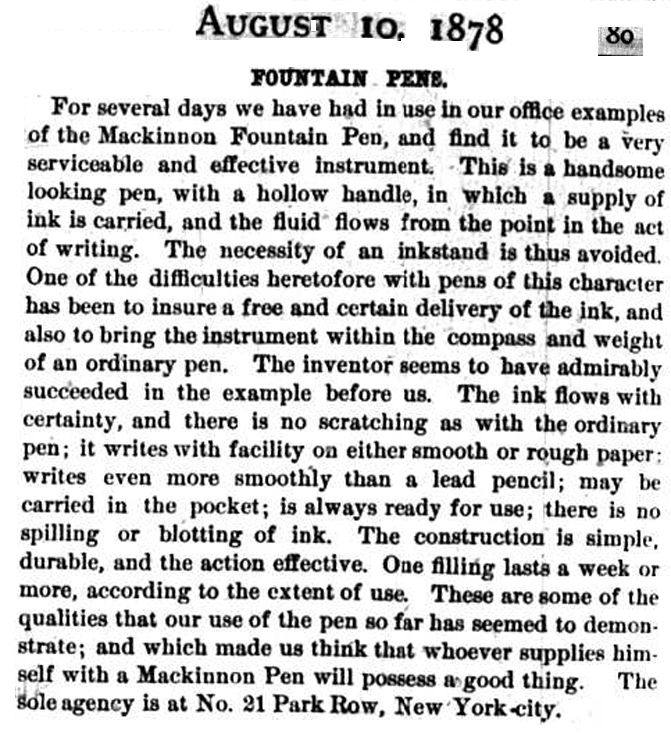
        For several days we have had in use in our office examples of the MacKinnon Fountain Pen, and find it to be a very serviceable and effective instrument.  This is a handsome looking pen, with a hollow handle, in which a supply of ink is carried, and the fluid flows from the point in the act of writing.  The necessity of an inkstand is thus avoided.  One of the difficulties heretofore with pens of this character has been to insure a free and certain delivery of the ink, and also to bring the instrument within the compass and weight of an ordinary pen.  The inventor seems to have admirably succeeded in the example before us.  The ink flows with certainty, and there is no scratching as with the ordinary pen; it writes with facility on either smooth or rough paper: writes even more smoothly than a lead pencil; may be carried in the pocket; is always ready for use; there is no spilling or blotting of ink.  The construction is simple, durable, and the action effective.  One filling lasts a week or more, according to the extent of use.  These are some of the qualities that our use of the pen so far has seemed to demonstrate; and which made us think that whoever supplies himself with a MacKinnon Pen will possess a good thing.  The sole agency is at No. 21 Park Row, New York City.

        Here’s another article about the MacKinnon stylograph in Sci. Am.,
Apr 24, 1880, p.261.
A New Writing Instrument.

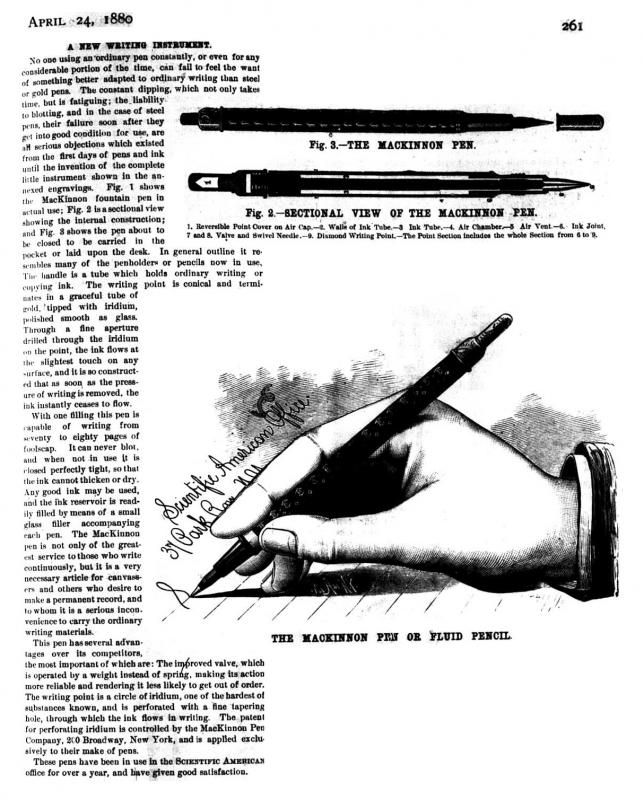
        No one using a pen constantly, or even for any considerable portion of the time, can fail to feel the want of something better adapted to ordinary writing than steel or gold pens.  The constant dipping, which not only takes time, but is fatiguing; the liability of blotting, and in the case of steel pens, their failure soon after they get into good condition for use, are all serious objections which existed from the first days of pens and ink until the invention of the complete little instrument shown in the annexed engravings.  Fig. 1 shows the MacKinnon fountain pen in actual use, Fig. 2 is a sectional view showing the internal construction; and Fig. 3 shows the pen about to be closed to be carried in the pocket or laid upon the desk.  In general outline it resembles many of the penholders or pencils now in use.  The handle is a tube which holds ordinary writing or copying ink.  The writing point is conical and terminates in a graceful tube of gold tipped with iridium, polished smooth as glass.  Through a fine aperature drilled through the iridium on the point, the ink flows at the slightest touch on any surface, and it is so constructed that as soon as the pressure of writing is removed, the ink instantly ceases to flow.
        With one filling this pen is capable of writing from seventy to eighty pages of foolscap.  It can never blot, and when not in use it is closed perfectly tight, so that the ink cannot thicken or dry.  Any good ink may be used, and the ink reservoir is readily filled by means of a small glass filler accompanying each pen.  The MacKinnon pen is not only of the greatest service to those who write continuously, but it is a very necessary article for canvassers and others who desire to make a permanent record, and to whom it is a serious inconvenience to carry the ordinary writing materials.
        This pen has several advantages over its competitors, the most important of which are:  The improved valve, which is operated by a weight instead of [a] spring, making be action more reliable and rendering it less likely to get out of order.  The writing point is a circle of iridium, one of the hardest of substances known, and is perforated with s fine, tapering hole, through which the ink flows in writing.  The patent for perforating iridium is controlled by the MacKinnon Pen Company, 200 Broadway, New York, and is applied exclusively to their make of pens.
        These pens have been in use in the Scientific American office for over a year, and have given good satisfaction.

        And just for good measure, here’s the article introducing the Livermore stylograph, which used the MacKinnon patent, in
Sci. Am., June 26, 1880, p.403.
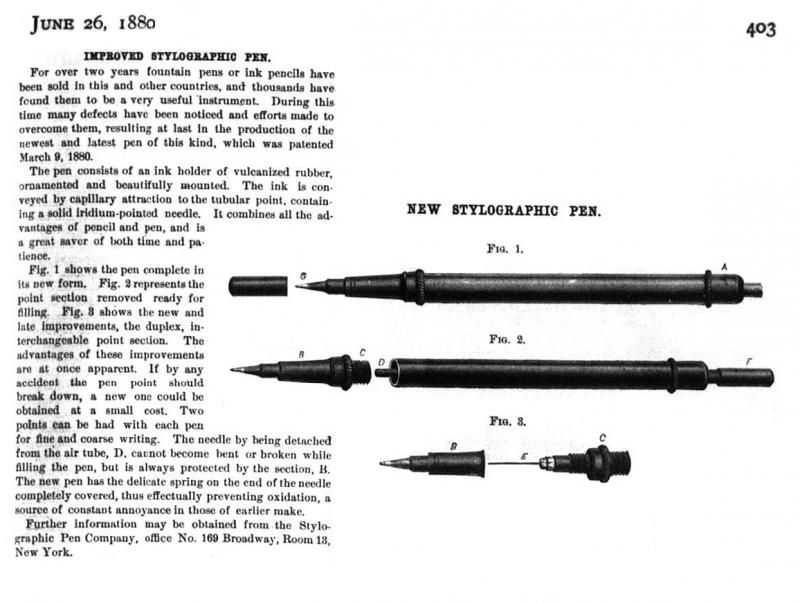
Improved Stylographic Pen.
        For over two years fountain pens or ink pencils have been sold in this and other countries, and thousands have found them to be a very useful instrument.  During this time many defects have been noticed and efforts made to overcome them, resulting at least in the production of the newest and latest pen of this kind, which was patented March 9, 1880.
        The pen consists of an ink holder of vulcanized rubber, ornamented and beautifully mounted.  The ink is conveyed by capillary attraction to the tubular point, containing a solid iridium-pointed needle.  It combines all the advantages of pencil and pen, and is a great saver of both time and patience.
        Fig. 1 shows the pen complete in its new form.  Fig. 2 represents the point section removed and ready for filling.  Fig. 3 shows the new and late improvements, the duplex, interchangeable point section.  The advantages of these improvements are at once apparent.  If by any accident the pen point should break down, a new one could be obtained at a small cost.  Two points can be had with each pen for fine and coarse writing.  The needle by being detached from the air tube, D, cannot become bent or broken while filling the pen, but is always protected by the section, B.  The new pen has the delicate spring on the end of the needle completely covered, thus effectually [effectively] preventing oxidation, a source of constant annoyance in those of earlier make.
        Further information may be obtained from the Stylographic Pen Company, office No. 169 Broadway, Rm.13, New York.



Canadian patent no. 4,809, p.7, May 1, 1875.

George Kovalenko.

.
 

Addendum 1, Nov 16, 2014, and Jan 6, 2015.
Some of these items were among the ones I submitted to The Pennant, Spr/Sum 1995, pp.6-8.
Also see my blog posts “MacKinnon v. Cross?” and “MacKinnon v. Cross!”.

 
Addendum 2, Aug 1, 2016.

The following information was found by Doug Stapleton, a genealogical researcher in Sarnia, Ont.
        “While researching Duncan MacKinnon, I found his surname, and that of his brother Angus, misspelled as “McKinnon” several times.  I have been unable to find where he was born, or the names of other family members.  I did find both brothers in the 1871 Census for Sarnia in Lambton Co.  Angus McKinnon, age 37, was listed as a physician, Sarah his wife 32, Agnes 7, Norman 5, Flora 1, and Duncan 32, druggist.
        “The 1880 US Census was undertaken in June, and I next found them in Adrian, Lenawee County, Michigan.  Adrian is 30 miles south of Ann Arbor and was the county seat for Lenawee.  Angus age 46, physician, Sarah 41, Flora 10, Jessie 2 and Duncan 41, brother of the head of household, druggist.  During further online research, I found that both Norman and Agnes died in the mid-1870s.  The 1881 Canadian Census was undertaken in April, and although I have searched several spellings of the MacKinnon surname in Lambton County, I have not found them.  They must have moved to Alvinston after April 1881, and thus would not have been enumerated.  And continuing with the 1891 Canadian Census for Lambton County, I found Angus age 55, a physician and surgeon in the town of Alvinston, Sarah 48, Flora 20, Jesse 13, but no trace of Duncan.  I also didn’t find any info online connecting him to Stratford.
        “I did a search of deaths and found that Duncan McKinnon died on March 18, 1882, age 43, in Alvinston, listed as a druggist.  His brother was listed as his physician and informant.  His death was due to chronic pneumonia, and he had been suffering for 6 years with this illness.
        “I visited Lambton County Archives and found that he is buried in the Alvinston Cemetery in Brooke Township.  His brother and family are also buried in the same row.”
        I always had unspoken reservations about the death certificate shown in The Pennant,
Spr/Sum 1995.  The middle initial “H.”, the age “49”, his marital status “married”, the number of years in the US “9”, and the occupation “carpenter” are all wrong.  And he caught his pneumonia six years before in Providence, R. I., while dealing with Cross, and he never got over it!  This new death certificate vindicates my suspicion.  It made no sense that he was still in New York in 1882, when he was no longer a principal in the company he started.  And nine years before his death, he was still a druggist in Stratford, not in the US.  He was in Stratford for only a few years in the 1870s, according to an article in the Stratford Beacon, Mar 1, 1873, and an ad and a listing in the Stratford Business Directory in 1876, all of which were part of the original packet I submitted to The Pennant, but which weren’t published.  As well, his patents in 1879 and 1880 place him in Stratford and Lucknow, Ontario.  So, I went back and checked my copy of the death certificate, and the surname there was actually spelled “McKinnion”, twice!  This death certificate is for a totally different Canadian, and the surname was altered, or “corrected”, by the editor of The Pennant, to try to make it fit.  We are indebted to Doug Stapleton for finding the actual death certificate of Duncan MacKinnon, thus helping to clear up and correct this glaring mistake in the pen history record.  By the way, I got the packet of information that was published in The Pennant from the Stratford Perth Archives, so they should be informed that they had the wrong death certificate in their files all along.
        I am still waiting for and hoping to get these crucial bits of the official record.
        1. Duncan MacKinnon was born in Unionville, near Markham, just north of Toronto, so the 1861, 1851, and 1841 Canadian censuses for Unionville and Markham still need to be checked.
        2. The new death info is the best part!  If it is from a death certificate, I am hoping to get a photocopy, or digital copy of the certificate, so that I can post a link to the image here to correct the death certificate in The Pennant.
        3. I am also hoping to get a photo of the headstones in the
Alvinston Cemetery in Brooke Township, not just his, but those of his brother and the rest of the family, the whole row.  All the birth and death dates should literally be carved in stone there.
        By the way, here’s the information about Duncan MacKinnon’s birthplace in Unionville, Ont., near Markham, Ont.

Duncan MacKinnon was “born in Markham [ca. 1839], in the old homestead near Unionville, one-quarter mile distant”, in the letter by his brother Angus G. MacKinnon to The Toronto Globe, Apr 17, 1914, p.6.
And I added the information about Duncan MacKinnon as a penmaker to the Wikipedia page for the city of Stratford, Ont., in the “Notable past and present residents” section.
Duncan MacKinnon was a druggist in Stratford, 1873-76, and a penmaker, the inventor of the stylographic fountain pen in 1875, cf. the article in The Toronto Globe, Apr 11, 1914, in the “Saturday Magazine Section”, on p.2.

Addendum 3, Aug 11, 2016.

The MacKinnon pen was still being reviewed, and favorably, as late as 1885, as shown by this article in The Engineer, Mar 27, 1885, p.250, even after the failure of the company in March 1884.
The MacKinnon Pen
        Although the pen is as old as the sword or the plough, its original form is still retained; but the material of which it is made is now drawn chiefly from the mineral instead of from the vegetable kingdom.  About the year 1875, Duncan MacKinnon, a druggist of Stratford, Canada, read a statement in the Scientific American to the effect that he who would devise an ink-writing instrument, as convenient as the lead pencil, would achieve both fame and fortune.  This stimulated his inventive powers, and abandoning the usual form of split nib, he started from the stylus of the ancients.  In a couple of years he had produced an instrument which, though far from perfect, was welcomed in the United States, and, after a year’s constant use, was stated by the above-named journal to have “given good satisfaction”, while the Science and Art Committee of the Franklin Institute also reported favourably on the invention.  But, though the correct principle had been attained, the practical difficulties of manufacture were far from being surmounted.  The metal cases were too heavy, besides being liable to corrosion by acid inks; and the platinum points wore away quickly.  Ultimately, vulcanized india-rubber was adopted for the case, being both light and proof against corrosion.  Glass was tried for the points, but, though hard enough, was found too brittle.  Iridium answered the purpose admirably; but it took six and a half hours to drill the first point with a hole too large for the needle, besides wearing out a 10-dollar diamond drill.  Later on, a Swiss succeeded in drilling two small holes of the required size, and hoped to accomplish six or eight holes a day.  The process of drilling was secured by patents; and the successive improvements in the pen itself were patented in [Canada], the United States, Great Britain, and other countries.  The MacKinnon pen now became a fact, and its success induced pencil-case makers to imitate it as closely as possible; but the points were made with a platinum alloy of uncertain hardness, the durability of which could not be depended upon.  The MacKinnon is chiefly distinguished from other forms of stylographic pen by the iridium point, which is practically unwearable.
       The needle which regulates the flow of ink at the orifice is also controlled mainly by a weight, forming a clack valve, which is lifted by pressure of the pen on the paper, the needle projecting slightly beyond the point when there is no contact with the paper.  A weak spiral spring is, however, added probably to overcome the friction and inertia of so slight a weight.  The annexed
views, partly in section, will assist in understanding the construction and working of the pen, which is really an ingenious piece of mechanism.  The tube or holder G is filled with ink, which should be of good quality, and especially of uniform composition, but not too thin, as might have been supposed the best.  The orifice is closed by screwing in the needle chamber D, a slightly enlarged detail of which is shown in section.  Inside the holder is the tubular air chamber F, with its outlet E, and an inlet at I, the open end of the tube being closed by the cap H; but a flat side is formed upon the screw, for admitting air on the cap being unscrewed.  As the ink in the holder is used, the air, entering to supply its place, maintains an even feed and flow.  C is the hollow iridium point, and E the needle, made of gold and tipped with iridium, that works therein, breaking up air bubbles and displacing minute extraneous particles that would otherwise collect at the point and intercept the flow of ink.  A is the cover for protecting the point when the pen is not in use, and which, for convenience, is placed on the projection at the other end when the pen is being used.  In the newest form of MacKinnon pen this cap is made longer and of the same diameter as the holder–as shown in the second view–so as to add to its length, a great convenience in writing, besides giving the pen s simpler and more business-like appearance.  The inside of the cap is also provided with an india-rubber cushion, which completely closes the point when not in use.
        This pen is really a very delicate instrument, so constructed as to withstand ordinary rough usage.  Various hypotheses of a very ingenious character have been published as explanations of the working of the pen; but it is quite clear that the idea that capillary attraction would prevent the flow of the ink down the very small space between the needle and the very small hole in which it fits is erroneous.  When in use, some of the ink is rubbed off the point to the paper; and the molecular cohesion of the fluid is sufficient to cause the flow of more ink to the point, this flow being permitted by the air supply from above, and capillarity really helping in the work of drawing the ink along the tiny channel allowed it.
 

Addendum 4, Aug 14, 2016.
Here are some more of the crucial bits of the official record found by Doug Stapleton.
        “The 1842 Assessment, not a census, lists only the head of the household, so until I discover his father’s name, I can’t do much else.
        “I searched the 1851 Census for York Co., Ont., which includes Markham and Unionville, and if the birth date of 1839 is correct for Duncan, I should have found a family group with his listing at age 11-12, and Angus 16-17, but with no luck.
        “The 1861 Census for Vaughan, York Co., lists Duncan McKinnon, 22, a school teacher living with Hugh age 24, farmer, Donald 23, and five other children ages 19 to 6, probably his brothers and sisters, and Flora McKinnon age 48 born in Scotland, housekeeper.  Elsewhere in this census district there is an Angus McKinnon age 28, a school teacher living on his own.
        “Here is the death certificate from the “Ontario Deaths 1869-1937”, p.469, record
no. 008451, County of Lambton, Division of Alvinston. “Duncan McKinnon [sic], 18 March 1882, Male, age 43, Druggist, born in Ontario, died of chronic pneumonia, duration of illness 6 years, his physician and informant Dr. Angus Mackinnon [sic] MD of Alvinston, death registered on Mar 27, 1882, religion Presbyterian”, estimated birth year 1839[?].
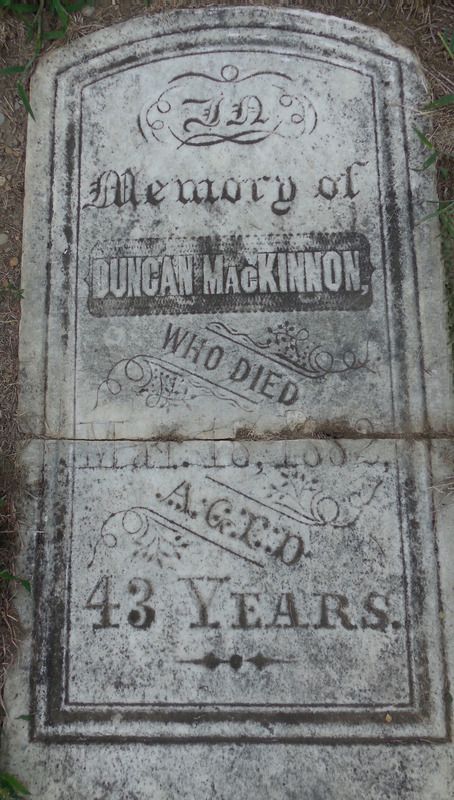
        “I visited the Alvinston Cemetery and took a photo of Duncan MacKinnon’s
headstone.  He is buried in Range 13, Lot 10.  Besides Duncan’s headstone, the only other MacKinnons were Aggie and Norman, children of Dr. Angus and Sarah MacKinnon.
        “I went back to the Lambton County Archives and a wonderful archivist named Patricia McEvoy helped me find information contained in an Alvinston book published as a centenary project, 1880-1980.  In it I found information about Dr. Angus MacKinnon, including, “In 1881, Dr. McKinnon [sic] opened a medical practice.  He gave devoted service for 20 years, then retired to Los Angeles”.  I found him in the 1910 US census for San Gabriel, Los Angeles, indicating that he and his wife immigrated to the US in 1902.  Angus MacKinnon died on Aug 3, 1918.  The 1920 US Census found Sarah living in Glendale, Los Angeles, with her daughter Jessie and son-in-law George Lockwood, a high school teacher.  I have created a memorial for Duncan in the Alvinston Cemetery in a Genealogy website called FindAGrave.com,
#168225642.  I used info for the bio from parts of your blog, The Globe article, and Angus’s letter to the editor.  I’ve also included the obituary and the photo of the headstone.  I also discovered that someone took a photo of Angus’s headstone in California, memorial #145376726.  His wife Sarah, memorial #145376727, died on Jan 24, 1926. [And here are their daughter Jessie and her husband George, memorials #85453297 and  #85453290, and their daughter Flora, memorial #145376728.  It looks like Angus and Flora might have been victims of the Spanish flu, dying just days apart in August 1918.]
        “Patricia McEvoy also helped me find Duncan MacKinnon’s obituary, which appeared in the Watford & Alvinston Guide-News, Mar 24, 1882, p.5.  “Mr. Duncan MacKinnon, brother of Dr. MacKinnon, who had been ill for some time, died on Saturday last, and his remains were interred on Monday of this week.  Mr. MacKinnon was not very extensively known in this neighbourhood.  He was a gentleman of culture and refinement”.”


November 13, 2014

An 1856 Fountain Pen


[This was first posted on the Pentrace homepage in 2001, and then was moved to the Older Stuff, and it also appeared in The Pennant, Spring 2001, p.14.]
      Call me a “notesnatcher”, but an interesting auction item sold on Ebay on July 19, 2000, a letter written by a certain E. B. Coon in the southern United States in 1856.  This letter goes on about family matters at first, but the interesting portion, for our purposes here, is a short section near the end devoted to the fountain pen with which the author is writing the letter.  It
’s an 1856 fountain pen!
      Before I quote the pertinent section, perhaps I should prepare you for its stilted, old-fashioned grammar and punctuation.  The writer doesn’t use a single comma or period in the whole letter.  For someone who doesn’t use a single period, it’s curious, however, that he does use the ironically serendipitous phrase “suit you to a dot”.  Instead of commas and periods, he uses dashes throughout equally as partial stops and full stops.  Many of the common, as opposed to proper, nouns in the letter have initial capital letters, even though they appear in the middle of a sentence.  All in all, the letter looks like the poetry of Emily Dickinson.  Well, at least it’s consistent and correct for its period.  There is also a quaint precursor to the word “itself”, some emphasis achieved through italicized underlining, a period contraction of the name William, and another even curiouser precursor to the word for “change”, as in “small change”, or “pocket change”, or “money in small denominations and coins received in exchange for money in higher denominations”.  So, these are the grammatical and semantic stumbling blocks to look out for.  Except for two minor errors, which I have corrected silently, the quote appears exactly as it does in the letter.

              Covington, Ky.          August 30th 1856                        
I am writing with a novel pen - It is the “Fountain Pen” - a Gold pen and Vulcanized India Rubber Holder - It pumps in Ink enough to write about 6 sheets [of] Foolscap and feeds its self uniformly - Therefore Inkstands become obsolete - It is a very splendid improvement - My pen is the $5.00 - though it cost me but a trifle - And it would suit you to a dot - I will send Wm his pen soon as I can get the exchange for a good one as there is now a poor supply -                 Respect to you all -                E. B. Coon
      The quote refers first of all to the two things that made the successful fountain pen possible, the gold nib with an iridium tip, and a hard rubber holder.  With the convergence of these two technological discoveries, the fountain pen industry simply took off.  In spite of this, he mentions that locally fountain pens are still hard to come by and in short supply.  And not only is it a fountain pen from 1856, it’s a self-filling fountain pen!  The pen “pumps in ink”, whatever that means, presumably by means of a piston, or a rubber tube or sac.  The letter doesn't say which, but in any case, it is not an eyedropper pen.  And as is usual throughout the early history of the fountain pen, the pen is praised for preserving us from the tyranny of the inkwell, a quality cited repeatedly in the 19th-century literature on pens, almost to the point of nausea.
      The writer calls it ‘the “Fountain Pen”’, not only in quotation marks, but also emphasized with italic underlining.  But that wasn’t its company name, or model name, like the “Duofold”, or “The Ideal Pen”.  The term “fountain pen” was still so novel that it needed to be flagged, and not just once, but twice.  The pen was, however, an “improvement”, implying that there were preceding pens that didn’t work as well.  So, to which pen exactly is he referring?  It’s a shame he doesn’t mention the penmaker’s name, but this was still the beginning of the fountain pen industry, and they were still figuring out how to market these newfangled writing instruments, so the pen may not even have had the maker’s name, etc., embossed on its barrel.
      There were five US patents for fountain pens before 1845, and another six between 1846 and 1850.  But any successful pen after 1851, the year of Nelson Goodyear’s first patent for vulcanized hard rubber, and indeed any pen as late as 1856, would definitely have been made of hard rubber.  Therefore, any patents before 1851 should be discounted as candidates for this pen, and certainly any pens before 1845.  The one notable exception is the 1848 patent held by A. Lyman & M. W. Baldwin, probably the very first for a pen with a rubber sac, or bladder.  Newell Prince held three patents for fountain pens, one in 1851 and two in 1855.  The first of the two 1855 patents holds the distinction of being the first US patent to specify that the holder should be made of hard rubber.  Charles Cleveland held an 1852 patent and another from 1854, and even though his 1852 patent doesn’t specify that hard rubber should be used, an article in The Scientific American that year states that the pen was indeed made of hard rubber.  H. K. McClelland held a patent in 1855, as did George W. White.  There are four other likely candidates, all dating from 1856, the patents of Henry A. Brown & James Wiley, A. F. Warren, Austin Goodyear Day, and Nelson Slayton.
      A closer examination of the patents and the advertisements for these early pens might definitely eliminate some of these prospects and elevate others as more likely candidates.  My best guesses are the pensmiths Prince, Warren, Day, and Cleveland, simply because these are the names with the greatest longevity in the early fountain pen industry.  Day held patents for both mechanical pencils and fountain pens, as well as for his own process of vulcanizing hard rubber.  Cleveland already held a patent for a fountain pen as early as 1833.  Prince’s pen, a piston-filler, was advertised well into the 1870s.  And Warren held four patents, the last issued in 1863.
      With early pens, all we have to go by, in most instances, is the paper trail left behind by and about these pens, not actual living examples of the pens.  And that’s what this letter is.  It’s part of the cryptic paper trail left behind by this unknown pen.


George Kovalenko.

.

Addendum.
      I searched for the name E. B. Coon in the 1850 US census on Ancestry.com, but I found no one with those initials in Kentucky, and the only ones with the initial E. were all women.  I found one Emily, one Ellen, and three Elizabeths.  The only clue in the letter for a possible relative is the given name William, and of these five women only one, Emily, was related to someone named William.  In 1850, Emily was 15 years old, and her brother was 13 years old, and they were living with their family in Christian County, on the southern border of Kentucky.  But Covington is in Kenton County on the northern border of Kentucky, and on the southern bank of the Ohio River, across the way from Cincinnati, Ohio.  It’s a long shot that Emily and E. B. are the same person, and there’s no definite proof, but maybe in 1856, she had moved north to the big city to look for work.  By the time of the 1860 census, her surname disappeared, most likely through marriage, but William was still living in Christian County, and was married with kids of his own.  Maybe that idiosyncratic punctuation common to both the letter and to Emily Dickinson’s poetry is a female thing, or maybe it
’s an Emily thing.
 

November 11, 2014

The Waterman’s ‘Fasces’ pen


  , another obscure Waterman’s pen.


[Posted on L&P on Dec 26, 2011.]
      Does anyone own, or has anyone ever even seen one of these Waterman’s fountain pens?  It has a
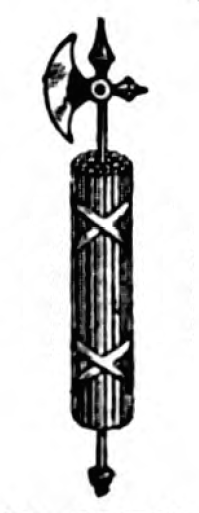
“Fasces” half-overlay on the barrel, and that makes the fountain pen the axe inside the bundle of wooden rods.  It’s from an advertisement in Am. Stat., Nov 9, 1918, p.21, where it is called “The Service Pen, A Convenience, Gift, and Heirloom All in One”.  Two examples of the pen are shown, and between them are illustrations of all the Waterman’s office and factory buildings, in the past and up to 1918.  It looks like it might be a #270-series or #370-series safety-capped eyedropper with a half-overlay, depending upon the size of the nib, and whether the half-overlay is sterling silver or solid gold, and also upon whether there’s a lever box out of view and hidden on the back side of the pen.
      Perhaps there’s a visual pun in there somewhere, something about the pen being mightier than the war, since the axe is missing from the bundle, in which case the design might have something to do with the date and the looming end of hostilities in WWI.  It anticipates the signing of the armistice by only a couple of days.
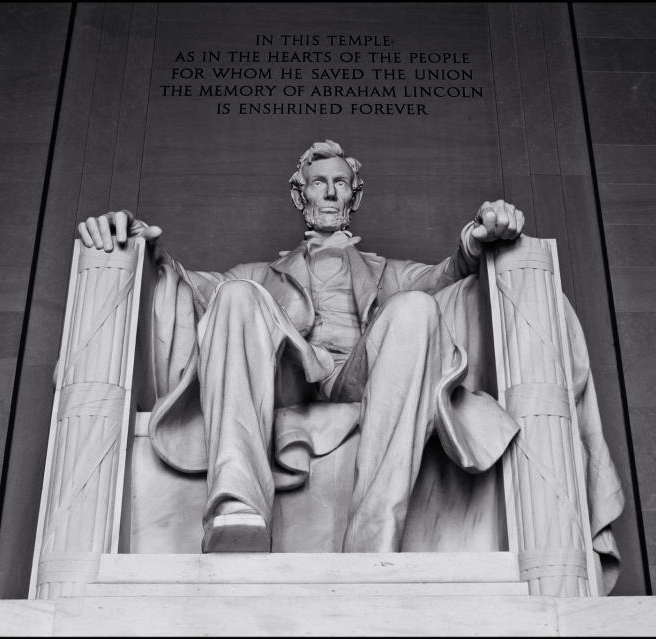
      David Nishimura wrote that he didn’t think any pun was intended, and posted the above Wikipedia link, which has a list of uses to which the fasces was commonly put.  Two fasces are prominently featured in the front posts of the armchair in which Lincoln sits in his eponymous
statue http://www.attractionsofamerica.com/images/washington/Lincoln_Memorial.jpg.  Then David added, “In the context of imminent victory, the fasces could have been read simply as celebrating that victory, since fasces was carried in Roman triumphal processions”.
      Well, we don’t know for sure whether the visual metaphor was intended, but the axe blade inside the bundle was definitely replaced with the nib of the pen.  However, the best bet for an interpretation is probably that the pen was intended to celebrate the triumph after the armistice.


George Kovalenko.
 
.

November 09, 2014

Pen Catalogues Online


      David Armstrong
posted on FPN that there are some vintage pen company catalogues available online through the Internet Archive.  He placed them in chronological order in groups by company name in an easily searchable index list on his website.  There is some controversy over the source of the PDFs, which originally came from the PCA library, but that is an issue for the Internet Archive to deal with.  There are also lots of pen company catalogues available for purchase on Bill Acker’s website.
      For those who can’t find the documents in the Internet Archive, here they are.  Click on the links in the column at the left to see the individual catalogues, which are, as David Armstrong said, “not chronological and are named a bit oddly”.

Waterman’s
https://archive.org/details/WatermanFountainPenCatalogs, 16 items


Parker’s
https://archive.org/details/ParkerPensCatalog1923, 4 items
https://archive.org/details/ParkerPenServiceManuals, 7 items
https://archive.org/details/ParkerVacumaticPensCatalogs, 7 items


George Kovalenko.
 
.

November 08, 2014

Grrr!, the opposite of GARR


[Posted on L&P on July 4, 2012.]

        I know, I know, we’ve all been spoiled by the Internet, and we all want the same things.  We want to be entertained.  We want instant gratification.  We want someone else to do all our work for us.  We want the information, we want it now, and we want it for free.  The lurkers out there want us to give them pictures of all of these things so they can harvest them, don’t they?  Well, of course they do, the image scavengers!  But there’s been way too much spoon-feeding going on these days in the pen message boards and blogs and websites.  So they’ll have to wake up and look up and research some of these things themselves, and not just for themselves.  They might want to share some of these things with others for a change.  No Grrr’s around here, only GARR’s.

George Kovalenko.

.
   

November 07, 2014

The Waterman’s pen factories


  , and other buildings.


        I posted this on L&P on Feb 29, 2012 after I finally finished gleaning and reading through all the issues of The American Stationer between the years 1906 and 1922.  The ones after the latter date, and the ones from the years 1898 to 1905, have not been digitized, yet, and then I plowed ahead into the past, that is, I started gleaning through the issues from 1878 to 1897.  Please excuse all the
georgic metaphors, but I’m feeling like I’m bringing in a very bounteous harvest of pen history.  And that’s putting it very lightly.  There is no hyperbole or over-exaggeration involved here at all.  Don’t worry about being surprised, because I astounded even myself.  So before I get too involved with my reading and researching again, let me leave you a list of all the ads and articles that either mention or illustrate some of Waterman’s pen factories and buildings in the years 1883 to 1922.  All the dates with page numbers, unless otherwise cited, are from Am. Stat.  I’ve gone through all the volumes systematically since then, so these examples are not so much stubbled upon as they are reaped.
 

Offices & Stores

        Feb 22, 1913, p.24, an article announcing that the “thirtieth anniversary of the founding of the L. E. Waterman Co.” was on Feb 12, 1913.  That means that the founding date of the company is Feb 12, 1883.  I think they meant Feb 12, 1884, the date of Waterman’s first patent.
        Apr 29, 1897, p.696, & May 6, 1897, p.731, an article and an ad with the following addresses.


        136 Fulton St., a room at the rear of a cigar store, March 1883-March 1884, the first feeds for Waterman’s “Ideal” fountain pens were made by Herbert Fisher on May 24, 1883, and the first pen was sold at the cigar store on July 11, 1883.

        10 Murray St., March 1884-February 1885.

        155 Broadway Ave., February 1885-1892.

        155-157 Broadway Ave., 1892-1902.

        173 Broadway Ave., 1902-1917, the “Pen Corner”.
        191 Broadway Ave., 1916-37, the new “Pen Corner”.
        344 Hudson St., 1939-50.
        Afterwards, they left N. Y., and were taken over by BIC, and who cares.


Factories & Offices
        Dec 3, 1910, p.6, article mentioning the single desk in the cigar store in NY in 1881 [sic, 1883].
        June 11, 1921, p.9, article with a photo of “The First Pen Manufacturing Plant”, no date, and no location given, which would have been nice to know.

        May 12, 1906, p.22, article with a photo of the window at the “Pen Corner” at 173 Broadway.

        June 16, 1906, p.1, ad with an illustration of the building at the “Pen Corner” at 173 Broadway.

        Oct 6, 1906, p.8, article with a photo of the new San Francisco store at 742 Market St., mentions the previous addresses at 18 Geary St. before the fire, and temporary address at 916 Broadway in Oakland right after the fire.

        Feb 8, 1908, p.30, article with a photo of the Boston store at 6-8 School St., later at 24 School St., then 40.  This picture shows the character of the School St. area in 1906, also the location of the Boston Fountain Pen Co. at #4, 46 School St., and here it is today on Google Maps.

        Feb 29, 1908, p.8, article mentioning the “Pen Corner” at 173 Broadway Ave.

        Mar 14, 1908, p.22, photo of the Waterman’s staff in Valparaiso, Chile, South America.
        May 30, 1908, p.1, front cover ad with photo of the Waterman’s “Pen Corner” at 173 Broadway.


        Dec 5, 1908, p.4, article with a description and illustration of the Canadian factory in St. Lambert, Quebec, also mentions the Canadian headquarters still at 136 St. James St., Montreal.

        Apr 3, 1909, p.23, article about a Japanese State visit to the Waterman’s factory in the Rhinelander Bldg., Rose St., an 1890s building now demolished to make way for the present NYPD headquarters.

        Feb 12, 1910, p.6, article with a photo of the Waterman’s headquarters in London, England, under construction.

        Apr 2, 1910, p.4, another photo of the Waterman’s headquarters in London in a later stage of construction.

        May 7, 1910, p.24, short article mentioning the new Chicago office at 189 Clark St.
June 18, 1910, p.8, article with a photo of the Waterman’s electric sign in Herald square, N.Y., the largest electric sign in the world, at the time.

        July 16, 1910, p.21, article with a photo of the group of buildings that constitute the Rubber Factory in Seymour, Conn.

        Sept 10, 1910, p.1, ad with an illustration of the new 10-story pen and ink factory at 34-40 Fletcher St., officially opened.

        Sept 17, 1910, pp.6+8, long article with illustration of the new factory at 34-40 Fletcher St.

        Oct 8, 1910, p.24, article with illustration of the completed English Waterman’s headquarters on 93 Kingsway, London, W.C., known as Koh-i-noor House, Hardtmuth company headquarters, also mentions its smaller digs at the old address, 12 Golden Lane, E.C.

        Oct 15, 1910, p.1, ad with a nighttime photo of the electric sign above their factory at 34-40 Fletcher St.

        Oct 15, 1910, p.81, ad with 9 illustrations of all its current office and factory buildings with addresses and locations marked.

        May 20, 1911, p. 18, article with oblique photo of the front of the factory at 34-40 Fletcher St.
        Apr 20, 1912, pp.21-22, article
with pic of the “Pen Corner” at Broadway Ave. & Cortlandt St.
        June 22, 1912, p.8, Waterman’s Pen Corner in Koh-i-noor House in London, and their truck in front advertizing both companies.


        Feb 22, 1913, p.35, article about the fireproof Waterman’s factory at 34-40 Fletcher St.

        Apr 26, 1913, p.1, ad with illustration of “Pen Corner” at 173 Broadway Ave. & Cortlandt St.

        July 5, 1913, p.1, ad with a list of the three Waterman’s factories in N.Y., Seymour, Conn., and St. Lambert, Quebec.

        Apr 18, 1914, p.69, ad for ink with an illustration of the ink factory at 34-40 Fletcher St., also new addresses for Boston, Chicago, and San Francisco.

        Feb 13, 1915, p.16, article with a photo of the English headquarters, now called the “Pen Corner” in London.

        Mar 13, 1915, p.16, article with photo of new factory under construction at 163 Front St., N.Y.

        May 29, 1915, p.28, article with a photo of the completed new factory at 163 Front St., N.Y., called “Factory No.4”.

        June 3, 1916, p.26, article with a photo of the pen exhibit in the window of L. G. Sloan’s “Pen Corner” in London.

        Aug 12, 1916, p.4, article with a photo of the new “Pen Corner” in a building leased at 191 Broadway Ave.

        Apr 28, 1917, p.9, ad with a large, full-page illustration of the “Pen Corner” at the corner of 191 Broadway Ave. and Dey St.

        Apr 28, 1917, p.15, article about Waterman’s moving into the new “Pen Corner” at 191 Broadway Ave.

        Nov 10, 1917, p.21, article with an illustration of the new office building for the Canadian headquarters at 179 St. James St., Montreal, called “The Pen Shop”.

        Nov 9, 1918, p.21, ad for the Waterman’s “Fasces” pen with illustrations of 8 of its current offices and factories.

        Apr 19, 1919, p.6, long article describing the new factory to be built in Newark, N.J.

        May 8, 1920, p.13, article with an illustration of the new 7-story building at 127-129 South State St., Chicago, also mentions previous addresses in a bookstore on Wabash Ave., and larger locations on State St., and 115 S. Clark St.

        May 8, 1920, p.33, ad with an illustration of the Chicago building.

        Oct 9, 1920, pp.31 and 35, two more ads with the same illustration of the Chicago building.

        Mar 5, 1921, p.23, ad showing the new factory at 140 Thomas St., Newark, N.J., the largest of five plants, occupied Feb 15.
        Mar 26, 1921, p.11, long article describing the new factory in Newark, N.J.

        Oct 15, 1921, p.6, ad showing an illustration of the new factory in Newark, N.J.

        A few last Waterman’s pictures, but these are not of buildings.  The ad in New England Stationer, May 1899, p.25, the photo in the article in Geyer’s Stationer, Aug 9, 1906, p.17, and the ad on the cover of Am. Stat., Dec 25, 1909, all have composite photos of the top Waterman’s officers and salesmen.  These three pictures include four members of the Waterman family, W. I. Ferris, E. T. Howard, and quite a few members of the Waterman’s baseball team.  And at the top of the edifice in the 1909 ad is F. D. Waterman, who two years later was referred to as “the king of Pendom”, in The Review Of Reviews, vol. 44, 1911, p.405.  But by the end of the 1920s, all the 
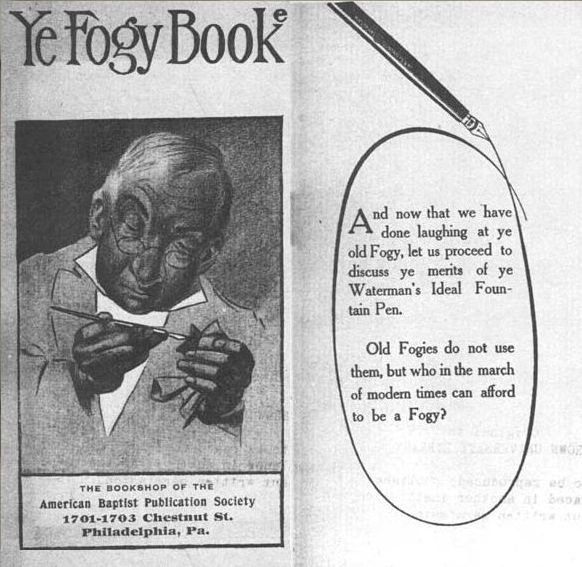
old fogies at Waterman’s had begun the process of squandering it all away.

George Kovalenko.

.

November 03, 2014

The Waterman’s #53?


  , just the facts.

      Here’s another obscure Waterman’s fountain pen.


No, those aren’t real pens.  The black one was cobbled together in Photoshop by Dennis Bowden and posted on L&P to stir things up, and the red one is just one that I made up out of the pic from Dennis and another I got from somewhere on the Web.  And although there is no artifactual pen, yet, this is definitely not fiction.
        Does anyone remember the Waterman’s #53 controversy on L&P?  In a thread about the Waterman’s color nibs, Rob Astyk wrote on June 8, 2005, “The #3 nib was dropped some time around 1910”.  And I wrote on June 27, 2005, “Do you mean only in the US, or everywhere else in the Waterman’s network of holdings as well?  I have a copy of a page from the 1925-26 Fall-Winter Eaton’s mail order catalogue with a lever-filling pen with a #3 nib offered for sale, ‘With pocket clip and No. 3 nib’.  How does this fit into your ‘Waterman’s By The Numbers’ scheme?”  I just thought that Waterman’s was using up some extra, leftover nibs.
        Rob Astyk wrote on June 27, 2005, “Everything is true until better information pops up”.  Well, actually nothing is true while we wait for better info.  Then he added, “I once thought that the #1 nib was entirely gone from the line-up about 1901-02.  Then #51’s started appearing….Thus I have no trouble in believing that the #3 nib remained in the line, too.  Therefore, to be clear about Waterman lever fillers let me note that…there would be 15 pens in the set as follows: 51V - 52½V - 52V - 54V - 55V - 56V - 52½ - 52 - 52X - 53 - 54 - 55 - 56 - 58 - 20 PSF”.  But then Rob corrected his list of Waterman lever-filling models on July 14, 2005.  “51V - 52 1/2 V - 52V - 53V - 54V - 55V - 56V - 58V - 51 - 52 1/2 - 52 - 52X - 53 - 54 - 55 - 56 - 57 - 58 - 20 PSF.  That would be a total of nineteen pens to complete a set, and a rather impressive one”.  He added the #53 in both of these lists, but then he denied its possibility later on that year.
        And then Dennis Bowden started a thread about the Waterman #13 on Oct 31, 2005, asking how common the #3 nib was.  Rob Astyk posted on Oct 31, 2005, that he thought they were fairly common.  He also wrote that, “There is even one reference that may well be to a Waterman 53 in the ‘Waterman’s color-nib chart’ topic, though that’s still uncertain and unconfirmed by either a pen or other references”.  And David just had to chime in on Nov 1, 2005 with this, “It is worth emphasizing that no #3-nib, screw-cap self-fillers have yet turned up, nor were they catalogued.  The existence of any specimens is purely speculative”.  Well, I wasn’t going to let that go unchallenged, so I wrote back on Nov 1, 2005, “Do you mean only in the US, or everywhere else in the world?  Here is a copy of a page from a Canadian Eaton’s mail order catalogue with a #53 pen offered for sale, a lever filler
“With pocket clip and No. 3 nib”.  This image happens to be from the Spr-Sum 1927 volume, but the same pens and nibs were offered between Fall-Wint 1925-26 and Spr-Sum 1928.  And you’re right, I’m still looking for one”.
        So David came back with, “We’ve already gone over that, George.  The catalog does not call the pen a “53”.  It does state it is a lever-filler with a #3 nib.  It is not an official Waterman catalog.  Most significant, no such pens have, to my knowledge, ever turned up”.  And I replied, “I know that we’ve already gone over that, David, but I didn’t bring it up again.  I also don’t dispute that it hasn’t been found in any official Waterman
’s catalogues, yet.  And I plainly stated that we’re all still looking for one, and that no such pens have as yet turned up.  But I think you’re in denial when you say that, although the catalogue states that it is a lever-filler with a #3 nib, that it’s still not a #53 pen because the catalogue doesn’t call the pen a “53”.  What is a lever-filler with a #3 nib except a #53?  And besides, the catalogue doesn’t use any of the other usual Waterman’s terminology or numbers for the other pens, either.  The catalogue uses its own item-number designations, and they probably didn’t want to confuse the buyer with a secondary model number.
        “Do you really think Waterman
’s would let a pen out of their factory that was marked #52 but with a #3 nib, or sold a pen with a #3 nib that was not marked at all?  I would guess that such things do happen, but only as one-offs, not as a large batch, or a run that extended for at least 3 years.  Variations of that catalogue listing did appear in at least 6 catalogues over a 3-year period.
        “We’ll have to wait until something turns up to prove it one way or another, whether it’s a pen, or an in-house catalogue, or a magazine ad.  But who knows, it may have been an Eaton’s exclusive in Canada.  We may never know.  As I said before, perhaps Waterman’s was just using up some extra, leftover nibs.”
        And then Rob and David piled on, and started making things up.  I don’t understand why, not one bit.  Rob Astyk on Nov 2, 2005, wrote that he thought the Eaton’s catalogue listing was “simply an error” by the copy editor, and they really meant a #4 nib, and that they were reusing burned printing plates from one catalogue to another.  And David on Nov 2, 2005, wrote that the price differential “supported Rob’s hypothesis”.  However, John Chapman wrote on Nov 2, 2005, in defense of the facts.  He found it interesting that the catalogue listing appeared in at least 6 catalogues over a 3-year period.  “If it was a mistake, was it a mistake that nobody noticed for 3 years?  No complaints from customers about [the typo]?  It seems odd that it wouldn’t get corrected.  Does the listing appear later on with a #4 option?”.
        And I wrote on Nov 2, 2005, “Whoa! You guys are writing fiction rather than history.  Where do you get these assumed errors and reused burned plates?  Are you just pulling them out of thin air?  Yeah, sure, they are possible, and so might the moon be made of blue cheese.  But until they’re proven, what David calls ‘hypotheses’ are just guesses and beliefs and fabrications and fictions.”
        I went back to my July 15, 1994 notes on the catalogues and found that the pen-with-a-#3-nib appeared in 6 catalogues in that 3-year period.  My notes showed that there were ads for the pen in the major “Spring-Summer” and “Fall-Winter” catalogues for those years, but the ads did not appear in the Christmas “Wish Books” in those years.  Also, my recollection was that different cuts and ad layouts were used in the various issues of the catalogue, but my memory was hazy.  I knew that there were at least two different layouts, because I remembered choosing to scan the more compact layout, the one in the above link.  I went to the library the next day and checked the microfilm again, and after I got back, I posted this on Nov 4, 2005, nine years ago less a minute.
        “I looked at all the Eaton’s catalogues from 1920 to 1935, and here are some facts to fly in the face of all your fabrications.  First of all, I found that all of the catalogues used different ads and different layouts.  There were no reused burned plates.  They are all unique, and there are no mistakes.  They are all on purpose.  The six catalogues that feature the lever-filler-with-the-#3-nib are the following.
        “Fall-Wint 1925-26, p.376
        “Spr-Sum 1926, p.281
        “Fall-Wint 1926-27, p.284
        “Spr-Sum 1927, p.236
        “Fall-Wint 1927-28, p.184
        “Spr-Sum 1928, p.257
        “Each of the Spr-Sum pen sections is a one-page layout, and each of the Fall-Wint pen sections is a two-page spread.  Now, the microfilm copies are quite crude, so when it came to reproducing one of the ads, I chose to digitize the fourth one because the archive where I work has a copy of this catalogue, and it would reproduce the best.  Well, it just so happens this is the only one of the six catalogue layouts that advertises the pen with #2 and #3 nibs only.  The other five all advertise the pen with a #4 nib as well.  The catalogues list the following four pens and prices, in Canadian dollars, of course.
        “Waterman’s Self-Filling Pen, No. 2 nib, without pocket clip, $2.50
        “Waterman’s Self-Filling Pen, with pocket clip, and No. 2 nib, $2.75
        “Waterman’s Self-Filling Pen, with pocket clip, and No. 3 nib, $4.25
        “Waterman’s Self-Filling Pen, with pocket clip, and No. 4 nib, $5.25
        “I think we can now safely call the first two pens #52’s, and the third one a #53, and the fourth one a #54.  And here’s the clincher.  The ad on p.246 of the next catalogue, the Fall-Wint 1928-29, is the first one to leave out the #53 pen from the layout, but the #54 pen is now described as a ‘Self-filling type, chased barrel and screw-on cap with pocket clip, holds more ink and has a large No. 4 nib’, and with the reduced price $4.25.  They finally ran out of the #3 nibs, and then they started promoting the #54 pen.”  As John Chapman had asked by chance, the listing had appeared all along with a #4 nib option.
        And those are the facts.  But Rob and David continued going off on a tangent with their fictions, so I’m not going to repeat them here.  Finally out of frustration I posted this on Nov 11, 2005, quoting an email from Rob from a year and a half before.
        “This whole episode started way back on Mar 17, 2004 when I sent Rob an email message.  I told him that while looking up something else in my library of pen-company images, I found something he might be interested in.  The university library here is very well stocked with books and other materials, and they have all the Eaton’s mail-order catalogues on microfilm.  This store was the Canadian equivalent of Sears in the US, and they always had a great pen department.  Well, in 1994, while I was looking for the Duofold ads from the 1920s, I found these Waterman’s catalogue listings along the way, and I noticed that the #3 nib hadn’t died out till 1928, at least not in Canada.  In 2004, I asked Rob whether that jived with his records.  I also told Rob that in 1999, Peter Markman phoned me out of the blue from New York when he was researching the article “Waterman in Canada” that he co-wrote with Joan Geschlecht for Pen World, Vol. 13, No. 2, Nov/Dec 1999, and that I had mentioned the #53 to him as well.  Peter included that tidbit as an aside in their article.  And Rob wrote this to me in his reply on Mar 18, 2004.

What you say about the #53 in Canada jives with the information that I have that the Canadian and English Waterman branches operated under a different set of rules from the US company.  I had no knowledge of a #53 before your message, or if I did, it was trapped in some Bermuda Triangle section of my brain.
      The Canadian and British Waterman Divisions were the personal property of the Waterman family and, specifically, of Frank D. Waterman.  That’s why the hallmark for factory nibs for the UK is “F.D.W.”  The corporate directors in the US, including the Days, set policy for the US operation.  Frank could set policy more autonomously in those other divisions.  Thus the operations in the British Commonwealth were different, and oddities, from my insular, American point of view, occur with some frequency.
      The fact is that the #1 nib was relegated to low priced pens (Remex, Penanink) early on (ca. 1900).  The #2 & #3 nibs were never that different in size or price, so at some point around 1910, the #3 was dropped from the American line, and the original #7 was dropped, too.  The #9 nib is the rarest of all.  I have seen only 1 example in a #20 that Pier Gustafson owns.  I believe on, admittedly, VERY slim evidence that the #9 nib was in the line for only a few months, and not more than 2 years certainly, right after Waterman acquired Aikin-Lambert.
        “And that’s all he wrote, just the facts, no fictions.  If he had left it at that, a simple statement of the facts, none of this would have transpired.  I never understood why Rob and David had taken the stance they had, but in light of everything they said, I tried to stay out of the way of the proverbial fan that they kept trying to point my way.  I thought I was just being helpful by pointing out a curiosity, but I just kept ending up in the way of their fan.”
        I’m not proud of some of the things I said back then, things said in hasty response to things that the others said, and I don’t know whether the others aren’t proud as well, so I am not going to repeat those things here.  But I stand by the things written here.  These are, I hope, just the facts.

        And by the way, while I was looking at the 1930-35 catalogues, I found some Canadian listings for the Parker depression pens, including one for the “Thrift-time”, which got me thinking about those pens as well, and I thought maybe I’d take up that topic again in a post here,
later.

George Kovalenko.

.

Addendum, Apr 22, 2019.
        It’s in a tantalizingly irrelevant picture, and it’s not in a lever-filling pen, but just the same, it’s an Eaton’s #3 nib in an Eaton’s pen, so let’s see what else turns up.  ;~)


November 01, 2014

The Parker ‘Arrow’


[This was posted on L&P on Aug 14, 2007, and before then on Zoss on Nov 21, 2000.]
        Misinformation abounds on the Internet, and surmises and guesses about the Canadian Parker “Arrow” keep cropping up every few years, so I am going to archive this here.  Over on the Zoss List in November 2000, Saul Davis dared to call this pen a Frankenpen, and Nathan Tardif jumped in to defend it as a production model.  It just so happened that I had taken one apart a few weeks earlier, and I chimed in as well on the pen’s production-model status.  I can’t give you the URL for the thread on Zoss because there is no archive for the pre-2005 messages, but below is a revised text of my post about the pen.
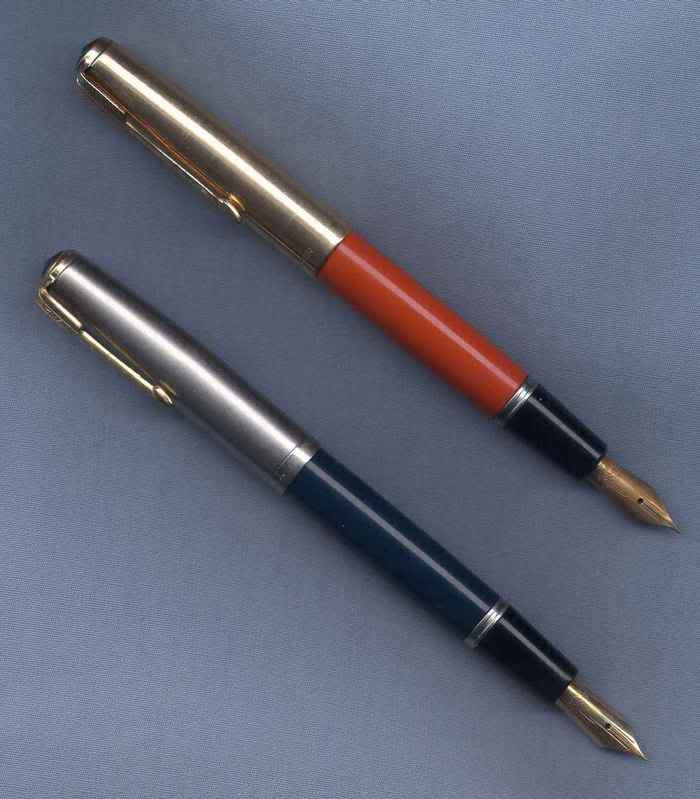
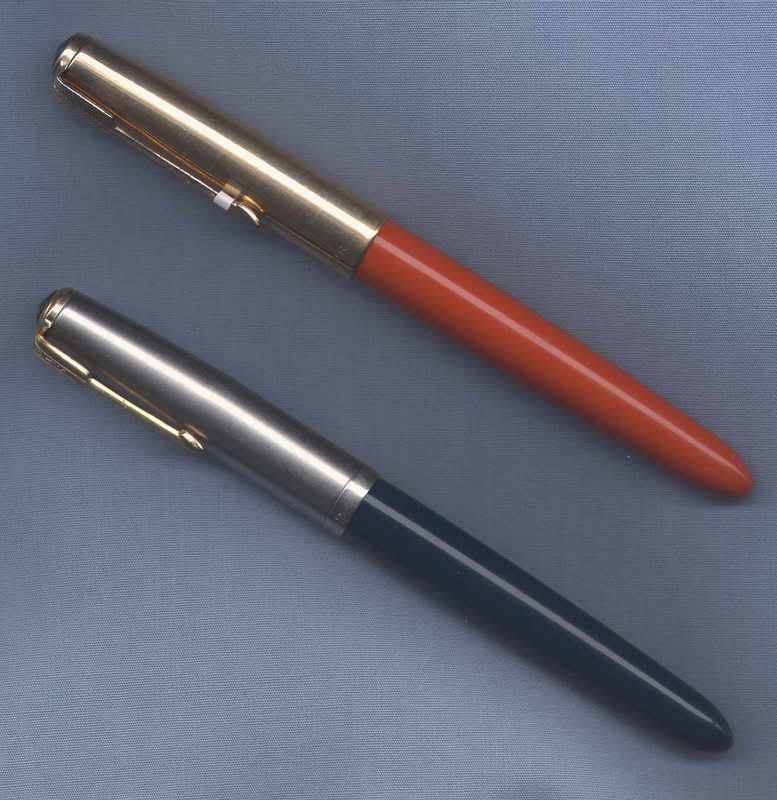
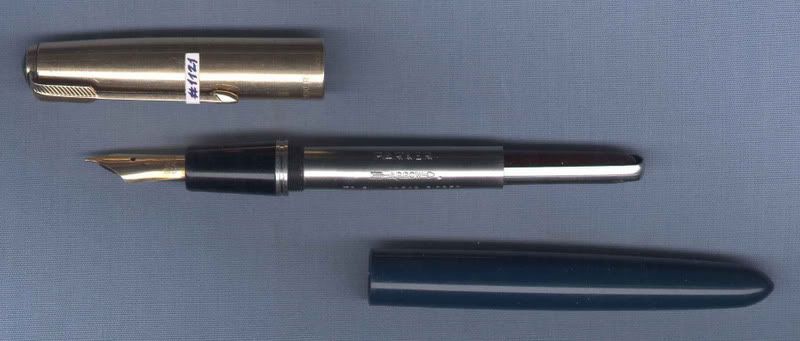
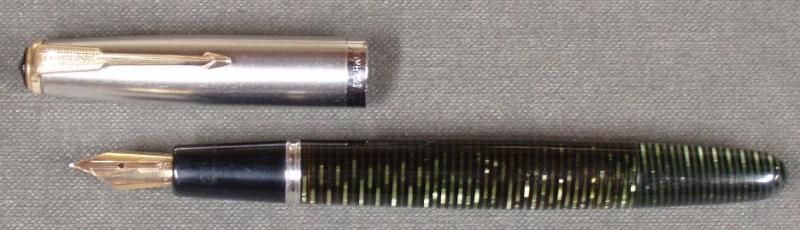
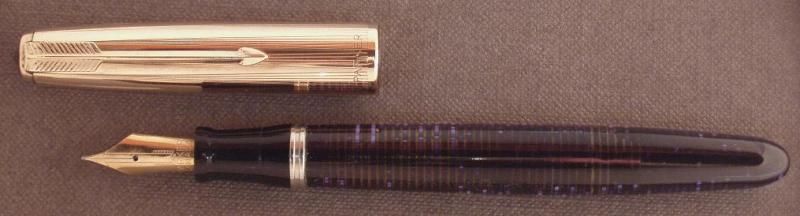
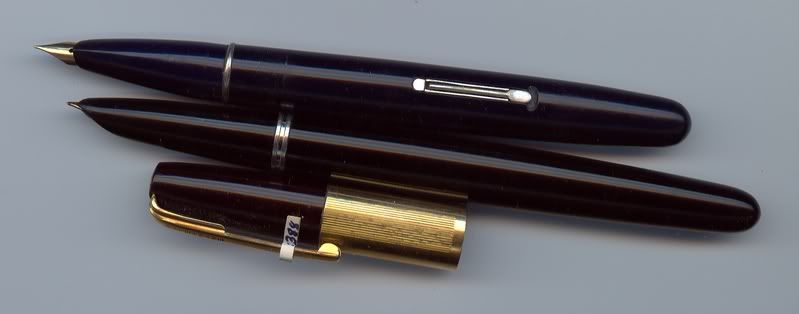
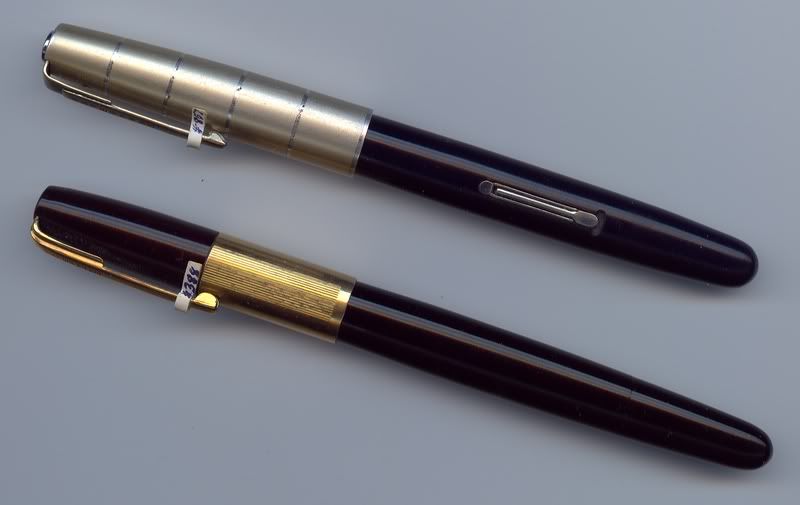
        On Nov 21, 2000, I wrote on Zoss, “Sorry Saul, but everything that Nathan writes is true.  You are right when you say that it was not a type of Parker 51 pen, but wrong when you say that it was not a Parker production pen in its own right, at least not up here in the Canadian Parker factory.  The pen was based upon the Parker 51 Special, and also the Parker 21, and it had its own name, the Parker “Arrow”.  It had a Vac nib with a Parker-21-type feed and aerometric unit set in a 21-type shroud, or hood.  The hood is cut back to make a section that allows the open nib and feed to protrude from the end, and the section is always black, no matter what the color of the barrel.  What probably happened was that Parker had an over-supply of Vac nibs in the 1950s, and they had the factory up in Canada use them up in this cost-effective way, using up old 51, 21, late-Duofold, and Vac parts.  I personally know of the existence of over 10 of these pens, including 3 pens that Max Stiedman owns.  I used to own one with a hunter green barrel and Parker 51 Heirloom-style Cap, and I currently own one with a blue barrel and a brushed-steel cap, and a much scarcer red-barreled one with a Heirloom-style cap.  Here are the above two pens
capped.
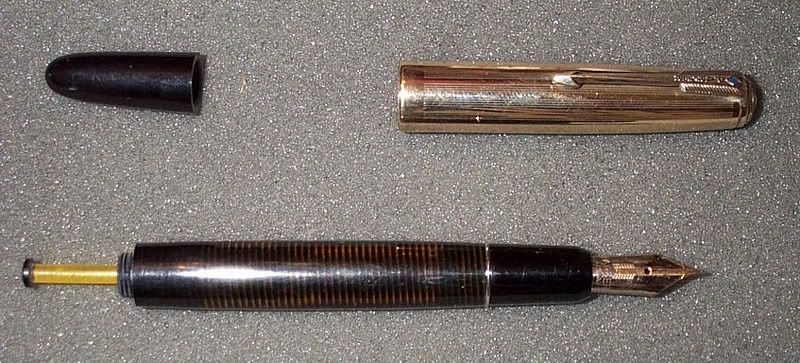
        “The “Arrow” was a very strange amalgam of pens and styles.  As well as the Vac nib and strange section and feed, the barrel is exactly the same as a Parker 21 barrel in length, diameter, and thread pitch.  The aerometric-filling unit is that of a Parker 21, but it is embossed with the name “Arrow” over top an embossed icon of an arrow.  The cap is the length of a Parker 51 Special cap, which is just a little shorter than the normal 51 cap, and it has the black jewel of the Special, but the diameter is that of a normal-sized 51 cap.  That means that you can exchange the “Arrow” cap with a normal 51 cap, but not with a 51 Special cap, because the metal bushing, or ring on the barrel that the cap slides on is the size of a normal 51 bushing.  I have seen various clips on the various caps, including Vacumatic 51 clips, Aerometric 51 clips, and the flat Challenger-style or 1940s-Duofold-style clips.  Here’s one taken apart.
        “The pens I have seen so far have had the Heirloom-style cap, but other styles of caps had been offered, including brushed steel.  I say Heirloom-style cap because it wasn’t exactly the same as the Heirloom.  The Heirloom is a gold-filled cap, with solid gold clip and barrel end trim, with widely-spaced horizontal and vertical lines forming large squares like a “window pane”, but the “Arrow” caps have gold-filled clips and have the horizontal lines only, not the vertical ones.  It’s sort of a half-Heirloom cap.
        “It’s truly an unusual pen, and the ones I have seen for sale at pen shows all sold for many hundreds of dollars, and I’m talking USD here, not Canadian.  One of these pens sold at the Chicago pen auction a while ago for $125-150, perhaps because no one except the buyer, Dan Zazove, and I knew what it really was.  I didn’t want another one, and there was no one else there to bid against Dan.”
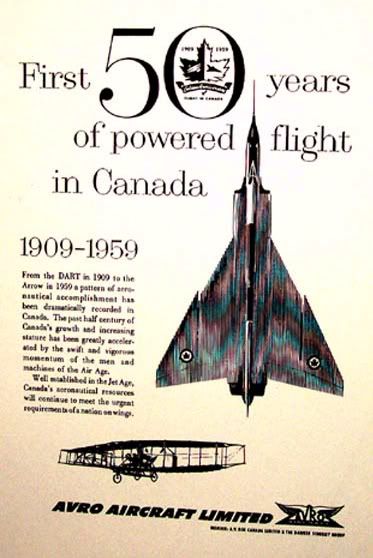
        Someone, perhaps Len Provisor because he’s interested in airplanes, suggested that the pen might have been named after the Canadian fighter jet, the
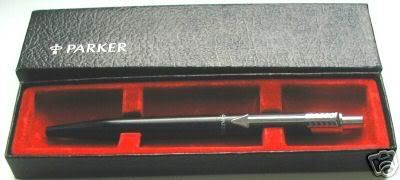
Avro Arrow, because they both appeared about the same time, but I haven’t been able to find any corroborative evidence in advertisements that might confirm this connection, yet.  And to confuse the issue just a little more, here’s a true Parker 51 Vacumatic “Arrow” Frankenpen that someone made up.  And the real “Arrow” pen should not be confused with a new pen that Parker is calling the “Parker Arrow”, and another pen, a ballpoint they called the “Big Arrow”.  Also check out this page on Tony Fischier’s website on the “Arrow”, and this French Parker, “La Plume”, except it has a screw cap.
        Matt McColm wrote on Aug 18, 2007 that Ernesto Soler’s Parker 51 site had a Canadian green pearl vac w/ an Arrow section and 1956 nib, 51 clutch ring, and demi vac 51 cap w/ Parker clip. It was on his site updates page, but has since been removed. Not only was the pen he mentioned there on Ernesto’s site, the
“Arrowvac”, but there was also this pen, the “Vacarrow”. The first pen was the closest to an “Arrow” with its cut-back-shroud section, which was also why Ernesto called it an “Arrowvac”. But the second one had a more traditional Vac-like section, and he rightfully called it a “Vacarrow”. However, both pens are somewhere between prototypes and frankenpens. I don’t think either pen was a prototype, because that would mean that they were being considered for being put into production. I think they were pens made up by Parker employees for themselves. That makes them more than just frankenpens. It makes them legitimate one-offs, probably made in the Parker factory, but not “Made by Parker”, that is, made for Parker.
        But the pen with the brown Vac barrel looks like it has a traditional section with the stepped profile machined off. It also looks like it has a Waterman’s Taperite bushing, which just happens to be very close to the sizes of the two types of Parker 51 bushings. That means that the 51 and Taperite caps are interchangeable, if you ever need a frankencap for your 51 with a missing or damaged 51 cap. It also makes the brown Vac pen a true frankenpen, since it mixes parts from at least two pen companies. The two pens on Ernesto’s site are at least all-Parker. Here are some pictures of
a Taperite pen and a Parker 51 pen, and a Taperite cap on a Parker 51 frankenpen.

George Kovalenko.

.