, or two Crosses don’t make a write.
[Thanks to the owner of the pencil for the pictures.]
A friend of mine sent me some pictures of the above pencil that he purchased recently, one that he called a bit of an anomaly. He wondered why a lead holder mechanism would be found in a stylograph case whose knob was imprinted with the date of US patent no. 217,888 granted to Duncan MacKinnon. He told me this pencil held standard lead of 0.046" diameter, even though the stylograph pre-dated Charles Keeran’s standard lead by almost 40 years. Keeran claimed in his 1928 letter, p.1, that he had originated that size of lead when he commissioned the Joseph Dixon Company to produce it for him in 1913. So what was the date of the mechanism in this pencil? He wondered whether the pencil was a fake, or a unique prototype, or just an aftermarket hack job of indeterminate origins and with no historic value. It seemed to him that what was needed was comparison with other stylographic pens and pencils of the era, whether those by MacKinnon, Cross, Livermore, American Pencil Company, or any other manufacturer.
The owner sent me two photos of the pencil beside a MacKinnon stylo, capped and posted.
I told him that it was a great pencil, whatever it was. I didn’t think it was a fake, or a unique prototype, but if it wasn’t, then it had to be a frankenpencil. That’s the only reason why a lead holder mechanism might be found in a stylographic pen case. It is most probably an aftermarket job, but definitely not a hack job with no historic value.
As for Keeran’s standard size mechanical pencil lead, some of the various diameters to be encountered in the 1800s come close, but they’re not exactly the same size. Back in 2012, the Writing Equipment Society in the UK had a “Chronology Project” that recorded basic data on when particular events happened and when certain designs were released. It included a link to a timeline on the topic of “Evolution of Lead Refill Sticks”, still accessible online at this link that connects directly to a document opener on your OS, not an online page in a browser. There is also a WES link to the chronology of pencil lead evolution, and it is also archived in Wayback, both of which also open in a document opener. There’s a list there of Sampson Mordan lead diameters compiled by Pendemonium, and none of them is close to Keeran’s standard size. It was Keeran in 1913 who defined the diameter for the interchangeable polygrade leads that the Eversharp pencil would hold. It may be that the mechanism in that BCHR case with the MacKinnon patent date on it holds a pre-Keeran lead diameter that’s close to his 0.046", but it’s not likely.


Here are two break-down photos of the pencil and a description. “A piece of 0.046" diameter lead (3) is held in the yellow metal split tube lead clutch of the lead carriage (4). There is a bright silvery two-prong tip (5) attached to the silvery carriage tube exiting the bottom end of a brown metal sleeve with a woodgrain texture (7). Solder residue appears at that end of sleeve (6), and there’s just enough longitudinal play there to let the brown sleeve slide up and down the carriage tube inside. At the top end of (7) is affixed a white metal collar (9). The old paper exposed at (8) may indicate packing for the connection. The strength of this connection was unknown, and therefore was not forced. The inside wall of (9) is threaded from the opening for 1/4 inch. On the knob there is a black hard rubber hollow stem (10) that is threaded at the bottom for 1/8 inch. It screws into (9) to connect the metal collar and the knob. This stem is tapered where it meets the knob (11). Parts (7), (8), (9) and the knob, when attached, move together as one. The lead does not rotate in propelling or repelling. Peering inside the end of the collar (9), there is a silvery centre ring with a moveable peg inside. That must be the top of the carriage tube with the peg of the lead carriage inside. Now, holding the tip (5) while rotating the collar (9), the carriage tube remains stationary while the lead carriage inside is caused to rise and fall non-rotationally. The mechanical parts [at first] appear consistent with one another in age and with the case[, or else they were made to appear so]. The tip (5) fits perfectly into the black hard rubber grip section.”
The owner of the pencil also took a close look at Barbara Lambert’s book, Writing History, 150 Years of the A. T. Cross Company, and he found two very interesting photo-spreads there on p.34 and p.54. Barbara Lambert’s book is full of errors and inadequacies in the descriptions and identifications of the pens in the book. Basically all stylos and pencils looked alike in that era, and Cross was basically a pencil company, so it’s understandable that they would have had a pencil-and-stylo commemorative set such as the one on p.34. But it doesn’t date to 1881, as the Cross book implies. 1881 was merely the founding date of the company. The stylo on p.34 of the Cross book is a later style of pen from the later 1880s and 1890s, and the business address on the Cross paper is one that they used from 1885 to 1890. Perhaps the commemorative set was meant for a 10th-year anniversary in 1891 of the company, or a 10th-year anniversary in 1887-88 of their stylo patents from 1877 and 1878.
But the two Cross stylos at the top of the picture on p.54 are another thing altogether. One is completely misidentified. They are actually a Cross stylo and a pencil just like the one we have here! Two Crosses don’t make a right, since one actually turns out to be a MacKinnon. And the pencil is not one that’s covered by the two pencil patents she shows on p.55. That’s what happens when a non-pen-and-pencil historian is conscripted to research and write a book about pens and pencils. In fact, the book is really about the family, not the pen & pencil company. It’s hard to tell from the picture of the pencil whether it actually has a seam between the barrel and the turning knob, and whether it advances the lead in the same way as the above pencil. Livermore also had an early pencil patent in 1881, and he advertised it as a “Stylographic Lead Pencil”, but that’s not the pencil we’re dealing with here, either. Take a look at the link in my blog post about the “Mechanical Pencil Decade”, in the second paragraph.
The owner also sent me a scan of an ad for an 1883 combo by Alvah S. French, who was an inkmaker, Alvah S. French Manufacturer, in Philadelphia in 1878, and he made and sold “Caw’s” ink for Major H. Brown and Francis C. Brown before the Browns started up their own ink factory, the Fountain Ink Co. The company name was changed to A. S. French Co., M’frs., and also A. S. French Manufacturing Co., in New York in 1879. The inkmaking was taken over by the Fountain Ink Co. in 1880, whose name was changed to Caw’s Ink And Pen Co., 1884, and French continued on till 1884 as a penmaker and seller of “MacKinnon” stylographs, “Fountograph” fountain pens, John Holland mechanical pencils, and “The Union” combo, which could be either a fountain pen and pencil combo, or a stylograph and pencil combo, in 1883-84.
After French gave up inkmaking, he formed the company French, Carleton, & Coffin, a stylographic pen company in New York, with his new partners George W. Carleton, president, Edmund Coffin, Jr., vice-president, and French as general manager, and secretary & treasurer. They bought The MacKinnon Pen Co. from Sutherland & Brown on July 5, 1881, re-organized it in September 1881 with George W. Carleton, president, later Alexander M. Sutherland, president, and Francis C. Brown, vice-president, and the whole company was later absorbed by A. S. French & Co. John Holland supplied them with their iridium points. Their office was in the Western Union Telegraph Bldg., corner of 199 Broadway Ave. & Dey St. in 1883-84. In the last days of the company, the stylographs were made for A. S. French & Co. by the Fountegraph Pen Co. at 89 Nassau St. in 1884. They were made with iridium points and mechanisms supplied by John Holland, and French used the address of the Fountegraph Pen Co., but he was not otherwise connected with them. The company failed and was placed under receivership in March 1884, and the office in New York was dissolved later in 1884.
So if there was no exact equivalent in the 1880s to the 0.046" lead pioneered by Keeran, this does, indeed, make the lead-holder mechanism in the pencil suspect for one reason, to start with. A second reason, now, is that the mechanism is also a propel-repel-expel type. This got me to look more closely at the pencil. First of all, the sections of the pencil and the one in the Lambert book are both Cross sections, although they are on MacKinnon barrels. That’s confusing. Here are some different sections used by MacKinnon, so from this aspect, they are both frankenpencils, or crosses between a MacKinnon stylo, a Cross stylo, and a pencil.
At first I thought that the pencil looked very well made, but now I have to qualify that statement. The external appearance and workmanship is still excellent, and everything still fits perfectly, but two things gave me further pause when I looked at the mechanism. I have to admit now that I have had reservations about the actual pencil mechanism right from the start. It just looked wrong to me. The nickel or chrome finish of the two knurled rings looks late. It just doesn’t look right for the period of the stylo case. But when I looked at the rod to which it is attached, it looked even more suspect. It looked like a copper or brass tube that had been scored and scratched up for some reason, what the owner called woodgrain texture, and it was not necessary to, or related to the function of the pencil. It looked like it was just some piece of rod that some pencil maker had available to him, and he scratched it up to disguise it.
The only difference between this pencil and the one pictured in the Cross book is that the one in the book has a plain, black cap, so they are not the exact same example, and there must be at least two examples of the pencil. It would be very interesting to examine and compare the two pencils side by side to see whether and how they are similar, or not. My suspicion is that if the other pencil does indeed exist, then it’s probably from the collection of Michael Fultz, now part of the Gregory H. Sachs pen collection, because I think that Fultz supplied most of the items pictured in the book.
The pencil is still very well put together, but some of the parts are suspect. It does not have the pencil mechanism in the A. S. French Co.’s “Union” combo, which was probably made for French by the John Holland pencil company. If this pencil was, indeed, made sometime in the 1880s, the mechanism could possibly have been made by John Holland, or Cross using one of their pencil mechanisms, but probably not. Even if there are two examples, two Crosses don’t make a wright, cuz they’re probably just frankenpencils.
George Kovalenko.
.
, and some early MacKinnon patents and legal cases.

[Posted on L&P on Apr 6-12, 2010.]
David Nishimura wrote, “The all-metal MacKinnons are rare. Although other examples were undoubtedly tucked away in collections at the time the pen that started this thread was found, this pen was probably the first example that most collectors–even advanced collectors–got to see and bid on. It was bought by Fultz, with me as underbidder. Whether the pen ended up in Fultz’s own collection or the Sachs-Fultz collection. I’m not sure.
“Since then, several other examples have turned up, including one from Canada and one from Europe. All that I have seen bear either an 1875 Canada-UK, or 1876 USA-France patent date, with no “Patent Pending” markings. I have yet to see an example with the 1879 patent date.
“At this juncture, I am inclined to the following interpretation. These all-metal pens are the exact design shown in the 1879 patent, 217,888, but their manufacture likely predates the patent and the patent application. As we all know, MacKinnon wasn’t the savviest about protecting his
inventions, so it would not be at all surprising for him to have started manufacture of these pens ca. 1875-76, applying for patent protection [174,965 in 1876] once he began to realize what the competition was up to. This delay could also be explained by the fact that the 1879 patent covers improvements to the mechanism in the 1876 patent–improvements that were patentable, of course, but which MacKinnon might well have believed were not so drastic as to dilute the earlier patent’s protection for the basic design. Circumstantial evidence also points to a very early date for the all-metal pens, including their absence from advertisements, their rarity, and the clear superiority of hard rubber, which would have been almost immediately apparent–and hard rubber MacKinnons (and other stylographic and nibbed fountain pens) were definitely in full production by the late 1870s. Not to mention that by 1880 the standard MacKinnon pens had posting pegs at the end of the barrel, whereas this feature is absent from the metal pens, and the early hard rubber MacKinnons, as well, so this is not a function of the materials used.
“According to [Ron Dutcher’s article on] Francis C. Brown, [also see my two blog posts on Francis C. Brown’s two autobiographies] it was the very first MacKinnons that were metal. Note that the all-metal MacKinnons that I’ve examined do not have a spring in the needle mechanism, just a simple weight. One very interesting feature, however, is what appears to be an adjusting screw at the back end of the needle weight. This does not appear in the illustrations in the 1879 MacKinnon patent, 217,888, nor is it described in the text. It does appear, however, in the first Cross patent, 191,798, filed 1876, granted 1877. Who was “borrowing” from whom? I’d very much like to reexamine the exact contents of the Cross-MacKinnon lawsuit; it is always stated that the dispute was over the addition of a spring to the needle mechanism, but could there have been other complaints of infringement as well?”
And I wrote, “David, since you’re dealing with MacKinnon, you might want to look at the original Canadian patent from 1875, Canadian patent 4,809. I can’t help with a transcript of the trial, but the abridged report of the case, “Cross v. McKinnon”, Circuit Court, S.D. New York, Mar 8, 1882, appeared in The Federal Reporter, vol. 11, pp.601-2. You might also want to look up the court case between Cross and Livermore, which Cross lost, “Cross v. Livermore”, Circuit Court D., Rhode Island, 9 F. 607; 1881 US App. LEXIS 2056, 1881. The abridged report appeared in The Federal Reporter, vol. 9, pp.607-11. In the Livermore case, Cross applied for an injunction and was refused. In the index for the volume, 9 F. 950, the Livermore case is used as an example in the clarification, or definition of the term “Injunction, When Refused”, on p.950. “A preliminary injunction will be refused where grave doubt exists, on the evidence, whether [or not] there has been any infringement, and there is some doubt as to the validity of the patent. Hence, a motion for a preliminary injunction, made by Alonzo T. Cross, as the patentee of letters patent Nos. 199,621 and 227,416, and reissued letters patent No. 9,716, for improvements in stylographic or fountain pens, against Charles W. Livermore, is denied.” It was deemed that, concerning Cross’s patents, there was some doubt as to their validity! and that grave doubt existed as to whether there had been any infringement! That should have been the conclusion of the MacKinnon case as well!
“Antonios Zavaliangos has a list of legal cases on his blog. The university where he works has access to LEXIS, and he uses it to find all the reports of pen company court cases.”
David Nishimura wrote, “Further digging reveals the summary of the “Cross v. MacKinnon” suit online. It does appear that the spring was the sole matter at issue. This is also found, in the case of “French v. Foley”.
“The answer to who French was appeared in yet another bit of MacKinnon litigation, a case decided in December of 1882. As for further details on French’s identity and other activities, that will take some further digging. As it was, the case cited above shows that a number of our assumptions about both the MacKinnon company and Francis C. Brown’s machinations were false. For one thing, I very much doubt that the Cross lawsuit did all that much to slow down the MacKinnon company. The death of the founder is far more significant, along with the flood of imitators rushing into the market and driving down prices. In any event, it now seems clear that Brown & Sutherland had sold MacKinnon before the Cross lawsuit was decided–and possibly even before it was filed. And that Brown took over the Fountain Ink Co. at some point shortly after the sale of MacKinnon–probably late 1881, or early 1882–his actions behind the screen of Fountain Ink Co. being the cause of French’s lawsuit.”
And I wrote, “Well, this gets us a little closer to French, but he’s still only a surname. Perhaps a bit more information might come forward in this case, “MacKinnon Pen Co. v. Fountain Ink Co.”, Court of Appeals of New York, 93 N.Y. 658, 1883 N.Y. LEXIS 378, argued October 16, 1883, decided October 26, 1883. Sorry, I couldn’t find it in Google Books.
“As for the Cross lawsuit, I agree that the spring in the Cross patent is over blown. I have already said elsewhere that “the spring was constantly submerged in the highly acidic ink of the day, and it very quickly corroded, even though it was made of silver or gold alloys, and it quickly lost it springy tension, and didn’t function very well after all”. It’s ironic that Cross eliminated the spring from his later stylos and used a simple weighed needle just like the one in the MacKinnon stylos, and the MacKinnon company could have successfully sued Cross! I go on to conclude, “Just look at all the drafting pens of our time, the direct descendants of the stylographic pens. Not one of them makes use of the spring idea. Every single modern drafting pen, to the last one, makes use of the weighted needle idea. MacKinnon’s original idea was vindicated. So now who has the last laugh?”
David Nishimura, “That’s strange, in that the link above is also “MacKinnon Pen Co. v. Fountain Ink Co.”–itself an appeal, so it would seem the case was appealed yet again. I can’t find it online, either, so we may have to appeal ourselves to someone with Lexis access.
“The spring may be “overblown” in terms of design, but what we really need to know is its impact in terms of litigation. Were there penalties or injunctions that disrupted the MacKinnon company’s operations? Or did this lawsuit have more to do with backroom haggling of which we have no record, where calling in the lawyers was just another means of applying pressure when negotiation came to an impasse? We should be mindful of situations, past and present, where rival companies sit on stacks of patents of sometimes questionable scope or validity, and rather than file suit at every possible instance of infringement, generally let things go as long as there is
a perceived balance, rather than risk upsetting the whole rickety construction.
“I also wouldn’t exaggerate the weaknesses of the spring system in stylographic pens.
A simple sprung needle, without a weight, was widely used in early 20th-century stylos by companies such as J. Ullrich Co., and was the norm for the English stylos that were so widely exported in the same era. The peculiarity of the Cross system is the combination of the weight and the spring.”
And I wrote, “In the meantime, the Carleton in French, Carleton, & Coffin is definitely George W. Carleton, president of the MacKinnon company in the early 1880s. As for Coffin, he may be Edmund Coffin, Jr., who received a patent for a stylograph in 1882, or it could be his father. And French might be Frederick S. French, who was a pen and pencil maker in Providence, R.I., later in the 1880s. The latter two names are still conjecture. Some of the reporters of these legal cases are better than others when it comes to giving the full names of the people in the cases they summarize, thus leaving us guessing about the identities of those involved.
“I just got back from the law library after looking up this second “MacKinnon Pen Co. v. Fountain Ink Co.” case. I found the appeal, but because they “all concurred”, and “agreed to dismiss the appeal”, there was no court case, and “no opinion” from the judges, and therefore nothing else to report on. All that the report consists of is the case name, “MacKinnon Pen Co. v. Fountain Ink Co.”, and six brief sentence fragments. In that sense it was a disappointment, but in another sense it was very fruitful. Unlike the other reports we have been dealing with, the full names of those involved are given.
“As it turns out, the Coffin in French, Carleton, & Coffin is definitely Edmund Coffin, Jr., whose name is listed “for the respondents”, so that name is no longer conjecture. And Samuel Jones, another new name to me, is listed “for the appellants”. Now, the only one we still need to find is French. Another problem with the reporters of these legal cases is that some of them misspell the names of the people involved. Getting back to the “French v. Foley” case, I looked in my Penmakers book and could find no penmakers named “Clarke”. It is possible that this is a misspelling of “Clark”, in which case the penmaker involved is probably G. S. Clark & Co., the principal names involved being Gilbert S. Clark and James M. Clark.”
David Nishimura, “Good work, and thanks! Quick question, though: aren’t the names listed as “for the respondents” and “for the appellants” the lawyers for the contending parties?”
And I wrote, “The names listed for the respondents and the appellants are the individuals who present the case, and you’re right, they’re usually the lawyers that represent the companies, or individuals. But they might also be a treasurer of the firm, or one of the owners, or some other officer on the board, or someone from the legal department. It just seems highly unlikely that there would be a lawyer and a writing-instrument inventor and patentee with the same idiosyn- cratic name, Edmund Coffin, Jr., both working for the same company. I think it’s the “Jr.” in his name that cinches it. But I still don’t know who Samuel Jones is.”
David Nishimura, “I wouldn’t be at all surprised to have Coffin being both counsel and partner. But Jones might just well be a lawyer, with no deeper connection to the litigants.”
And I wrote, “Or Jones might be a silent partner, and an investor. [Since this was first posted on L&P, a lot more information showed up for my Penmakers book. Carleton is definitely George W. Carleton, Coffin is definitely Edmund Coffin, Jr., and French is Alvah S. French. More on all this in my next post. As for Samuel Jones,] More than likely, he was just a lawyer.”
George Kovalenko.
.
, or the William Cowen (or Cowan) fountain pen.

Fountain pen, quill pen, ink bottle, wax seal, and marble paper weights, one in the shape of a book.
All items at Monticello except the seal, courtesy of a private collection. Photo by Edward Owen.
I’m sick and tired of seeing this topic come up every few years. The last time this cropped up was last November on Pentrace where two old friends, a couple of old fogeys, were discussing Thomas Jefferson’s 1824 fountain pen. All those involved shall remain nameless to protect the guilty. It was stated there that the pen was filled as an eyedropper and that the pen was non- functional because it had no feed, and there was nothing to keep the ink inside the barrel. Someone else said that even though it was non-functional, you could still dip it. Then they proceeded to discuss whether there was any way to install a feed so that at least one dip would give a few lines of writing. They were beginning to drive me crazy with their casual banter.
First of all, this pen was not filled with an eyedropper because it predated the invention of elastic rubber by 20 to 25 years, and it couldn’t have had a hard rubber feed because it predated the invention of hard rubber by 25 to 30 years. It could only have been filled with a glass pipette, or by literally pouring the ink into the barrel using a funnel. It is what is now known as a Bion-type pen. Second, it is totally functional as a Bion-type pen. It is an exact reproduction of Jefferson’s pen, and no parts are missing, so nothing additional is required to make it functional. There is a tiny hole at the nib-end, and it has no feed because that’s the way Bion-type pens work. The ink is kept inside the barrel by the surface tension of the liquid. You prime the nib by giving the pen a single, little shake at a time, as required. You could also prime the nib by gingerly unscrewing the monogrammed end cap to let in some air. You could alternatively use a needle to break the surface tension and drag out the ink to get it started. Of course it could get messy. I’m not denying that. It just takes a little pensmithship to get the priming just right. But it’s not broken, for goodness sake. You can see more pictures of such Bion-type pens in Michael Finlay’s book, Western Writing Implements In The Age Of The Quill Pen, p.81.
Another time on Pentrace, this time on Dec 31, 2005, Ron Dutcher innocently posted the link to his article about the Thomas Jefferson pen on his webpage about presidential pens. Someone took him to task for his grammar and his orthography, which is a lost cause. And someone else asked whether this pen had an ink reservoir, and how it worked, or whether it was a long-lasting dip pen. “What about a feed, etc.?”, he asked.
I finally had to chime in to say that the pen did have a reservoir, so it was a fountain pen, not a dip pen. At the barrel’s end there is a little oval flange, or elliptical end plate, with “TJ” engraved on it, Jefferson’s monogram. It could serve as a wax seal, or stamp, except that the initials would be backwards in the wax wafer, so it’s just a decorative monogram, not a wax seal. It would also serve to stop the pen from rolling off the desk top, sort of like the crescent on a Conklin, but in transverse position. This end-piece unscrews for filling with ink, so it qualifies as a simple Bion- type fountain pen. What it doesn’t have is an underfeed. The nib was primed by shaking the pen until some ink got onto the nib, but that was a precarious process. Often the paper and desk and floor and walls and ceiling ended up getting blessed with the ink as well. The replica comes with a cheap gold-plated steel nib, but the original had a gold nib without any tipping material. It could, alternatively, have had a quill slip nib, which would have been ideal. They offer superior writing properties, no corrosion, and can be sharpened with a penknife and replaced at will. The original pen was made by a jeweler named Cowen in Richmond, Virginia in 1824, and the pen should more properly be called the Cowen pen. Being made in the 1820s, the nib doesn’t have any iridium tipping, nor any other kind. The pen is referred to in an 1824 Jefferson letter, which is how we know the penmaker's name, and the original pen is on display at Monticello. As far as I know, the replica is an exact one, except for the nib. The reproductions of these pens were being sold a few years ago by the gift shop at the Monticello Center, in the Monticello Museum Shop, for the Thomas Jefferson Memorial Foundation, but they are now sold out. They were also sold through Levenger’s, and later by Ray Adams at
Wood ’n’ Dreams in 1999. Here’s the sales listing, which reproduces the text from the paper insert. And here are some more photos.
A big part of the confusion was caused by the Monticello Center itself, or at least the Monticello Museum Shop, which called it a dip pen on the paper insert in the box with the pen.
Thomas Jefferson’s Silver Dip Pen
Thomas Jefferson, third President of the United States and author of the Declaration of Independence, wrote approximately twenty thousand letters during his lifetime. In the early 1820’s, Jefferson purchased a sterling silver pen, which he described as “one of the best I ever saw”. The pen was manufactured by William Cowen, a watchmaker in Richmond, Virginia. After Jefferson’s death in 1826, the pen was inherited by his daughter, Martha Jefferson Randolph, who gave it to her son-in-law, Nicholas P. Trist. It descended through the Trist-Burke family and has survived in the Monticello collection.
This reproduction sterling silver pen faithfully follows the original design of Jefferson’s cylindrical writing instrument. Turned from solid bars of .925 Sterling silver, the pen features a removable cap that can be threaded off to expose a gold nib. The elliptical head, which is also removable, has been engraved with the initials of Thomas Jefferson, “TJ”, in the same cipher style as the original. The pen has been hand buffed to a brilliant finish and is an authorized reproduction of the Thomas Jefferson Memorial Foundation, Inc.
Diameter 0.69", Length 4.75"
made by
Van Cort Instruments, Inc.
29 Industrial Drive East
Northampton, Mass.
Nowhere on the paper is the pen identified as a fountain pen, even though it is referred to as such by Jefferson. In his letter of May 13, 1824 to Col. Bernard Peyton, his agent in Richmond, Virginia, he ordered a copy of the pen to be made by William Cowen (1779-1831), a Richmond watchmaker.
I saw yesterday in the hands of Mr Dyer a fountain pen, one of the best I ever saw. He said it was made for him by Mr Cowan [Cowen], a watchmaker of Richmond, and cost him 5 dollars. The outer tube was of silver, but the two leaves of the pen were gold, and no other metal will resist the corrosion of the ink.
Silvio Bedini in his book Thomas Jefferson And His Copying Machines, published in 1984, mentions this letter, which is now in the Coolidge Collection of Thomas Jefferson Papers, in the Massachusetts Historical Society.
Mike Stevens wrote a review of the repro pen in 1999 for Stylophiles, an online magazine for pen lovers, and all of this led him to also title his article “The Thomas Jefferson Dip Pen”. And so the confusion grew. He also got some other things wrong. Nicolas Bion published his illustration of his pen in 1709, and the 1758 book is a republication of Edmund Stone’s 1723 translation of the original French book. He then goes on to deny that the pen is a fountain pen, and says, “I don’t know if I would go that far, I would describe it as a ‘dip pen with a self-contained ink supply’”. But that’s the definition of a fountain pen! In other words, because there was no feed of any kind on this pen, he denied it the privilege of being called a fountain pen. The ink had to be delivered to the nib manually by giving the pen a slight shake, so it’s not a fountain pen, according to him. Gad Gur-Ari also wrote a review of the pen where he called it “a very plain looking dip pen”. But then he discovers that “this little dip pen has an ink reservoir!”, and he redeems himself by calling it a “Fountain Dip Pen!”. Well, he redeems himself only halfway.
Mike Stevens goes on to say that, while the pen is being filled, the end cap is removed only with the other cap in place. One of the caps must be sealed at all times. You then screw this cap firmly back in place, remove the main cap, and give the pen a little shake, to allow the ink to drop down into the nib. When not in use, the pen seals up nicely with no leaking problems at all. The pen requires a bit of practice to get used to it. It needs a bit of a jiggle every few words to keep the ink flowing. It’s not as simple to use as a modern pen, but it must have been a lot better than a conventional dip pen. You have to get into the habit of keeping the ink moving. The only part of the pen that’s disappointing is the nib. While the iridium tip is very smooth, the rigid steel nib has absolutely no expressive quality on paper. Mike replaced the plain, generic nib in the pen with a “super-flex Waterman’s #2 nib, and the results were amazing, in terms of the line”, but you could also exchange it with an italic nib. Either one would probably be “a lot closer to the original”, and would make it much more fun to use. Jefferson understood this and was truly the pensmith of happiness, or at least he was pursuing the happiness of the pensmith.
George Kovalenko.
.
, New York, Brooklyn, Boston, and Philadelphia.
New York used to be the center of US fountain pen manufacturing between 1850 and 1950, and a lot of the history of the N. Y. pen companies is preserved in the N. Y. business directories. Here’s a short list of online resources for these directories in a few cities.
The website titled “New York City Online Historical Directories” has a comprehensive list of links, but many of them are not free. Fortunately, some are backed up with free links. But watch out. There are lots of stumbling blocks. Beware of all the Williams volumes from 1830 to 1835 because there are no lists of names and occupations. Also remember that the volumes on Ancestry are not word-searchable. What you find is all a matter of what words you choose for your search. Always search for the singular and plural of a word. Look for the words “pen”, “pens”, “quill”, “quills”, “pencil”, and “pencils”, and also the words “gold” and “silver”. But the worst thing of all is, as usual, all the gaps in the record. I hate gaps!
Here’s a “History of City Directories in the United States and New York City”.
Here’s a guide to the digitized “New York City Directories” at the New York Public Library.
Family Search’s “New York Directories” lists various commercial online resources.
Here are the links to the “Brooklyn City Directories” as PDF’s at the Brooklyn Public Library.
Here are the three sets of links for the “Boston City Directories” on the Hathi Trust. When you open up each volume in all the links, you’ll find that they are text-only, so you will have to add the suffix ;view=1up;seq=1 to the ends of all the URLs to get the full imagery versions.
Fold3.com’s “New York Directories” has volumes between 1786 and 1922.
Fold3.com’s “Brooklyn Directories” has volumes between 1862 and 1913.
Fold3.com’s “Philadelphia Directories” has volumes between 1785 and 1922.
Fold3.com’s “Boston Directories” has volumes between 1789 and 1926.
Here’s the first Philadelphia city directory, the 1785. And here’s the first New York directory, the 1786 as republished by Doggett in 1851. It was also republished by Patterson in 1874, copies in Hathi and Google Books, but they don’t have the “Annals of New York City” section with the reference to Thomas Allen, a stationer and book binder who was also a seller of imported quills. Somehow, he was left out of the name list in the directory, as well.
These are the links for “Trow’s New York City Directories” from 1853 to 1877, but they are text-only, so you have to add ;view=1up;seq=1 to the ends of the URLs to get full imagery.
Here are some stray volumes of “The Trow City Directory” from 1864 to 1890.
Here are the “Doggett’s New York City Directory” volumes from 1843 to 1852.
And here are the “Longworth’s New York Directory” volumes from 1801 to 1843.
I will place my own distilled, chronologically-arranged lists of links of free, online, searchable N. Y., Boston, and Philly volumes here, eventually, once I finish them off, so keep checking back.
George Kovalenko.
.
Philadelphia city directories
1785–1867
New York city directories
1786–1910
Boston city directories
1836–1922
Brooklyn city directories
1856–1908

[From Mar 28, and Aug 31, 2005, and posted on L&P on Nov 13, 2005.]
Here’s a bit of information on A. Morton & Co., an early gold nib maker in the US, but please allow the dates a little leeway. Wherever there is a tilde sign, please read “approximately”, or “about”. A little more research still needs to be done to fine-tune the time frames.
A. Morton & Co. made gold pens, and gold & silver pen & pencil cases, and was in business since ~1848. It was listed at 25 Maiden Lane, New York, since 1859. Alexander Morton was in charge from ~1848-90. Persons P. Allen joined the company about 1860. And James Morton became the successor to Alexander Morton ~1890 till 1910. Victorine C. Morton inherited the company from her deceased husband James Morton in 1910, and ran the business till ~1920-22. The 1910 trademark that was listed under her name was said to have been in use since 1848, and the company was out of business by ~1920-22.
Thomas Neureither was feeling a little burnt out and a bit tired of the short half-life of the chat on other pen message boards, and wrote to me backchannel on Mar 28, 2005 about Kaweco. Thomas is trying to collect the history of fountain-pen production in his hometown, Heidelberg, and the most important firm there in the first quarter of the 1900s is Kaweco. Our conversation touched upon his area of collecting, and he gave me permission to post the following for him.
Kaweco started importing Morton nibs and fountain pens from NY around 1899. In 1913, Kaweco bought the Morton factory and the rights to produce under the trademark. In March 1914, the engineers and representatives of Morton came to Heidelberg with production machines and taught the Kaweco workers how to produce their own gold nibs with Morton’s know-how, or penknowledgy, and Kaweco changed over to the Morton nib-producing system. When WW1 began, the Americans returned to NY, but Kaweco bought the machines and the rights to produce under Morton’s well-reputed trademark for the next few years. By the time they left in 1915, they were enthusiastic that the quality of the Heidelberg gold nibs imprinted with Kaweco or Morton was as good as the American Morton nibs. The first nib craftsmen for Kaweco were Hermann Böhler and Peter Rupp. Hermann Böhler together with his brother Georg founded their own writing equipment factory, Osmia, in the same neighborhood, and after the first bankruptcy of Kaweco, Peter Rupp founded a gold nib factory, the nibs with the lion head. It all makes for a very nice story from the first times when they still had good co-operations across the big pond.
Jürgen Kuhse added the following information on Aug 31, 2005. Kaweco started in 1883 as Heidelberger Federhalterfabrik, but in 1921 they changed the name to Koch, Weber & Co. Around 1925 a company with the name Knust, Woringen & Grube with the logo KWG also existed in Heidelberg, and they produced models like Aurumia and Colleg. In the year 1929, these two companies joined together under the name Kaweco Badische Füllhalterfabrik, Worringen & Grube. Joseph Knust built his own factory and named the company IKA, but the company was not successful.

George Kovalenko.
.
[Posted on L&P on May 17, 18, and 20, 2012.]
Here’s another stationery item from an age before laptops and desktop computers. There’s a picture in The American Stationer, July 6, 1907, p.6, of a 20-pen Signagraph, a pantographic apparatus for signing 20 cheques, or letters, or documents at a time. Larger, or smaller versions with more, or less pens were also available. A lot of pen people may not realize that the so-called “Signagraph” was at also known as the “Scriptographe”, as shown by this article in Bookseller and Stationer, May 1909, p.34, or Can. Stat., as I like to call it. Also, the various patents were not issued or assigned to Waterman’s, but rather, were licensed to Waterman’s. “The vast increase in corporate issues caused by expanding business” made this writing machine a necessity at the time, and the “relief” it brought was welcomed and “endorsed by the leading captains of industry”, in the words of the editors of Am. Stat. Wow, what a timesaver. All you had to do was fill up and maintain 20 fountain pens so that they wrote simultaneously and their tips didn’t dry up and write sporadically and intermittently. But if you can find one today they are worth a lot of money. It’s like the first Texas Instruments so-called desktop computer. It was actually a full desk in its own right with a large shroud over it to cover the almost-wall-sized screen. Only about 25 of them were ever produced, but if you can find one today they would be worth a mint. I’m not saying that a Signagraph is worth that much, but it’s up in the thousands, if you can find one. I’d say at least $100 per pen, and probably more, and then something more for the mechanism. The ones I’ve seen have all had pens made especially for the purpose.
David Nishimura wrote, “I’ve never seen an actual surviving 20-pen Signagraph. Those were big units; the 5-pen Signagraph Junior was a portable unit that fit into a case the size of an oversize briefcase, and I’ve seen and owned a number of them. A single #4-size BHR slip-cap ED pen for a Signagraph Junior recently sold on eBay for $207. Note that one does not have to use the special pens–any pen with more or less the same thickness will do. I have seen people set up a Signagraph with thick-barrelled rollerballs for demonstration purposes. And since the Signagraph Junior remained in production into the later 1930s at least, one will find them with different pens–including Ink-Vues on later examples.”
And I wrote, “Here’s an article in Am. Stat., Nov 16, 1912, p.13, about another one, this time a “Junior Signagraph”, but there’s no picture. It doesn’t specifically say that it’s a 5-pen version, but it does say it can be used to sign “four or five checks to a sheet”. It also says that the “Waterman’s Ideal fountain pens have made this instrument possible”. There is, however, a stand-alone photo in Am. Stat., Dec 14, 1912, p.32, of a 10-pen version being used by the “Paymaster Of A Large Corporation” to sign 6,500 checks.”
George Kovalenko.
.
[Posted on L&P on May 16, 17, and June 25, 2012.]
The Waterman’s Utopian tokens are sometimes mistaken for poker chips, but an article in American Stationer, Sept 14, 1907, pp.16, 18, shows that their original purpose was as good luck “souvenir coins”. The article also helps to put a time stamp on their first availability and currency.
David Nishimura wrote, “It is not as simple as all that. A number of us have been aware of the 1907-08 ads for these pieces as good luck tokens, but as the years went by and various caches of tokens were discovered in colors other than the original black–and colors that correspond directly to those used for poker chips–it became clear that something else was going on. While it is likely that these tokens were originally intended as promotional talismans, there can be no question that at some point the colored versions were run off as gaming tokens. My theory is that Frank D. Waterman had them made for his personal use, for the same sort of milieu as the Prohibition Pen [a liquor flask disguised as a safety eyedropper fountain pen].”
And I wrote, “An article titled “Poker Chip Industry” in Am. Stat., June 2, 1906, p.20, reports that in the US “a new industry has sprung into life” during the previous decade, the making of poker chips, which before had been done almost exclusively in Japan. It goes on to say that US industry is now doing this “patriotic work in furnishing these essentials of the national card game”. Now, I understand national flowers, and national birds, even national sports, but did you know that the US had a national card game? Perhaps the Waterman’s red, white, and blue tokens were also part of this nationalistic urge to repatriate this “essential” work. I’m not making this up. They actually said these things.”
George Kovalenko.
.
, a fantasy, fake ballpoint, or the Lamy Tipo revisited and re-vised.
[Posted on Pentrace on May 11, 12, 22-24, 2008.]
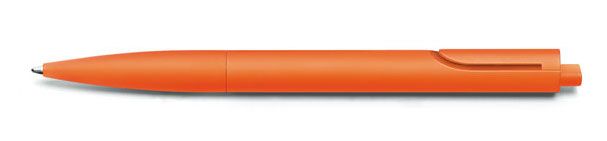
I really like the Lamy Tipo. It’s a rollerball pen, but my friend Glenn Craig figured out that you can use a Pilot G2 Gel refill in the pen, so I thought I would improve its looks.
This is what an orange Lamy Tipo looks like, but I took the orange one, and cross-pollinated it in Photoshop with the one with the aluminum section, or hand grip, and got this one
. It might also look good with a gold-filled, or gold-color anodized aluminum cone tip and clip. But then it might not be a cheap pen anymore. I asked whether someone knew how to photoshop the silver color into a 10K-gold color, and Steve K. on Pentrace obliged with this one. “Is this what you had in mind for gold trim?”, he wrote. “Way to go!”, I wrote, “That looks great”. The Lamy Noto, alas not a stylograph, but a ballpoint, also looks good in orange except it shouldn’t be triangular (there is no way to photoshop that out), which causes it to go out-of-alignment, lopsided, and uneven at the joint, either with normal use, or with over-tightening. It will cause it to go, not out of round, but out of triangular!
Now, if that’s what a Lamy Tipo usually looks like, then how about a Lamy Tipo Duofold, or rather, the Lamy Tipofold in the above picture? It makes for a nice orange writing stick. Now, if someone out there can Photoshop this image and turn it into an all-orange Lamy Tipo, then it would be a Lamy Tipo Cardinal. Again Steve K. responded with this one. And I posted this one, based upon this Parker Duofold RHR pencil, and this Waterman’s Cardinal pencil.
“More please!”, Rena on Pentrace pleaded. And Steve K. offered up this pencil, and this pen. And if it had two narrow bands instead of one, it would be like a Waterman’s #7 pencil in Cardinal red, or a Gel ballpen in Cardinal red.
The nice thing about the Pilot G2 gel refill is that it writes almost like a fountain pen, and now the Lamy Tipo is my favorite doodlestick. It’s the only reason that I even bother with a ball pen. It writes like a dream. I prefer the 0.5mm refill, which is great for making interlinial interlineal analogue corrections. There! I just made an intralineal digital correction.
P.S. The Pilot “Juice” gel pen also uses the G2 refill, but with an extended range of 36 ink colors! And you might also be interested in this blog post with a pic of the full range of Lamy pen colors. If they can make it in all-gray, no black at all, then they can make it in all-orange, or all-flame.
George Kovalenko.
.