collection1b

collection1b

January 11, 2015

The Snorkel Precursors


, some more obscure pens.


Part 2
[Posted on L&P on Aug 6, 2006, and cross-posted to Pentrace.]
        So who was the first to come up with a snorkel filler?  Sheaffer was the first to call it such, but was it first to come up with the tube-filler idea, or the “Don’t get your nib dirty with ink” idea?  Well, take a look at US patent no. 1,548,502, the first snorkel-type filler, or rather a precursor to the Sheaffer Snorkel Filler.  The patent specification reads in part, “One of the objects…is to provide…a self-filler having the peculiarity or characteristic of filling…itself without requiring a dipping of the pen proper [nib] into the ink.  Another object is to provide a filling channel independently of the supplying channel for the [nib]”.  The snorkel is called a “filling tube” in this patent, but it’s definitely a snorkel, even before Sheaffer’s snorkel.  The only original thing that the Sheaffer Pen Co. contributed to the snorkel filler was the name.  If you don’t know your own history, you’re doomed to repeat it, or maybe they did know it, and stole the idea.


        And then there’s US patent no. 2,603,189, another Snorkel precursor in which the snorkel is called a “filler needle”.  It was issued on July 15, 1952, then re-issued as US patent no. RE23,683, on July 7, 1953 and assigned to the W. A. Sheaffer Pen Co., to buy out the competition in the business.  Check out the interesting replacement of all uses of the word “pen” in the patent by the word “nib” in the re-issue.  And then there’s the snorkel piston filler that Herbert Anders created for Wahl-Eversharp and that Len Provisor found, and that Fultz wrote about in Pen World, and which may never have been patented.  And then there’s the snorkel-like vanishing point that William E. L. Bunn created for Sheaffer, and which may never have been patented. Len Provisor posted on Pentrace that Sam Fiorella found the 1959 industrial drawings for the pen, and wrote about it in The Pennant, Winter 2004.  Len noted that the Pilot Capless Vanishing Point pen was not introduced until 1963, and that this Sheaffer pen was a cartridge filler and did not have a working snorkel feature.  The nib slid in and out like a snorkel tube, and was shaped like a snorkel.  Now, that’s about as close as you’ll get to actually writing with a snorkel tube!  The snorkel story isn’t over yet.
        My interest in pen patents peters out somewhere in the mid-1950s, and I couldn’t find any
US patents that were issued to William Bunn.  The only items I have been able to find issued to Bunn are US design patents, about 14 of them, all assigned to Sheaffer, including the one for the PFM, D188,267.  I’ll leave it for someone else to try to find the patent, if it can be found at all.  So the above pen may be another of those unpatented, or unpatentable projects, perhaps because Sheaffer considered it too futuristic, or too complicated and expensive to put into production.  Or perhaps, because the pen conflicted with the US patents for the Capless and the Vanishing Point.  Here are a few of them, 3,203,403, 3,292,593, 3,399,946, 3,427,112, and 4,560,298.

George Kovalenko.

.
 

January 07, 2015

The Snorkel Vanishing Point


, and the Parker 51 and 61 snorkel fillers, and some other obscure pens.


Part 1
[Posted on L&P on Jan 22, 2006.]
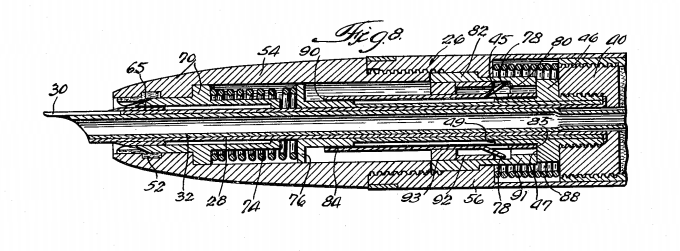
        The Snorkel pen is about as close as Sheaffer got to producing a vanishing point, or did it?  Maybe it got closer than that.  Did you ever wonder whether you could write with the snorkel part of a Sheaffer Snorkel pen?  Now, come on, admit it.  Okay then, you don’t have to speak up, but how about this?  Did you ever actually try writing with the snorkel?  No?  Well, I did, once. It didn’t work very well.  Very scratchy, and very blobby.  Well, there is a Sheaffer patent for a fountain pen with a vanishing nib, and that’s about as close as you’ll ever get to writing with the snorkel itself.  It’s US patent no. 2,949,887, and it’s a shame it was never put into production.  Has anyone ever seen one?  The nib is tubular, sort of like a Parker 51 nib, and the snorkel is a concentric tube that fits snuggly inside the nib, just barely sliding within this outer shell, and it acts like the feed for the nib.  Both tubes slide out of the shroud together just enough to expose the nib for writing, but not for filling the pen.  The snorkel slides out further separately for filling.  The images for this patent are gorgeous and highly detailed.  This one’s especially for all the Sheaffer collectors and the vanishing point enthusiasts out there.


        Who would have thunk it?  A Capless Sheaffer Snorkel Vanishing Point!  It’s about as crazy as the Parker 51 frankenpen with a snorkel filler that’s illustrated in US patent no. 2,799,247.  It’s actually demonstrated being filled from a Sheaffer “Top Well” ink bottle!  I can’t claim finding this one.  Tim Barker found it and pointed it out quite a few years ago, on Apr 8, 2003, to be precise, on the Zoss List.  This one’s especially for all the Parker and Sheaffer collectors out there.
        And here’s another hybrid pen, a Parker-Sheaffer pen that was never put into production, a capillary filler with a snorkel, or a snorkel filler that fills by capillary action, US patent no. 2,784,699.  You would have dipped the snorkel and waited for it to fill itself.  It’s a Parker “61” and Sheaffer “Snorkel” frankenpen!  Also check out US patent no. 2,774,332 for a Parker “61” capillary filler, but with the capillary material extending right under the nib to become the feed.  It was meant to be filled at the nib end, although it could be filled at the rear end as well, but only “after the sections of the body have been separated and the rear section removed”.  These are for all the Parker and Sheaffer hybrid collectors out there.
 
George Kovalenko.

.
 

January 04, 2015

The Waterman’s Vacuum Filler


, or pump, or piston filler, another obscure Waterman’s pen.


[Posted on L&P on July 24 2006.]
        Do you remember the Waterman’s Plunger Filler?  Well, here’s another obscure one for all the Waterman’s collectors out there, a Waterman’s button-activated vacuum filler.  But first, let me repeat a slightly revised version of the preamble from my previous post.
        Did Waterman ever produce a piston, or plunger, or pump filler in the 1930s?  And how about a button-vac filler?  Well, Parker had its Vac with its diaphragm filler, so Waterman’s had to have its Ink-Vue with a diaphragm, even though theirs was lever-driven rather than plunger-rod activated.  So why didn’t Waterman have a vac filler as well?  Sheaffer and Pelikan had some very competitive piston fillers.  So why didn’t Waterman’s have a piston, or plunger, or pump filler?  And if Waterman did have pump fillers, or vac fillers under development in the 1930s, but never put the pens into production, then how do you look for them?  How can you look for them, when you don’t know that they ever existed?  And how can you look for 1930s patents when the word “pen” isn’t used in the title of one of them?  Well, the answer is you can’t, unless you stumble upon them, and even then, they’re only the patents for the pens, not the actual pens.
        Well, here’s another obscure Waterman’s pen, the Waterman’s button-activated vacuum filler in their US patent no. 2,139,084, also unproduced as far as I know.  Has anyone ever seen one of these?  Again David Nishimura said that he couldn’t say he had ever seen an actual example of this one, but he also mentioned that the patent cited the file number for a patent application for the barrel plug that might be the one that Waterman used in their late Ink-Vue filler with the one-piece barrel
that’s HELL to fix!  The file number, as it turns out, is the one for patent no. 2,087,672, the standard Waterman’s “Ink-Vue” lever-actuated bulb-vacuum filler.  But the later version with the one-piece barrel is patent no. 2,217,755, the goofy, late, one-piece Ink-Vue barrel.
        And here’s an interesting piece of Canadian “Ink-Vue” ephemera, a pen that was sent back from the Waterman’s repair department in Montreal as unfixable due to a lack of repair parts.


George Kovalenko.

.

 

January 01, 2015

The Waterman’s Plunger Filler

 
, or pump, or piston filler, another obscure Waterman’s pen.


[Posted on L&P on Jan 17, 2006.]
        Did Waterman ever produce a plunger filler in the 1930s?  Well, Parker had its Vac with its diaphragm filler, so Waterman had to have its Ink-Vue with a diaphragm, even though theirs was lever-driven rather than using a plunger rod.  So why didn’t Waterman have a piston, or pump, or plunger filler as well?  And if Waterman did have a plunger filler under development in the 1930s, but never put the pen into production, then how do you look for it?  How can you look for one, when you don’t know whether one ever existed?  And how can you look for a 1930s patent when the word “pen” isn’t used in the title of the patent?
        Well, the answer is you can’t, unless you stumble upon the patent for it, and then it’s only the patent for one, not an actual pen.  US patent no. 1,967,580 is for a pump filler that was assigned to the L. E. Waterman Co. in 1934.  The piston rod, or plunger had to be pumped several times to fill the pen.  Gabriel Larsen held at least 25 pen patents and designs including this one, all assigned to Waterman, but this one was, as far as I know, another obscure Waterman’s pen that was never produced.  David Nishimura also wrote that he had never seen an actual example.  Has anyone else ever seen one?  I found the patent while looking up patent no. 2,489,976 for another pump- piston filler that cited the Larsen patent in its list of references at the end of the specifications.

George Kovalenko.


.
 

December 31, 2014

Arrow Trademark Pointers


[Posted on L&P on May 1, 2010, July 7, 2010, and Aug 13, 2010.]
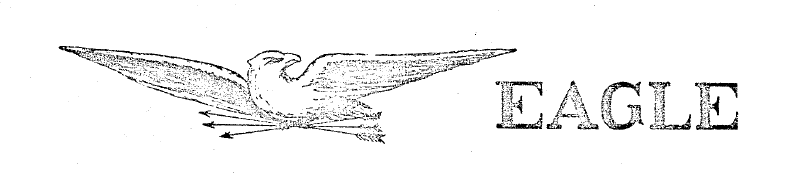
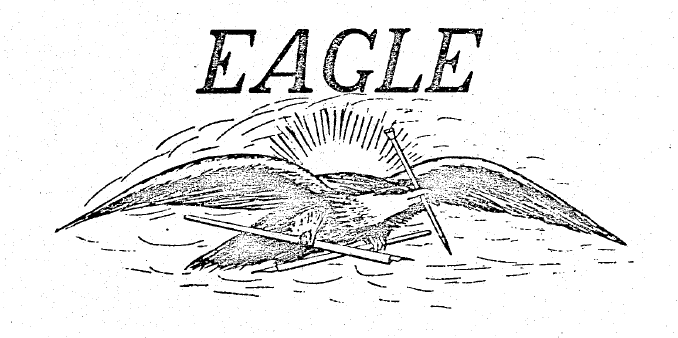
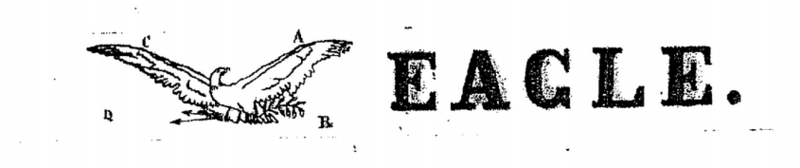
        Almost all of the Eagle Pencil Co. trademarks include these tantalizing little images of eagles with outstretched wings, and holding
spears or arrows in their beaks or talons, and other pointy sticks such as pencils and penholdersSome of the images show the eagle holding spears on one side and an olive branch on the other, perhaps their version of the pencil being mightier than the sword.  The Eagle Pencil Co. seems to be implying that, when writing with their pens and pencils, you will shake spears with your written words. But here are a few slightly different pointed marks.
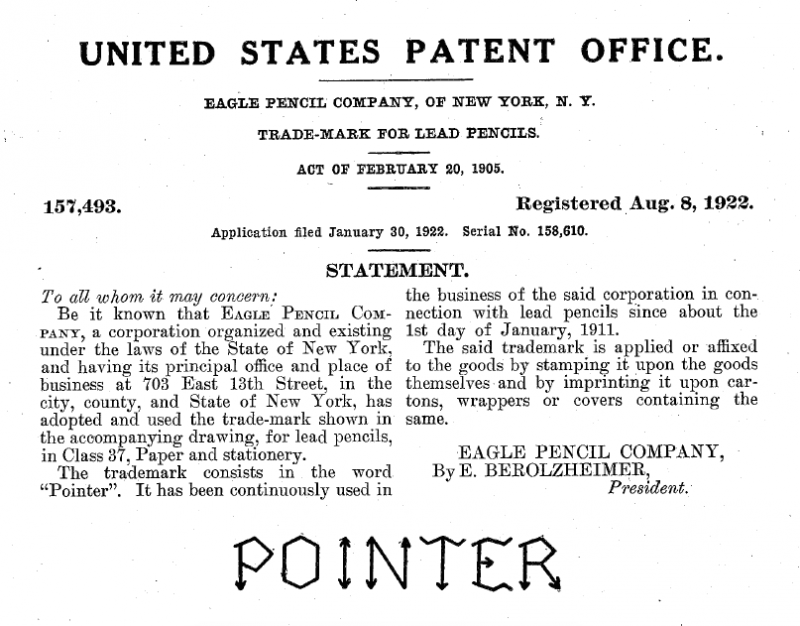
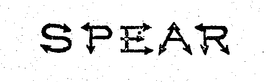
        US trademark no. 71,047 from 1908, but said to be used since 1890, is for the word “Spear”, but with the letters constructed of little spearheads, or arrowheads, so that the letters look like they have little arrowhead-shaped serifs.  And US trademark no. 157,493 from 1922, is for the word “Pointer”, but with the letters a little more crudely formed, and the serifs shaped like simply drawn arrows.  Also let me also point you to US trademark no. 69,248 from 1908, but used since 1882, for the word “Arrow” along with a stylized picture of an arrow.
        The long-standing tradition of the use of figurative arrows in pen trademarks and designs continues with these two feather designs, US no. D88,821 from 1932 for the Parker “Vacumatic” pen and pencil arrow clip, and US no. D93,444 from 1934 for the “Quill Feather” pen and pencil arrow clip assigned to the Spencerian Pen Co.  US trademark no.
323,266 by A. W. Faber for “Rubber Erasers” from 1935, but used since 1924, is for the word “Arrowhead” for wooden-pencil erasers shaped like, you guessed it, arrowheads.  US trademark no. 419,077 from 1946, but used since 1932, is for the Parker Pen Co. symbol of an arrow.  It was registered by Kenneth S. Parker, but Ivan D. Tefft was appointed as attorney “to prosecute this application for registration”.  US trademark no. 628,281 by Parker from 1956 is for the name “Golden Arrow”, and US trademark no. 628,282 is for the name “Silver Arrow”.  US trademark no. 659,068 by Parker from 1958 is for a heraldic crest, or shield with two quills, an arrow, and the letter “P”, for Parker.  US trademark no. 774,545 by Parker from 1964, but used since 1955, is for the word “Arrow”.  US trademark no. 779,075 by Parker from 1964, but used since 1958, is for an earlier version of the familiar Parker arrow-and-oval symbol.  US trademark no. 904,691 by Parker from 1970, but used since 1965, is for another version of the Parker arrow-and-oval symbol.  US trademark no. 1,178,088 by Parker from 1981, but used since 1932, is for an arrow-shaped clip illustrated on the short, Minim-sized Jotter ballpoint in US trademark no. 811,716.  US trademark no. 1,301,611 by Parker from 1984, used since 1955, is for a clip that preceded, but which later became the tasteful, early “Centennial Duofold” arrow clip, also shown in US design no. D330,217, in Figs. 3 and 4 in the illustrations.  The later “Centennial Duofold” arrow clip was redesigned in a bulbous, bloated, garish, and ungainly version of the clip, designed for a more crass buying public interested only in limited editions and pens as investments.  They are more interested in being seen carrying a fountain 
pen than actually using a fountain pen.  But life is too short to write with an ugly pen.


George Kovalenko.

. 


December 28, 2014

Jewelry Trademarks 1922


, and 1904.


        Here is the 1922 volume of the Trademarks of the Jewelry and Kindred Trades, the hardest volume to find.  I was just looking through the statistics for my blog, and I found a curious “Referring URL” in the “Traffic Sources” in my “Blogger Dashboard”.  The URL was for the Hathi Trust, which I use a lot for making references to specific issues of stationery magazines.  I prefer the Hathi Trust online references, which are universally clickable, to the Google Books online references, which are clickable only within the US.  Well, as I was looking through the list of featured databases in the above Hathi reference, I stumbled upon this one, the complete volume of the 1922 jewelry trademarks.

http://babel.hathitrust.org/cgi/pt?id=hvd.hb9jsx;view=1up;seq=1

As well, here’s a short version of the 1922 marks from the “Chicago Silver” website.  [Thanks to Cheryl Bynum, a jewelry collector, for the link.]

http://chicagosilver.com/jmarks1.htm

        The original volume of the long version is from the Harvard University library, and it is downloadable only by logging in with a partner institution, but you can always view it online, anytime.  Alternatively, Hathi allows downloading of PDFs of individual pages one at a time, and the website facilitates easy online citations of the whole volume, or individual pages.  Here’s the first page of the pen section within the context of the whole volume.

http://babel.hathitrust.org/cgi/pt?id=hvd.hb9jsx;view=1up;seq=314

And here’s the individual image of page 288, or pageview 316.

http://babel.hathitrust.org/cgi/imgsrv/image?id=hvd.hb9jsx;seq=316;width=1250


The fountain pen and mechanical pencil company section begins on page 286 of the hardcopy and goes to page 295, but the online version in Hathi goes from pageview 314 to pageview 323.
        There were various editions published in 1896, 1904, 1915, 1922, 1943, and 1950.  Cheryl tells me there is also a 1909 supplement to the 1904 edition.  The PDFs of the 1904 edition can be found online at the following two links.  The pen and pencil section starts near the beginning of the second part, on hardcopy page 142, and pageview 13.

http://www.ipmall.info/hosted_resources/ip_antique_library/Trademark/Jewelers_1904_a.pdf
http://www.ipmall.info/hosted_resources/ip_antique_library/Trademark/Jewelers_1904_b.pdf


        Paolo Demuro, a pen collector in Italy, also sent me these alternate links to the 1904 trademarks.  –July 2, 2017.

https://ipmall.law.unh.edu/sites/default/files/hosted_resources/ip_antique_library/Trademark/Jewelers_1904_a.pdf
https://ipmall.law.unh.edu/sites/default/files/hosted_resources/ip_antique_library/Trademark/Jewelers_1904_b.pdf

        Does anyone know of any other online editions for the other years?

   George Kovalenko.

.
 

December 20, 2014

A. A. Waterman obituary


         In my Waterman’s v. Waterman” blogpost below, I mentioned that in the genealogical history of The Waterman Family, by Edgar F. Waterman & Donald L. Jacobus, there is a listing for Arthur A. Waterman in vol. 2, pp. 82-84.  At the end of the entry there is a citation for the source of the information.  The obituary is said to be in the Mar 13, 1939, issue of The New York Times, with no page number given, but it’s actually from Mar 12, 1939, on p. 61.  I found the obituary at my local university library in “ProQuest Historical Newspapers: The New York Times (1851-2010)”.  The Waterman book also cites a “news item” in the May 4, 1939 issue, but I can’t find that reference at all.  Given that the other date was incorrectly cited, perhaps this one might have been incorrectly cited as well.  The genealogical listing in the book follows the obituary quite closely.  Here it is.
 

“ARTHUR WATERMAN DIES IN BROOKLYN”

Retired Inventor of ‘Middle
  Joint’ Fountain Pen, Rival
    of L. E. Waterman Co.
————————
 
FIRMS’ HEADS UNRELATED
————————
 
Manufacturer, 79, First Head
  of Harvard Cooperative
    Society in 1880s

       
Arthur A. Waterman of 37-46 Seventy-sixth Street, Jackson Heights, Queens, a retired fountain pen manufacturer, died yesterday in the Kings County Hospital, Brooklyn, of uremic poisoning after an illness of two years.  He was born seventy-nine years ago at Arcadi, near Troy, N.Y.
       
After attending Harvard College, where he was a member of the class of ’85 and was the first superintendent of the Harvard Cooperative Society, Mr. Waterman established his home in this city.  He was the first inventor and manufacturer of a “middle joint” fountain pen.
       
For some years he manufactured pens here under the name of the A. A. Waterman Fountain Pen Company, with headquarters at 22 Thames Street, later moving to Chicago, where he carried on the business until his retirement about twenty years ago [my rubrication and italic emphasis].
       
At one time his company was engaged in litigation with the L. E. Waterman Company, rival manufacturers of fountain pens, as a result of the similarity in name.  The fact that two unrelated Watermans were making fountain pens at the same time was said last night by a member of Mr. Waterman’s family to have been purely a coincidence.
       
Surviving are his widow, the former Emma Fuller; a son, John F. Waterman, and two daughters, both high school teachers, the Misses Dorothy W. and Emma F. Waterman, all of New York.

        So, as “more recent research has shown”, he was only ostensibly forced out of his own pen company in 1905, but instead carried on until his retirement around 1919-20.

George Kovalenko.

.

 
Addendum, Apr 9, 2019.
        Thanks to Robert Ramish who sent me some of his memories of the three A. A. Waterman children.  As a young boy in the early 1970s, he knew John, Emma, and Dorothy Waterman.  They where in their seventies and early eighties, all school teachers who never married, and they lived together, until their deaths, in the
Gibson Apartment House in Flushing, N.Y.  The Waterman’s were fluent in German, and Emma was determined to teach it to Robert.  There was probably some German in the Waterman family line.  However, Latin and Greek were still prerequisites in the higher-educated, academic world of that era, and German and other foreign languages were required in philosophical studies.  All three had a very strong intellect, and were ardent readers.  They were the finest people you could ever imagine.  When John died, his bedroom was filled with his WWI uniforms and regalia.  The sisters eventually sold off the contents of his room, and Robert bought his pocket watch, which still runs perfectly.  He also has a number of other items that they sold him, but it’s the stories they told him that he holds most dear to his heart.
        There was a collection of their father’s pens, but for the most part, they held onto it.  They did sell Robert some of it, wrapped in a leather case, but those are
now long gone.  He does not recall any other items such as advertising pieces or paper ephemera from the A. A. Waterman company.  When Emma and Dorothy, mostly Emma, did speak of their “Father”, it was always with an over abundance of love and admiration.  They were so Victorian in sensibility, so sweet and gentle.  Now, Robert often thinks back on that generation from the Gibson, and the older he gets, the more he sees them all in himself in many respects, and misses them all.  Flushing, N.Y., was a remarkable place in its day, its prominent families, its horticulture, and its architecture.   Sadly, all that is now gone, only the Bowne house, the Quaker meeting house, and the Kingsland house are left.  Eventually, everything in the apartment was sold to a local antique dealer back around 1975.  Everything is all long gone by now, surviving somewhere in private pen collections perhaps, not in any museum or archive.

.

December 14, 2014

System, the magazine of business


        Here’s System, another early stationer’s magazine from Hathi Trust, an almost complete run from Volume 1, 1901, to Volume 42, 1922.  There aren’t as many fountain pen and mechanical pencil ads as there are in some other stationers’ magazines, but they are there.  The magazine deals mostly with systematization methods and organizational tools for the business man, mostly forms and statistics and ledgers and graphs and filing cabinets and index cards.  Oh yeah, they love their little index cards.

v. 1 (1901) http://babel.hathitrust.org/cgi/pt?id=coo.31924106098514;view=1up;seq=1
v. 2 (1902) http://babel.hathitrust.org/cgi/pt?id=uc1.b2896761;view=1up;seq=1
v. 3 (1903a) http://babel.hathitrust.org/cgi/pt?id=umn.319510028049417;view=1up;seq=1
v. 4 (1903b) http://babel.hathitrust.org/cgi/pt?id=uc1.b2896763;view=1up;seq=1
v. 5 (1904a) http://babel.hathitrust.org/cgi/pt?id=uc1.b2896764;view=1up;seq=1
v. 6 (1904b) http://babel.hathitrust.org/cgi/pt?id=uc1.b2896765;view=1up;seq=1
v. 7 (1905a) http://babel.hathitrust.org/cgi/pt?id=uc1.b2896766;view=1up;seq=1
v. 8 (1905b) http://babel.hathitrust.org/cgi/pt?id=uc1.b2896767;view=1up;seq=1
v. 9 (1906a) http://babel.hathitrust.org/cgi/pt?id=uc1.b2896768;view=1up;seq=1
v. 10 (1906b) http://babel.hathitrust.org/cgi/pt?id=uc1.b2896769;view=1up;seq=1
v. 11 (1907a) http://babel.hathitrust.org/cgi/pt?id=uc1.b2896770;view=1up;seq=1
v. 12 (1907b) http://babel.hathitrust.org/cgi/pt?id=uc1.b2896771;view=1up;seq=1
v. 13 (1908a) http://babel.hathitrust.org/cgi/pt?id=uc1.b2896772;view=1up;seq=1
v. 14 (1908b) http://babel.hathitrust.org/cgi/pt?id=uc1.b2896773;view=1up;seq=1
v. 15 (1909a) http://babel.hathitrust.org/cgi/pt?id=uc1.b2896774;view=1up;seq=1
v. 16 (1909b) http://babel.hathitrust.org/cgi/pt?id=uc1.b2896775;view=1up;seq=1
v. 17 (1910a) http://babel.hathitrust.org/cgi/pt?id=uc1.b2896777;view=1up;seq=1
v. 18 (1910b) http://babel.hathitrust.org/cgi/pt?id=uc1.b2896778;view=1up;seq=1
v. 19 (1911a) http://babel.hathitrust.org/cgi/pt?id=uc1.b2896776;view=1up;seq=1
v. 20 (1911b) http://babel.hathitrust.org/cgi/pt?id=uc1.b2896779;view=1up;seq=1
v. 21 (1912a) http://babel.hathitrust.org/cgi/pt?id=uc1.b2896780;view=1up;seq=1
v. 22 (1912b) http://babel.hathitrust.org/cgi/pt?id=uc1.b2896781;view=1up;seq=1
v. 23 (1913a) http://babel.hathitrust.org/cgi/pt?id=uc1.b2896782;view=1up;seq=1
v. 24 (1913b) http://babel.hathitrust.org/cgi/pt?id=uc1.b2896783;view=1up;seq=1
v. 25 (1914a) http://babel.hathitrust.org/cgi/pt?id=uc1.b2896784;view=1up;seq=1
v. 26 (1914b) http://babel.hathitrust.org/cgi/pt?id=uc1.b2896785;view=1up;seq=1
v. 27 (1915a) http://babel.hathitrust.org/cgi/pt?id=uc1.b2896786;view=1up;seq=1
v. 28 (1915b) http://babel.hathitrust.org/cgi/pt?id=uc1.c2555790;view=1up;seq=1
v. 29 (1916a) http://babel.hathitrust.org/cgi/pt?id=uc1.c2555791;view=1up;seq=1
v. 30 (1916b) http://babel.hathitrust.org/cgi/pt?id=uc1.c2557300;view=1up;seq=1
v. 31 (1917a) http://babel.hathitrust.org/cgi/pt?id=uc1.c2557301;view=1up;seq=1
v. 32 (1917b) http://babel.hathitrust.org/cgi/pt?id=uc1.c2557302;view=1up;seq=1
v. 33 (1918a) http://babel.hathitrust.org/cgi/pt?id=uc1.c2557303;view=1up;seq=1
v. 34 (1918b) http://babel.hathitrust.org/cgi/pt?id=uc1.c2557304;view=1up;seq=1
v. 35 (1919a) http://babel.hathitrust.org/cgi/pt?id=uc1.c2557305;view=1up;seq=1
v. 36 (1919b) http://babel.hathitrust.org/cgi/pt?id=uc1.c2557306;view=1up;seq=1
v. 37 (1920a) http://babel.hathitrust.org/cgi/pt?id=uc1.c2557307;view=1up;seq=1
v. 38 (1920b) http://babel.hathitrust.org/cgi/pt?id=uc1.c2557308;view=1up;seq=1
v. 39 (1921a) http://babel.hathitrust.org/cgi/pt?id=uc1.c2557309;view=1up;seq=1
v. 40 (1921b) http://babel.hathitrust.org/cgi/pt?id=uc1.c2557310;view=1up;seq=1
v. 41 (1922a) http://babel.hathitrust.org/cgi/pt?id=uc1.c2557311;view=1up;seq=1
v. 42 (1922b) http://babel.hathitrust.org/cgi/pt?id=uc1.c2557312;view=1up;seq=1
 

        The shame is that the online issues stop in 1922, just before the Duofold era, and there are some real badass Duofold ads coming, if they ever release the rest of the issues.  I know there are some unique, and heretofore unseen and unknown ads because I’ve seen hardcopies of some of them.  But even though the links for these later volumes are supplied by Hathi Trust, they are not available online.  If you click on these links, you get the message, “This item is not available online (Limited search only) due to copyright restrictions”, and if you perform a word search, say for the word “Duofold”, you get the message, “Full view is not available for this item due to copyright © restrictions”.  But maybe someday, soon, . . .

v. 43 (1923a) http://babel.hathitrust.org/cgi/pt?id=mdp.39015010780768
v. 44 (1923b) http://babel.hathitrust.org/cgi/pt?id=mdp.39015010781410
v. 45 (1924a) http://babel.hathitrust.org/cgi/pt?id=mdp.39015010781402
v. 46 (1924b) http://babel.hathitrust.org/cgi/pt?id=mdp.39015010781329
v. 47 (1925a) http://babel.hathitrust.org/cgi/pt?id=mdp.39015010781394
v. 48 (1925b) http://babel.hathitrust.org/cgi/pt?id=mdp.39015010781436
v. 49 (1926a) http://babel.hathitrust.org/cgi/pt?id=mdp.39015010781428
v. 50 (1926b) http://babel.hathitrust.org/cgi/pt?id=mdp.39015010781238
v. 51 (1927a) http://babel.hathitrust.org/cgi/pt?id=mdp.39015010781352
v. 52 (1927b) http://babel.hathitrust.org/cgi/pt?id=mdp.39015010781279
v. 53 (1928a) http://babel.hathitrust.org/cgi/pt?id=mdp.39015010781246
v. 54 (1928b) http://babel.hathitrust.org/cgi/pt?id=mdp.39015010781444
v. 55 (1929a) http://babel.hathitrust.org/cgi/pt?id=mdp.39015010781527
v. 56 (1929b) http://babel.hathitrust.org/cgi/pt?id=mdp.39015010781535

George Kovalenko.

.
 

[Addendum, Jan 7, 2015.
Some of the volumes above have had their advertisements stripped out of them when they were bound, but here are some substitute volumes from another university library offered by Hathi as alternates.]

v. 4 (1903b) http://babel.hathitrust.org/cgi/pt?id=coo.31924106098555;view=1up;seq=1
v. 5 (1904a) http://babel.hathitrust.org/cgi/pt?id=coo.31924106098654;view=1up;seq=1
v. 6 (1904b) http://babel.hathitrust.org/cgi/pt?id=coo.31924106098605;view=1up;seq=1
v. 7 (1905a) http://babel.hathitrust.org/cgi/pt?id=coo.31924106098662;view=1up;seq=1
v. 8 (1905b) http://babel.hathitrust.org/cgi/pt?id=coo.31924106098670;view=1up;seq=1
v. 9 (1906a) http://babel.hathitrust.org/cgi/pt?id=coo.31924106098688;view=1up;seq=1
v. 10 (1906b) http://babel.hathitrust.org/cgi/pt?id=coo.31924106098696;view=1up;seq=1
v. 11 (1907a) http://babel.hathitrust.org/cgi/pt?id=coo.31924106098613;view=1up;seq=1
v. 12 (1907b) http://babel.hathitrust.org/cgi/pt?id=coo.31924106098639;view=1up;seq=1
v. 13 (1908a) http://babel.hathitrust.org/cgi/pt?id=coo.31924106098647;view=1up;seq=1
v. 14 (1908b) http://babel.hathitrust.org/cgi/pt?id=coo.31924106098621;view=1up;seq=1
v. 15 (1909a) http://babel.hathitrust.org/cgi/pt?id=coo.31924106098563;view=1up;seq=1
v. 16 (1909b) http://babel.hathitrust.org/cgi/pt?id=coo.31924106098597;view=1up;seq=1
v. 17 (1910a) http://babel.hathitrust.org/cgi/pt?id=coo.31924106098571;view=1up;seq=1
v. 18 (1910b) http://babel.hathitrust.org/cgi/pt?id=coo.31924106098589;view=1up;seq=1
v. 19 (1911a) http://babel.hathitrust.org/cgi/pt?id=coo.31924106095940;view=1up;seq=1
v. 20 (1911b) http://babel.hathitrust.org/cgi/pt?id=coo.31924106095932;view=1up;seq=1
v. 21 (1912a) http://babel.hathitrust.org/cgi/pt?id=coo.31924106095924;view=1up;seq=1
v. 22 (1912b) http://babel.hathitrust.org/cgi/pt?id=coo.31924106095916;view=1up;seq=1
v. 23 (1913a) http://babel.hathitrust.org/cgi/pt?id=coo.31924106095908;view=1up;seq=1
v. 24 (1913b) http://babel.hathitrust.org/cgi/pt?id=coo.31924106095957;view=1up;seq=1
v. 25 (1914a) http://babel.hathitrust.org/cgi/pt?id=coo.31924106095965;view=1up;seq=1
v. 26 (1914b) http://babel.hathitrust.org/cgi/pt?id=coo.31924106095973;view=1up;seq=1
v. 27 (1915a) http://babel.hathitrust.org/cgi/pt?id=coo.31924106095981;view=1up;seq=1


December 11, 2014

The Waterman’s globe-shaped Santa


[First posted on L&P on Dec 21, 2011.]
      I’m not a Christmas person, so I’m going to post this Santa image one last time.  I follow the solstices and equinoxes, and the hibernal solstice is a good marker for the beginning of the year, so at most I will say Happy Yuletide to everyone with this b&w ad, which was
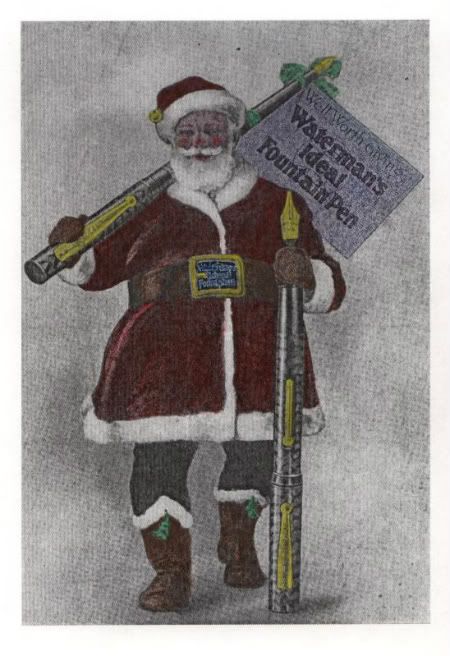
colorized by moi, yours truly.  I thought I also found a use of the word “fountpen” by a pen company other than Mabie Todd Co., in the imprint on the buckle holding the belt around Santa’s fat girth society.  I thought it read “Waterman’s Ideal Fountpen”, shortened because there wasn’t enough room for the full word, but the full word “Fountain Pen” is there, just like in the big sign over his shoulder.
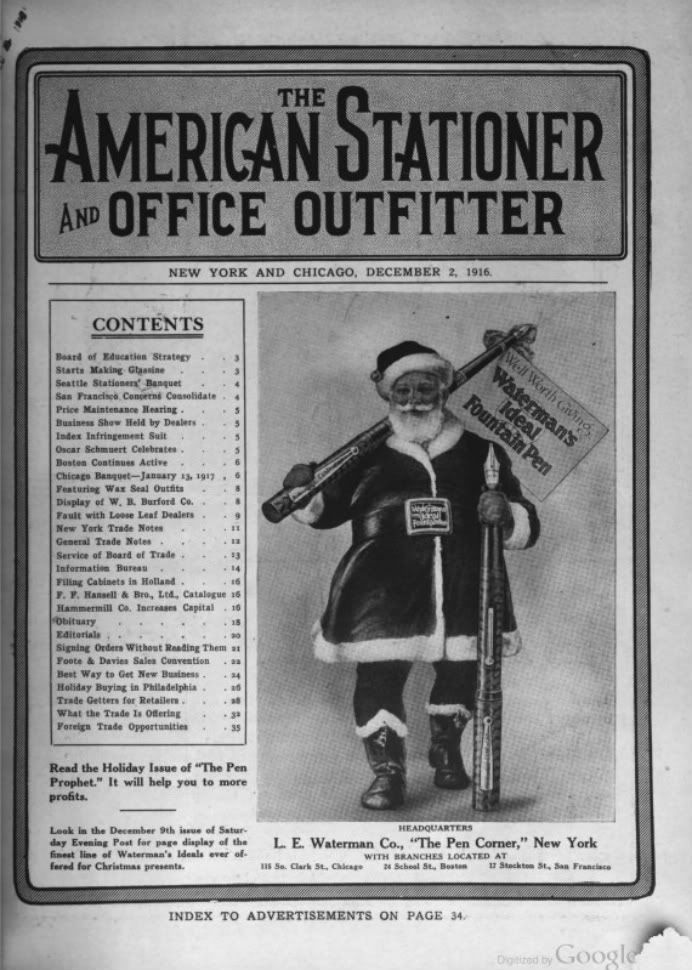
      Here’s the original Waterman’s ad on the cover of The American Stationer.  This image was first used 99 years ago in the cover ad on Dec 18, 1915, p.1, but I used the version from a year later, Dec 2, 1916, p.1, because the digitization was cleaner.  Also, there is an illustrated article in the earlier issue, on p.5, in which the globe-shaped model for the rotund and orotund Santa is identified as Charles N. Bellman, the then-current president of the National Assoc. of Stationers.
      And here’s a
color version of this ad image used as part of a Waterman’s brochure, which I found on Luiz Leite’s blog, and where it is said to be from 1919.  But all the pens they hold in their left hands have cap bands, and some of the pens are Ripples, and all the Santas are holding pencils over their right shoulders, all of which place it after 1923.  The earlier version of the ad came from an era when the colors in Santa’s costume could still have been the non-standard, or unusual colors, but by the time of the later brochure, the colors had been standardized to what is commonly thought to be the corporate Coca-Cola red-and-white color scheme, which Coca-Cola merely popularized with its Santa ads.

George Kovalenko.

.
 

December 07, 2014

The ‘Peter Pen’ Episode


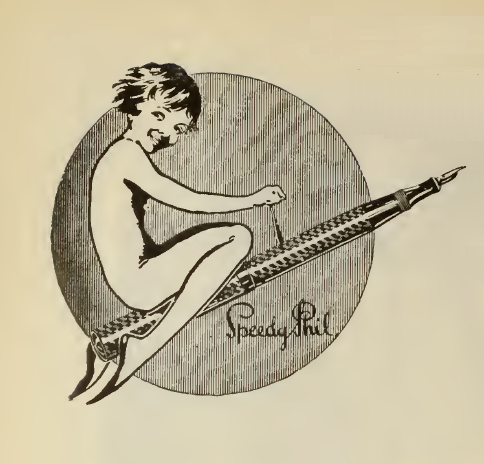
      [No, this is not about the cartoon figure that was featured in the early Onoto pen ads.  And it’s not about “Speedy Phil”, Conway Stewart’s answer to Onoto’s “Peter Pen”.  This short segment of a chapter is from the slim French novel Racines de sable (2000) by Monique Genuist, pp.32-36.  The book is an autobiographical novel about a house named Sandrine in which the author lived, here in my city.  The novel is narrated by the house, which literally has “roots of sand”, and it calls the author Janine, and tells the story of all the people who lived and all the things that happened within the house.  All the characters are living people who have been tuckerized and fictionalized.  And writing a calligraphic line is like riding a tightrope, or flying like Peter Pan on Flying-by-Foy theatrical line sets, in order to let you “jump on the wind’s back and then away you go”.  I call it
the Peter Pen high-wire episode.]

      . . . Against the apple tree where balloons are floating, the international sign of a garage sale, a young man sets his bicycle.  Janine recognizes him.  Whatever the weather, he sports a grey felt hat firmly posted for cycling, a black leather jacket, a little timeworn at the seams, and jeans with a narrow leg of the same color.  When it gets really cold, he wraps a red scarf around his neck.  Tall, very thin, this bicycle funambulist [tightrope rider] seems to thrive in all kinds of weather.
      Janine doesn’t really know him.  One day, he smiled at her and she responded.  Since then, they would greet one another every time they met, she who walked, he who pedalled with long, lean legs through wind, snow, or dust storm.
      He comes towards her.  For the first time, she notices the clear blue eyes illuminating the face like the blade of a knife.  He asks her, scorchingly point‑blank:
      “Do you have any old fountain pens?  You know, pens that are filled from an ink bottle, like we used to use.”
      She thinks for a moment:
      “Yes, I think so.  I haven’t yet emptied my desk drawers.  I am sure that we have several.  Old ones that don’t work any more and which we have kept, just like that, because they are pretty.  It would have been a pity to throw them out.  Wait a minute.”
      She runs inside and brings back three.  He holds out a long slender hand and takes them with delicacy.  He removes the cap from the first one, tries the filling lever.  He lifts to her a gentle smile.
      “1930!  A Waterman in green celluloid that resembles jade, it’s magnificent.  Where did it come from?”
      “It belonged to my grandmother.”
      “How much do you want for it?”
      She sees the jeans, the jacket, the felt hat, always the same types of clothes since she met him.  But she has no intention of parting with this souvenir of her grandmother.  On the other hand, what price can one place on a keepsake?
      “I had no intention of selling it.”
      “Oh, . . . okay.”
      His smile melts away.  He examines the two others attentively.
      Those were hers, but now she prefers the Bic Stick that one doesn’t need to refill and which doesn’t leak.  With the fountain pen, she oftentimes found a way to stain herself.
      He says:
      “These are more recent, from the fifties.”
      He opens his black backpack, which he carries by a strap over one shoulder.  He takes out a handful, some Parkers, some Sheaffers, some Eversharps.  Some large, some thin, some black, some gold-filled, some marbleized to look like semi-precious stones; one speaks of onyx, coral, jade, lapis lazuli, or mother of pearl inlaid in ebony.  He touches them, fondles them, caresses them.  He explains that fountain pens existed from the tenth century, in Egypt, but that they did not start to become popular till about the 1850s, when they could be made from hard rubber.  He selects a slender one, black, gold band, and to demonstrate for Janine, he writes his name in fine letters, large and well formed on a card: Peter Engel.
      But why not “Peter Pen”, rather, she wonders, amusedly.
      He tells her he likes nibs that can form both wide downstrokes and slender sidestrokes.  Then he adds, nostalgically:
      “The ballpoint pen has killed the calligraphic quality of everyday handwriting.”
      Janine doesn’t say anything, she who writes like the illegible scrawlings of a frog
in the mud [gribouillis de grenouille].  She remembers her writing lessons in elementary school.
      She recalls how she was taught to write properly, how all the letters had to be formed between the lines in a copybook with Seyes paper, how she dreaded these classes dedicated to penmanship, how the school mistress gave her a tap on the fingers with a ruler because she would drift away during these lessons, thinking of other things such as recess, and the singing of the birds in the school yard, so much so that she had not mastered the art of calligraphy of which this young man spoke.
      “But what do you do with all these pens?”
      “I collect them, I repair them, I use them, I research them, I write about them, and I sell them when I have duplicates.”
      What does he eat, then, this fountain pen funambulist
? [funambule aux plumes-fontaine] [tightrope artist aux fountain pens] [tightrope writer] [tightrope penman] [tightrope pensmith] [fountain pen fundamentalist]!
      He gently smiles at her and asks, timidly:
      “You’re moving away, aren’t you?  That’s too bad.  How much do you want for the other two?”
      All of a sudden, she can no longer stand the softness of that smile, a little sad, nor those penetrating blue eyes that fix on her so as not to forget her
.
      She lowers her head.  She takes his long supple hand, opens it, and places the three pens in it, then gently closes his fingers over them and murmurs:
      “I give them to you, in remembrance.”
      A burst of happiness animates his thin face.  The young man carefully arranges his treasures in his black bag.  He hands her a card where he has written in well-formed letters his address below his name:
      “For when you come across some others.”
      Then he sets off again, the
fountain pen funambulist, the Don Quixote on a bicycle, face bright, “fun-again awake” in his eyes, hat tilted a little, with grandmother’s fountain pen snug in the bag slung across his shoulders, like a bandolier of mightier pens. . . .

—translated, a little freely, by George Kovalenko.

.
 

December 04, 2014

The Geocentric Universe


, a pen-trade cartoon.


Star, sun, moon, flat earth.

 It used to be that Waterman’s was the center of the universe, 
and all the other penmakers revolved around it.
It had a virtual monopoly of the trade,
and squandered it all away.
 
Next week, the fat girth society.

George Kovalenko.


.